
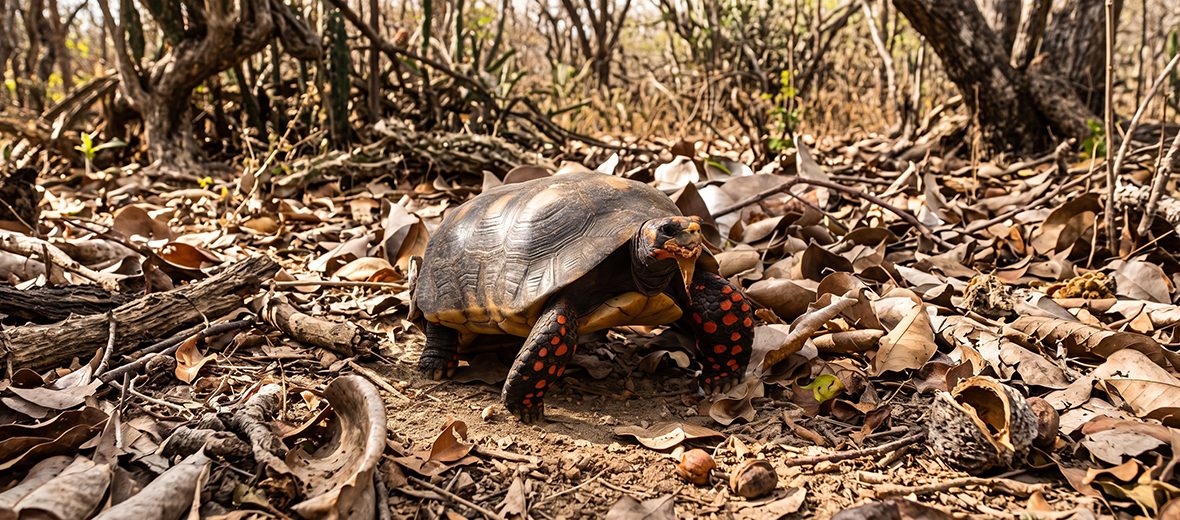
The red-footed tortoise is a medium sized tortoise that hails from Central and South America. They can be found from savannahs to forest edges around the Amazon Basin. They face the threats of overhunting and poaching. This is considered to be the single largest threat to this species. In many areas across their native South and Central American range, red-footed tortoises are considered a culinary delicacy. Thousands are legally or illegally collected for their meat and eggs. Due to their striking coloration, docile nature, and longevity, they are highly popular in domestic and international exotic pet markets. Over-collection of wild individuals to support this trade has severely depleted local populations. Individual wild-caught tortoises can fetch hundreds of dollars, fueling unsustainable poaching networks that severely deplete localized wild populations. Large swaths of their native tropical dry forests, savannahs, and grasslands (such as the Chaco forest) are actively being cleared for cattle ranching, agriculture, and timber. The drainage of wetlands for housing development, along with road construction, fragments their habitats. Roads not only divide populations but also lead to direct mortality from vehicle strikes (being hit by vehicles). Humans frequently develop land adjacent to the water bodies and forest edges where these tortoises forage and lay their eggs, destroying critical nesting grounds. Due to these threats, these tortoises are listed as Endangered by the IUCN. Their population trend is listed as decreasing as well.
First the Stats…
Scientific name: Chelonoidis carbonarius
Weight: Up to 30 lbs.
Length: Up to 20 inches
Lifespan: Up to 80 years
Now on to the Facts!
1.) A variety of plants, grasses, flowers, fruit, fungi, earthworms, red worms, and other invertebrates are all on the menu. They also eat carrion (dead animals).
2.) Seeing as they hail from equatorial regions, they do not brumate (hibernation for reptiles), however, they do aestivate (a type of hibernation-like state).
3.) Adults are preyed on by caimans, crocodiles, giant river otters, as well as large birds of prey, bush dogs, jaguars, jaguarundis, margays, certain monkeys, ocelots, pumas, and tayras.
4.) Juveniles are preyed on by tegus, coatis, rats, mongooses, snakes, crocodilians, curassows, rails, cuckoos, falcons, opossums, foxes, peccaries, and feral dogs.
5.) Biologist, zoologist, and explorer Johann Baptist von Spix first described the red-footed tortoise in 1824.
But wait, there’s more on the red-footed tortoise!
6.) They prefer heavily forested, humid environments near the transition zones between savannahs and tropical forests.
7.) There are several variants of these tortoises: northern, northwestern, northeastern, southern, and eastern.
Did you know…?
These tortoises will often eat soil if they cannot obtain enough calcium in their diet.
8.) Like many other reptiles, they seek shelter in places that offer thermoregulation and protection from predators.
9.) These tortoises go by many names, such as red-leg, red-legged, red-foot tortoise, savanna tortoise, carumbe, karumbe, which means ‘slow moving’ (Brazil, Paraguay), wayapopi, morrocoy (Venezuela, Colombia), jabuti, japuta, and jabuti-piranga (Brazil, Argentina) to name a few.
10.) Grasses, leaves, flowers, roots, shoots, fruits, fungi, ants, termites, beetles, butterflies, snails, worms, carrion (dead animals), and fox feces (poop) are all on the menu for these omnivores (eat plant and animal matter).
But wait, there’s still more on the red-footed tortoise!
11.) These tortoises can move up to 109 yards per hour when the need arises.
12.) Females produce a clutch of up to 7 eggs that hatch in up to 202 days.
13.) They are among the most popular pet tortoises the world over. They’re relatively cheap, are a handleable size, have unique personalities, and are colorful. All pet tortoises should be bought as captive-bred from a reliable breeder when possible to both help protect wild populations and to avoid internal parasites and diseases.
Now a Short Red-Footed Tortoise Video!
Be sure to share & comment below! Also, check out the Critter Science YouTube channel. Videos added regularly. Be sure to like and subscribe!

Want to suggest a critter for me to write about? Let me know here.
Some source material acquired from: Wikipedia & IUCN


Leave a Reply