
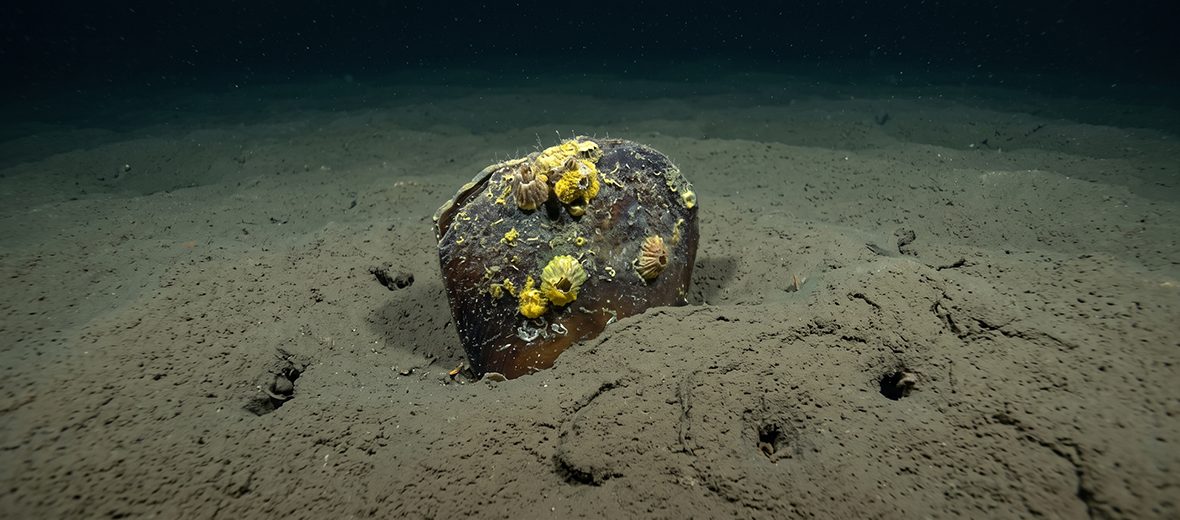
The fan mussel is among not only the largest, but the rarest of the bivalve molluscs in the Atlantic Ocean. They can be found off the coast the northeast Atlantic Ocean, the Mediterranean Sea, and around the British Isles down to Mauritania. They face the threats of bottom trawling and dredging which is where ships drag heavy benthic gear across the seafloor that can easily crush their exceptionally thin, brittle shells. Beyond commercial fishing, operations like harbor dredging, coastal development, boat anchoring, and industrial moorings physically destroy their soft-tissue bodies and the delicate benthic habitats in which they depend. These bivalves rely on filter-feeding to survive. High concentrations of fine, silty terrestrial sediments washed into coastal waters can smother the mussels, clog their filtering apparatuses, and drastically lower their feeding efficiency, ultimately leading to death by starvation. As broadcast spawners, these mussels release their eggs and sperm directly into the open water column. Because populations have been decimated and are highly isolated from one another, the chances of successful fertilization drop drastically (a phenomenon known as the Allee effect). They have an irregular, sporadic reproductive cycle and a slow growth rate (only up to 1.57 inches per year). This makes it incredibly difficult for populations to naturally recover or re-establish even after active threats are removed. However, despite all these threats, these creatures are listed as Not Evaluated by the IUCN. Their population trend is listed as decreasing though.
First the Stats…
Scientific name: Atrina fragilis
Weight: Up to 12.91 ounces
Length: Up to 19 inches
Lifespan: Up to 100 years
Now on to the Facts!
1.) These bivalves are so rare that surveys of nearly 9,000 sites around Britain between 1987 and 1998 found none.
2.) The fan mussel has a larval stage which is rather challenging to identify due to their rarity.
3.) Their preferred habitats contain soft marine substrates like mud, sandy mud, and muddy gravel.
4.) Like many other mussels, they attach to small stones by the secretion of strong byssal threads through their byssus gland to avoid being swept away in the ocean’s current.
5.) Efforts are under way to identify their larvae to implement effective conservation of this rare species.
But wait, there’s more on the fan mussel!
6.) Fan mussels classically consume phytoplankton through suspension feeding.
7.) They grow up to 0.0002 inch per day, and can achieve up to .03 inch before attaching to the substrate.
Did you know…?
The shells are attached to the sand by fine gold-colored silk produced by special glands found in their muscular foot. This silk or byssus are fine threads which historically were used to make special royal fabrics. These were called Pinna silk or sea silk, although the species more frequently used was the noble pen shell (Pinna nobilis) from the Mediterranean.
8.) Based on other related species, females release upwards of 29,000,000 gametes, or eggs, into the water column via bradcast spawning.
9.) After fertilization, it takes upwards of 4 months before the larvae attaches to the substrate to begin life as an adult.
10.) Currently, there are 2 marine protected areas (MPAs) in the OSPAR network (joint Oslo Convention and Paris Convention) that include these bivalves as a feature identified for protection; the South-West Deeps (England) and the Small Isles (Scotland) MPAs.
Now a Short Fan Mussel Video!
This video talks about mussels in general.
Be sure to share & comment below! Also, check out the Critter Science YouTube channel. Videos added regularly. Be sure to like and subscribe!

Want to suggest a critter for me to write about? Let me know here.
Some source material acquired from: Wikipedia & IUCN

Leave a Reply