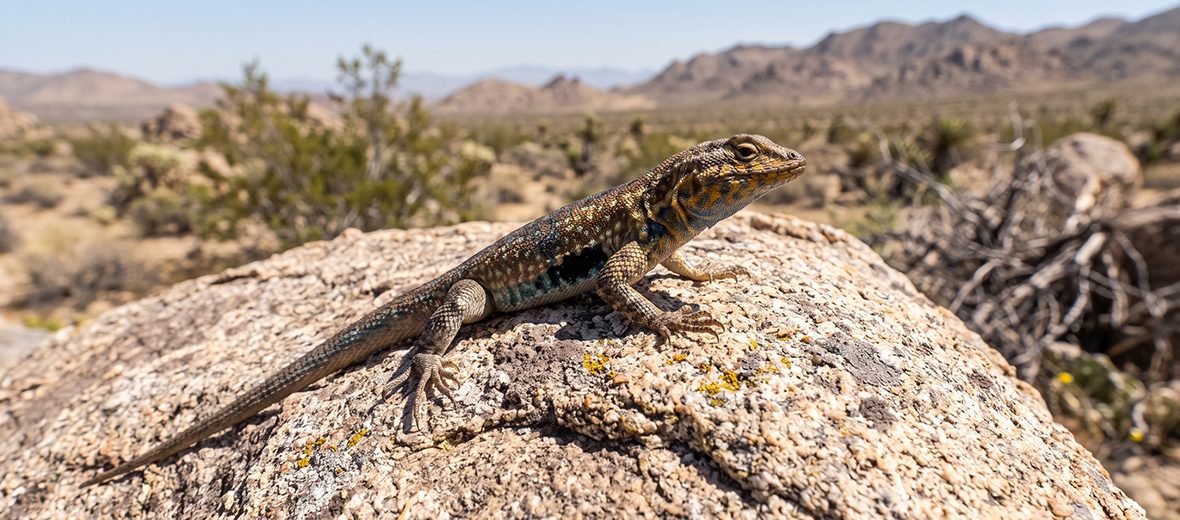
The common side-blotched lizard hails from the western portion of the United States and into northern Mexico. They are noted for having a unique form of polymorphism where each of the 3 different male morphs uses a different strategy in acquiring a mate. Each of the 3 morphs competes against one another following a sort of rock, paper, scissors pattern, where 1 morph has advantages over another but is then outcompeted by the 3rd. With regards to threats faced, converting native desert and shrub-steppes into farmlands and/or housing destroys the rocky outcrops and scattered brush these lizards utilize for shelter. Heavy cattle grazing removes copious amounts of protective vegetation, damages lower shrub branches, and crushes their underground burrows. Driving off of designated trails in off-road vehicles damages delicate desert soils and destroys ground cover. Non-native weeds such as cheatgrass and knapweed fill in bare patches of soil, creating dense ground cover that makes the habitat unusable for these lizards. Invasive grasses also tend to dry out quickly and fuel more frequent, intense wildfires, which further destroy native shrub habitats. Due to climate change, warmer temperatures force these lizards to spend more time hiding underground to avoid overheating. This reduces their time to hunt and disrupts breeding cycles. As a result, this also causes hotter desert regions and rising temperatures which are forcing populations to shift upward to higher elevations in order to survive. Each year, free-roaming outdoor cats kill untold numbers of lizards near residential areas. However, through all these adversities, these lizards are still abundant and widespread. Therefore, they are listed as Least Concern by the IUCN. Their population trend is listed as stable as well.
First the Stats…
Scientific name: Uta stansburiana
Weight: Up to .35 ounce
Length: Up to 6 inches, including their tail
Lifespan: Up to 7 years
Now on to the Facts!
1.) Their specific epithet, stansburiana, is in honor of Captain Howard Stansbury of the US Corps of Topographical Engineers, who collected the first specimens while leading the 1849 – 1851 expedition to explore and survey the Great Salt Lake of Utah, in the United States.
2.) There is a slight degree of sexual dimorphism in this species in that males are a little larger than females. Females also have stripes along their backs/sides, and can be relatively drab in coloration; where the males are more brightly colored.
3.) The ability to survive without a tail provides them a chance to escape predation after being caught. However, while this defense mechanism can be helpful, the loss of a tail can also negatively impact a lizard’s survival and reproduction chances.
4.) Caudal autonomy (the ability to detach their tail) has its disadvantages. Seeing as the loss of a tail is accompanied by a loss of social status amongst their peers. No tail or a replacement tail is not as visually appealing as their original tail.
5.) Males exhibit distinct polymorphism in their throat colors, and can be divided into 3 different categories, or morphs. Each of these 3 different morphs varies in how they compete for mates, and variation within a breeding population is maintained by a rock, paper, scissors mechanism of frequency-dependent sexual selection.
But wait, there’s more on the common side-blotched lizard!
6.) A cycle is created where the least common morph of 1 breeding season often has the largest number of mature living offspring in the following year. This is because 1 morph does particularly well against another, but poorly in comparison to the 3rd morph.
7.) Orange-throated males are “ultradominant”. They’re the largest and most aggressive morph, defending relatively large territories and keeping harems of females that they mate with.
Did you know…?
These lizards can run at speeds of up to 5.7 mph.
8.) Blue-throated males are “dominant”. They’re medium in size, and guard smaller territories that contain only a single female.
9.) Yellow-throated males are called “sneakers”. Their coloration is similar to that of sexually mature females, and they typically mimic female “rejection” displays when they encounter dominant orange-throated or blue-throated males. Yellow-throated males do not hold territories.
10.) Females produce clutches of up to 9 eggs that hatch in up to 80 days.
But wait, there’s still more on the common side-blotched lizard!
11.) Speciation has resulted from the formation of reproductive isolation between populations when a population loses 1 or more of the male morphologies.
12.) The loss of a male morph can change selection on the remaining morphs. In these lizards, for example, female mate preferences change after the loss of a male morph, and alleles that once allowed other male morphs to outcompete the lost morph for mates are no longer seen as beneficial.
Did you know…?
Like other reptiles, they are ectothermic (thermoregulate via external heat sources). The colder it gets, the less they eat. Subsequently, the warmer it gets, the more they eat, due to their higher metabolic rate.
13.) Dominant male side-blotched lizards are aggressive while defending territories. They perform 1 or more “pushups”, arch their backs, and extend their limbs before approaching the opponent. This is followed by butting, nipping, or rushing at the intruder till it flees.
14.) Courting includes circling, flank-biting, licking, smelling, slight head-bobbing, and ultimately copulation.
15.) Grasshoppers, beetles, ants, termites, ticks, spiders, scorpions, flies, and small amounts of plant matter are all on the menu.
Now a Short Common Side-Blotched Lizard Video!
Be sure to share & comment below! Also, check out the Critter Science YouTube channel. Videos added regularly. Be sure to like and subscribe!
Buy My Book
Select the image below to see everywhere my book is sold.


Want to suggest a critter for me to write about? Let me know here.
Some source material acquired from: Wikipedia & IUCN