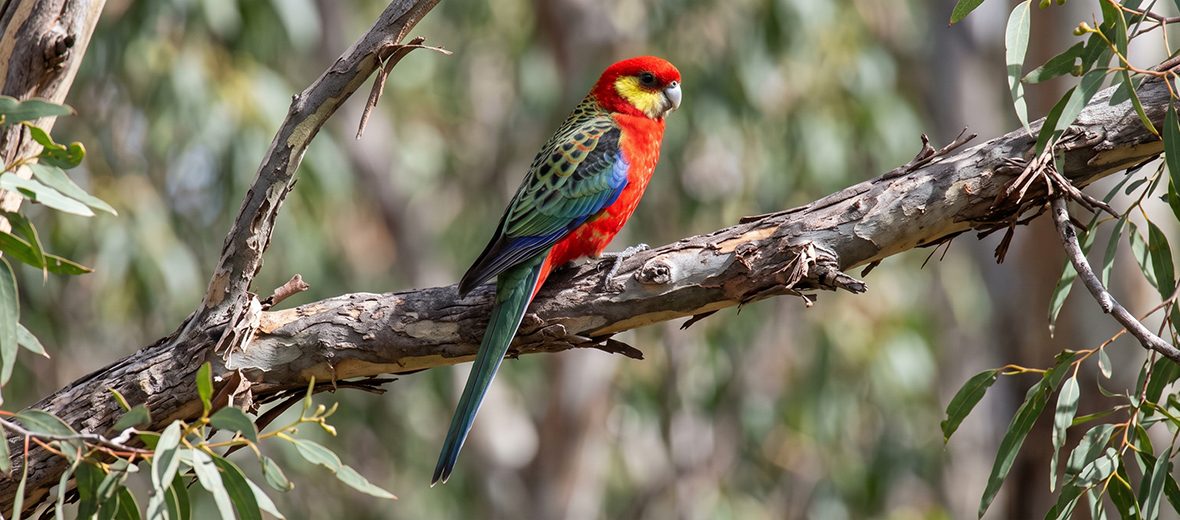
The western rosella, aka moyadong, is a species of parrot that hails from southwestern Australia. They are classified as 2 subspecies: an inland group and a coastal group. These parrots face the threats of large-scale clearing for agriculture, urban development, infrastructure, and mining which has severely fragmented their home range. Just like most parrots, these birds are obligate cavity nesters, depending entirely on old-growth eucalypt trees to create natural hollows for breeding. The removal of these mature trees is the primary driver behind local disappearances, mainly in the Western Australian Wheatbelt. Introduced European honey bees frequently invade and take over the remaining clean tree hollows, excluding the rosellas from viable breeding sites. Due to the fact that these rosellas often forage on the ground for grass seeds and fallen fruit, they are incredibly vulnerable to predation by introduced species and invasive species, such as domestic and feral cats as well as red foxes. The severe shortage of tree hollows places them in direct competition with other cavity-dependent wildlife as well. Historically, these birds were considered a major agricultural pest by orchardists and grain farmers. They were termed as “vermin” by the Western Australian government and actively trapped and/or culled in massive numbers for the aviculture trade up until 1998. Even though they are now fully protected under the Wildlife Conservation Act, the historical toll left local populations permanently depleted in certain regions. Lastly, climate change causes not only droughts but severe flooding that can alter their habitats. However, through all these adversities, these parrots are still abundant enough to be listed as Least Concern by the IUCN. Their population trend is listed as decreasing though.
First the Stats…
Scientific name: Platycercus icterotis
Weight: Up to 2.8 ounces
Length: Up to 11.8 inches
Wingspan: Up to 16 inches
Lifespan: Up to 40 years
Now on to the Facts!
1.) These birds are the smallest species of rosella known, to date.
2.) They were first described scientifically by French zoologist Coenraad Jacob Temminck and German naturalist Heinrich Kuhl in 1820.
3.) Sexual dimorphism exists in these birds in that males are much more colorful than the duller females.
4.) Their calls consist of “ching-ching-ching,” “chink-chink,” and “pink-pink” sounds. They also produce a high frequency “quink, quink, quink, quink” and a softer voiced call of “whip-a-whee”. These birds don’t have a strong or well-known reputation for mimicking human speech or complex environmental sounds the way some other parrots or songbirds do.
5.) The preferred habitats are open eucalypt forests, woodlands, and timbered areas in southwestern Australia, typically expanding into adjacent agricultural lands, orchards, and cleared areas where seeds are readily available.
But wait, there’s more on the western rosella!
6.) The inland and coastal subspecies of the these birds often interbreed where their territories overlap.
7.) While most often seen in pairs, they will often congregate into flocks of up to 20+ individuals.
Did you know…?
Individuals feeding out in the open are not typically bothered by human presence and can be approached quite closely before fleeing.
8.) Females lay up to 7 eggs that hatch in up to 25 days.
9.) Seeds, grains, flowers, nectar, berries, soft fruits, and insects are all on the menu.
10.) Like the eastern rosellas, western rosellas are a popular bird in aviaries and for zoological gardens, typically displaying the favorable characteristics of related species without the reputation for aggression and raucous vocalizations.
11.) As is the case for all rosella species, they are diurnal (active during the day).
Now a Short Western Rosella Video!
This video talks about rosellas in general.
Be sure to share & comment below! Also, check out the Critter Science YouTube channel. Videos added regularly. Be sure to like and subscribe!
Buy My Book
Select the image below to see everywhere my book is sold.


Want to suggest a critter for me to write about? Let me know here.
Some source material acquired from: Wikipedia & IUCN