
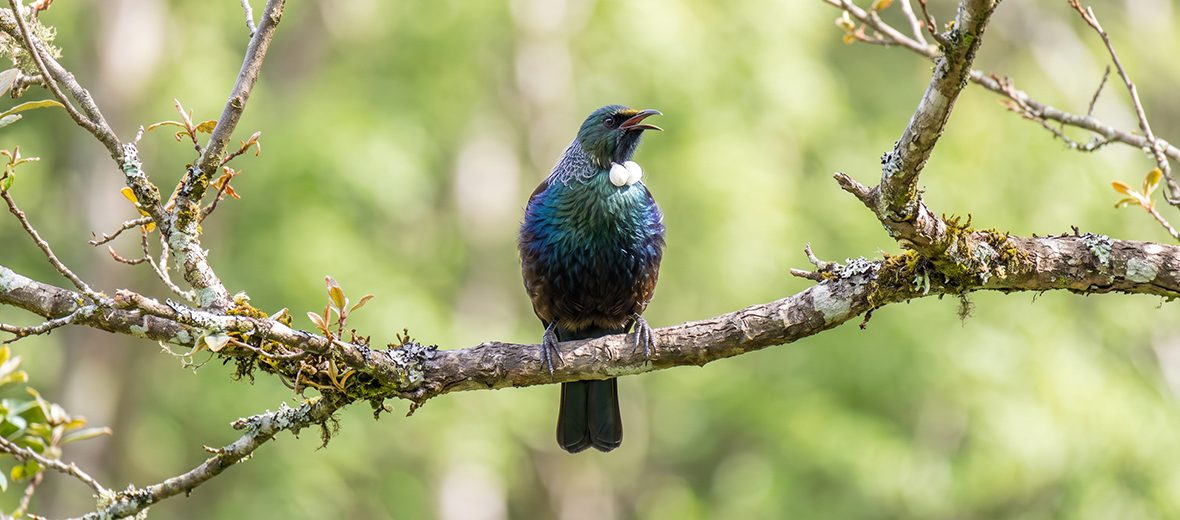
The tūī is 1 of the largest species in the diverse Australasian honeyeater family. They are 1 of 2 living species of that family that dwell in New Zealand. Introduced mammals pose the most severe direct threat to these birds. Rats, stoats, weasels, and ferrets frequently prey on their eggs, nestlings, and incubating females. Feral cats and hawks also hunt adults and juveniles. Widespread deforestation since European settlement drastically reduced the native lowland forests that they rely on for survival. Fragmented habitats force them to travel greater distances in search of seasonal food supplies. Invasive species such as possums disrupt the tūī’s food supply by heavily browsing on the flowers and fruits of native trees (like kōwhai, pūriri, and rewarewa), leaving fewer sources of nectar and less food resources available. Among suburban environments, these birds are vulnerable to various urban hazards. They are known to suffer from lead poisoning, which can occur when they drink rainwater collecting on old building roofs with lead flashing. Highly pathogenic avian influenza (H5N1) has reached New Zealand. While it presents an acute danger to small, isolated island populations, it still remains a monitored biosecurity threat for all native species of birds. However, despite these threats, these critters are abundant enough to be listed as Least Concern by the IUCN. Their population trend is listed as decreasing though.
First the Stats…
Scientific name: Prosthemadera novaeseelandiae
Weight: Up to 5.3 ounces
Length: Up to 12 inches
Wingspan: Up to 16 inches
Lifespan: Up to 12 years
Now on to the Facts!
1.) They are the only species in the genus Prosthemadera.
2.) German naturalist, chemist, botanist, entomologist, herpetologist, and malacologist Johann Friedrich Gmelin first described these birds in 1788 when he revised and expanded Carl Linnaeus’s Systema Naturae.
3.) Other names for these birds are the New Zealand creeper, poly-bird, and poe-bird.
4.) There are 2 recognized subspecies: P. n. chathamensis and P. n. novaeseelandiae.
5.) Their name hails from the Māori language, although there are 14 other Māori names for the tūī, including: kōkō, Kōkōtaua, Kōkōtea, Kōkōuri, Kōpūrehe, Kouwha, Kukari, Pikari, Pitui, Tākaha, Takahē, Tataki (or Tātākī), Teoteo, and Tute.
But wait, there’s more on the tūī!
6.) The preferred habitats of these critters are low-altitude native forests, primarily thick podocarp-broadleafs, podocarp-broadleaf-beeches, and beech forests.
7.) Males can be extremely aggressive, chasing all other birds (large or small) from their territory with loud flapping and sounds that resemble crude human speech.
Did you know…?
There are roughly an estimated 2,300,000 wild indivuduals remaining, to date.
8.) These feisty critters have even been known to mob harriers and magpies.
9.) Nectar is the standard diet, however, fruit and a variety of insects are also often eaten, and occasionally pollen and seeds.
10.) Particularly popular among these critters is the New Zealand flax, whose nectar sometimes ferments, resulting in their flying in a manner that suggests that they might actually be drunk.
But wait, there’s still more on the tūī!
11.) Females lay up to 4 eggs that hatch in up to 14 days.
12.) The chicks fledge after approximately 20 days.
13.) They are known for their noisy, odd, sometimes soulful calls, that are different for each individual, and that combine bellbird-like notes with clicks, cackles, timber-like creaks, groans, and wheezing sounds.
14.) These birds also have the ability to clearly imitate human speech, and re-create sounds such as glass shattering, car alarms, classical music, and advertising jingles.
Now a Short Tūī Video!
Be sure to share & comment below! Also, check out the Critter Science YouTube channel. Videos added regularly. Be sure to like and subscribe!

Want to suggest a critter for me to write about? Let me know here.
Some source material acquired from: Wikipedia & IUCN

Leave a Reply