
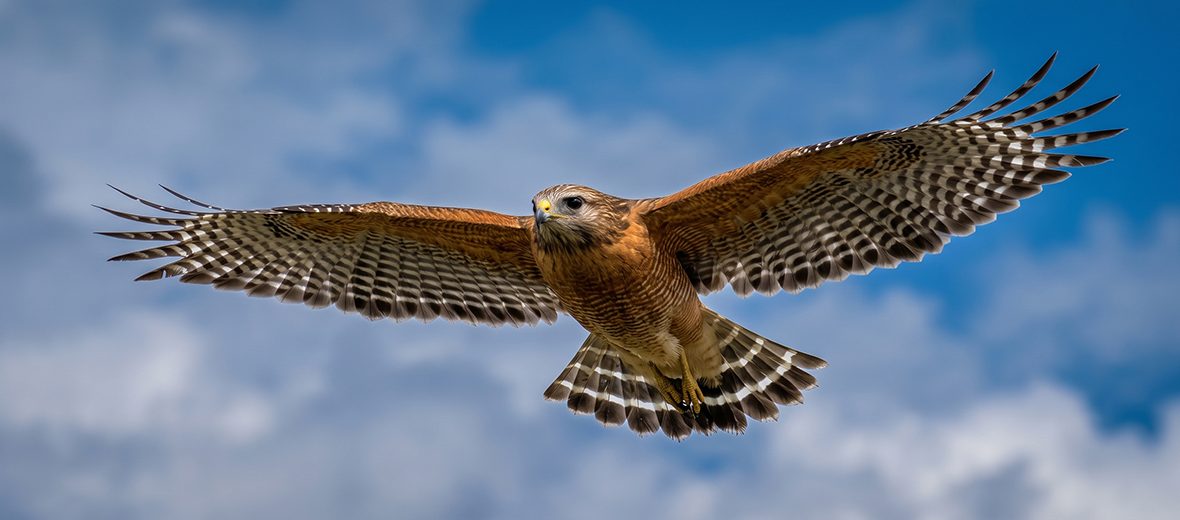
The red-shouldered hawk hails from North America–primarily the west coast and eastern half of the United States as well as Mexico. These raptors migrate from the northern parts of their ranges to central Mexico. They face the threat of deforestation via the clearing of large, mature, contiguous forests for timber, agriculture, and urban development. Relying heavily on wooded wetlands, riparian zones, and swamps, draining or polluting these areas depletes their primary food sources. They are also highly sensitive to human activity during the breeding season. Nearby logging, construction, or heavy foot traffic can cause adults to abandon their nests. Vehicle strike (being hit by vehicles) is another issue because they often hunt from low perches, they face a high risk of fatal collisions with automobiles and power lines. While historical pesticides like DDT heavily damaged their eggs in the 20th century, modern threats come from chemical rodenticides. Hawks that consume poisoned rats or mice frequently suffer lethal secondary poisoning. However, through all these threats, they are abundant and widespread and thus listed as Least Concern by the IUCN. Their population trend is listed as increasing as well.
First the Stats…
Scientific name: Buteo lineatus
Weight: Up to 1.5 lbs.
Length: Up to 24 inches
Wingspan: Up to 50 inches
Lifespan: Up to 19+ years
Now on to the Facts!
1.) These hawks were formally described by the German naturalist Johann Friedrich Gmelin in his revised and expanded edition of Carl Linnaeus’s Systema Naturae in 1788.
2.) The genus name Buteo is Latin and translates to “buzzard“. The specific epithet lineatus is Latin and means “marked with lines” or “lined”.
3.) There are 5 subspecies recognized: B. l. alleni, B. l. extimus, B. l. texanus, B. l. elegans, and B. l. lineatus.
4.) Their preferred habitats are mature, closed-canopy deciduous forests, or mixed forests that are located near water source openings.
5.) These hawks have a decent adaptability to human-altered landscapes, which is critical seeing as riparian forest habitats have been reduced by 98% from 1850 – 1977 in California’s Central Valley.
But wait, there’s more on the red-shouldered hawk!
6.) Voles, gophers, mice, rats, moles, chipmunks, rabbits, tree squirrels, frogs, toads, lizards, snakes, birds, fish, crayfish, insects, eastern screech owls, flying squirrels, and carrion (dead animals) are all feasted upon.
7.) Females lay up to 4 eggs that hatch in up to 33 days.
Did you know…?
There are approximately 1,900,000 wild individuals, to date.
8.) Chicks fledge at up to 6 weeks, but remain dependent, to a degree, on their parents for up to 19 weeks of age.
9.) Only around half of the chicks survive to their first year.
10.) Raccoons, martens, fishers, and larger arboreal snakes often prey on these hawk’s eggs, hatchlings, fledglings, and sometimes incubating and brooding adults.
But wait, there’s still more on the red-shouldered hawk!
11.) These hawks have hybridized with gray hawks, red-tailed hawks, and common black hawks.
12.) As is the case with all hawks, they are diurnal (active during the day).
13.) In Florida, they often collaborate and peaceably coexist with American crows.
Now a Short Red-Shouldered Hawk Video!
Be sure to share & comment below! Also, check out the Critter Science YouTube channel. Videos added regularly. Be sure to like and subscribe!

Want to suggest a critter for me to write about? Let me know here.
Some source material acquired from: Wikipedia & IUCN

Leave a Reply