
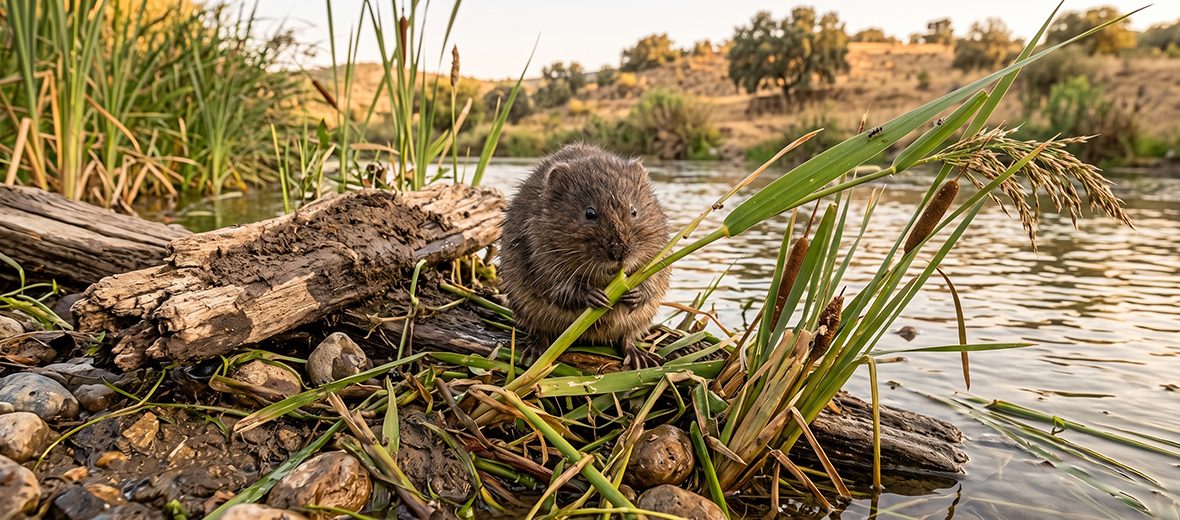
The southwestern water vole, aka southern water vole, is a large amphibious species of vole hailing from France, Portugal, and Spain. They only thrive where the banks and vegetation haven’t been drastically altered by human activity. Consequently, habitat loss and degradation (as a result of drainage, dredging, canal-building, infrastructure development, intensive agriculture, and droughts) are serious threats. Competition with the introduced coypu, muskrat, and Norway rat for food as well as dens is also a threat. Attempts to control invasive species via poisoning have resulted in accidental water vole deaths as well. Habitat loss and destruction via residential and commercial developments, farming, ranching, and logging are other serious threats, and dams flood their homes as well. Climate change causes severe droughts. Finally, agricultural and industrial runoff exposes them to water pollution and chemical pollution. Through all these threats, these critters are listed as Near Threatened by the IUCN. Their population trend is listed as decreasing as well.
First the Stats…
Scientific name: Arvicola sapidus
Weight: Up to 10.6 ounces
Length: Up to 8.7 inches, plus up to a 5.9 inch tail
Lifespan: Up to 4 years
Now on to the Facts!
1.) They prefer freshwater and low-salinity wetland habitats almost exclusively.
2.) Leaves, shoots, stems of water plants, grasses, roots, bulbs, insects, frogs, tadpoles, and occasionally even small fish are all on the menu.
3.) Eurasian otters, American minks, European polecats, red foxes, wildcats, martens, genets, rats, herons, white storks, booted eagles, owls, and swamp harriers all prey on these rodents.
4.) These voles do not hibernate. They stay active throughout the year.
5.) They are cathemeral (active both day and night).
But wait, there’s more on the southwestern water vole!
6.) These voles create intricate systems of burrows and tunnels into the soft banks of streams, rivers, canals, and ponds.
7.) Even though reproduction occurs year-round, their primary reproduction times span from March – October, and peak between April – June.
Did you know…?
This species of vole was historically used as a primary ingredient in traditional recipes for authentic Valencian paella. That is before populations declined and the species became legally protected.
8.) Females undergo up to a 23 day gestation (pregnancy) that can yield up to 7 pups.
9.) A female can have up to 4 litters per year.
10.) The pups are weaned in up to 21 days.
Now a Short Southwestern Water Vole Video!
This video talks about water voles in general.
Be sure to share & comment below! Also, check out the Critter Science YouTube channel. Videos added regularly. Be sure to like and subscribe!

Want to suggest a critter for me to write about? Let me know here.
Some source material acquired from: Wikipedia & IUCN

Leave a Reply