
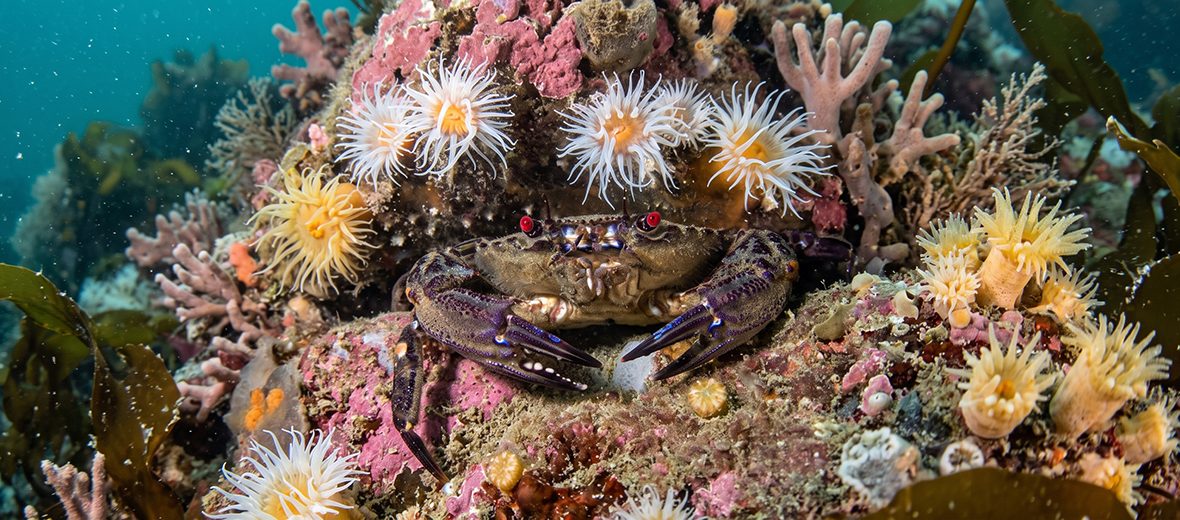
The velvet crab, aka velvet swimming crab or devil crab, hails from the northeast Atlantic and the Mediterranean. Since the 1980s, commercial targeting of these crabs has intensified significantly, particularly in the UK, Ireland, and Scotland where they are highly prized for international export. Overfishing poses a localized threat of stock depletion if harvesting outpaces sustainable reproduction. They are often caught as collateral bycatch in bottom trawling operations and pot fisheries that primarily target other species, like the brown crab. Rising carbon dioxide levels lead to ocean acidification, which threatens the crab’s ability to effectively calcify and maintain its protective exoskeleton. It also impacts the availability of its calcifying prey species, such as mussels. Climate change also increases sea temperatures disrupting their natural reproductive cycles, metabolic rates, and overall physiological processes. Being highly exposed to coastal microplastics pollution, studies have shown that ingested microplastics can penetrate their vascular systems and reach their brains, potentially impairing cognitive functions, resource assessment, and crucial survival behaviors. Habitat loss via marine dredging, coastal development, and chemical runoff destroys or pollutes the shallow waters, rockpools, and structurally complex seabed substrata that juvenile and adult crabs rely on for foraging and shelter. However, through all these adversities these crustaceans have maintained an abundance that has them listed as Not Evaluated by the IUCN. Their population trend is listed as decreasing though.
First the Stats…
Scientific name: Necora puber
Weight: Up to 9.45 ounce
Length: Up to 2.6 inches
Width: Up to 3.9 inches
Lifespan: Up to 6 years
Now on to the Facts!
1.) These crustaceans were first formally described by Carl Linnaeus in the second part of the first volume of the twelfth edition of his definitive work Systema Naturae in 1767.
2.) Populations have historically suffered severe declines due to infections from the parasitic dinoflagellate Hematodinium sp.. This pathogen causes “Pink Crab Disease,” which degrades the crab’s hemolymph (blood) and muscle tissues, rendering them bitter and unfit for commercial sale.
3.) Some other common names include velvet fiddler crab, lady crab, and Kerry witch.
4.) In France, these crabs are considered a delicacy.
5.) These crabs have been traditionally eaten in France and Spain, and are commercially important for the British Isles, although they were there once regarded as pests.
But wait, there’s more on the velvet crab!
6.) Targeted fishing for these crabs is a recent phenomenon in Ireland, having started in circa 1980s in response to an increased demand due to the collapse of the Spanish velvet crab fisheries and thus of the southern European stocks.
7.) Brown algae, mussels, limpets, bivalves, gastropods, smaller crabs, small fish, urchins, sponges, worms, and carrion (dead animals) are all on the menu.
Did you know…?
In 2011, the Scottish velvet crab fishery caught £5.8 million worth of crabs, or more than 2,205 tons.
8.) Even though the industry is regulated, the crabs may be being overfished in the Firth of Clyde, Orkney, and South Minch.
9.) Females produce upwards of 278,000 eggs each clutch.
10.) Atlantic cod, octopuses, and sea anemones all prey on these crabs.
Now a Short Velvet Crab Video!
Be sure to share & comment below! Also, check out the Critter Science YouTube channel. Videos added regularly. Be sure to like and subscribe!

Want to suggest a critter for me to write about? Let me know here.
Some source material acquired from: Wikipedia & IUCN

Leave a Reply