
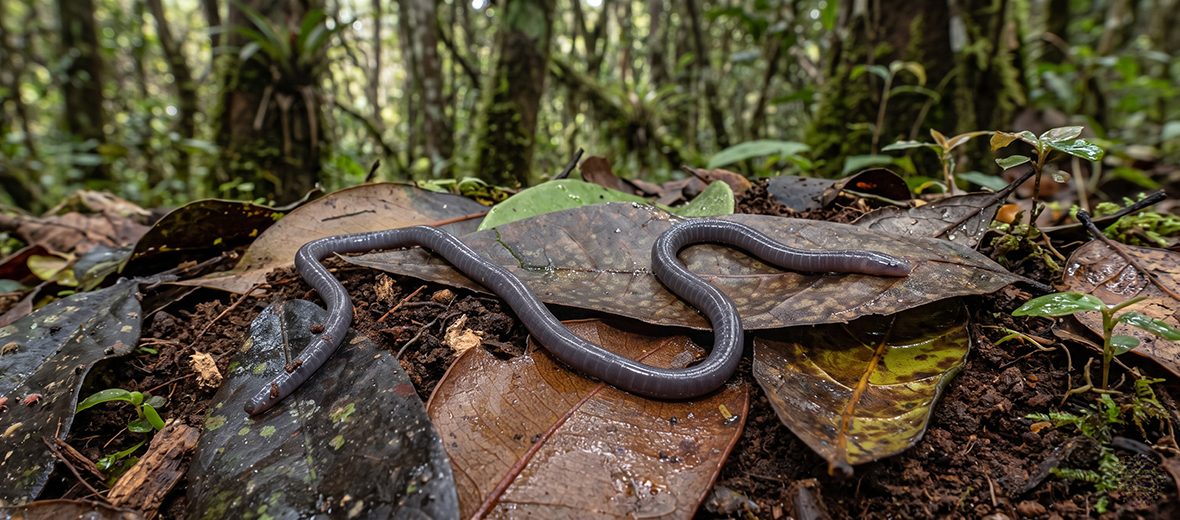
The Sagalla caecilian is a worm-like amphibian that dwells among what remains of Sagalla Hill in Kenya, Africa. These critters seem to be adaptable enough to still survive among the heavily deforested hillside. That being said, they do suffer the threats of habitat loss and deforestation at the hands of eucalyptus and pine plantations. But to what extent is unknown at this time. It is also not known whether or not they are being harmed or benefiting from the plantations and their massive amount of water consumption. However, seeing as they dwell only on Sagalla Hill, they are listed as Endangered by the IUCN. Their population trend is listed as unknown at current, due in part to the fact that they are subterranean (fossorial) and difficult to find.
First the Stats…
Scientific name: Boulengerula niedeni
Weight: Up to .2 lb.
Length: Up to 10.83 inches
Lifespan: Up to 12 years
Now on to the Facts!
1.) They were first described in 2005 by herpetologists H. Müller, G. J. Measey, S. P. Loader, and P. K. Malonza.
2.) These caecilians have been listed as 1 of the top-10 “focal species” in 2008 by the Evolutionarily Distinct and Globally Endangered (EDGE) project. A focal species is a specific organism chosen by conservation biologists as a target for management and landscape planning.
3.) Even though they resemble earthworms, caecilians possess a prominent mouth, nostrils, and, uniquely amongst vertebrates, a pair of retractable tentacles, 1 on each side of their head, between the eyes and nostrils.
4.) Their eyes are dramatically reduced, and, sometimes, nearly entirely covered by bone and/or skin. Their eyes may form like this due to the lack of need for vision, beyond the sensing of light, whilst digging.
5.) As mentioned, these caecilians can only be found on Sagalla Hill and at elevations of 3,281 – 4,934 feet above sea level.
But wait, there’s more on the Sagalla caecilian!
6.) Furthermore, they are only found among a patch of land that is 7.7 square miles.
7.) Females produce a clutch of up to 5 oblong eggs each season.
Did you know…?
The Zoological Society of London’s “EDGE (Evolutionarily Distinct & Globally Endangered) of Existence” campaign has started working to establish a caecilian preserve and restore habitat for this species.
8.) It is presumed that once the eggs hatch, the mother feeds the young using maternal dermatotrophy—a process where the young peel and eat a nutrient-rich layer of the mother’s own skin, which regrows each day.
9.) Some priorities for these caecilian’s conservation include: stabilizing the soil by restoring vegetation and improving agricultural practices, careful replacement of eucalyptus plantations with indigenous trees, working with local communities, and continuing to study their ecology.
10.) These critters are nocturnal (active at night).
Now a Short Sagalla Caecilian Video!
This video talks about caecilians in general.
Be sure to share & comment below! Also, check out the Critter Science YouTube channel. Videos added regularly. Be sure to like and subscribe!

Want to suggest a critter for me to write about? Let me know here.
Some source material acquired from: Wikipedia & IUCN

Leave a Reply