
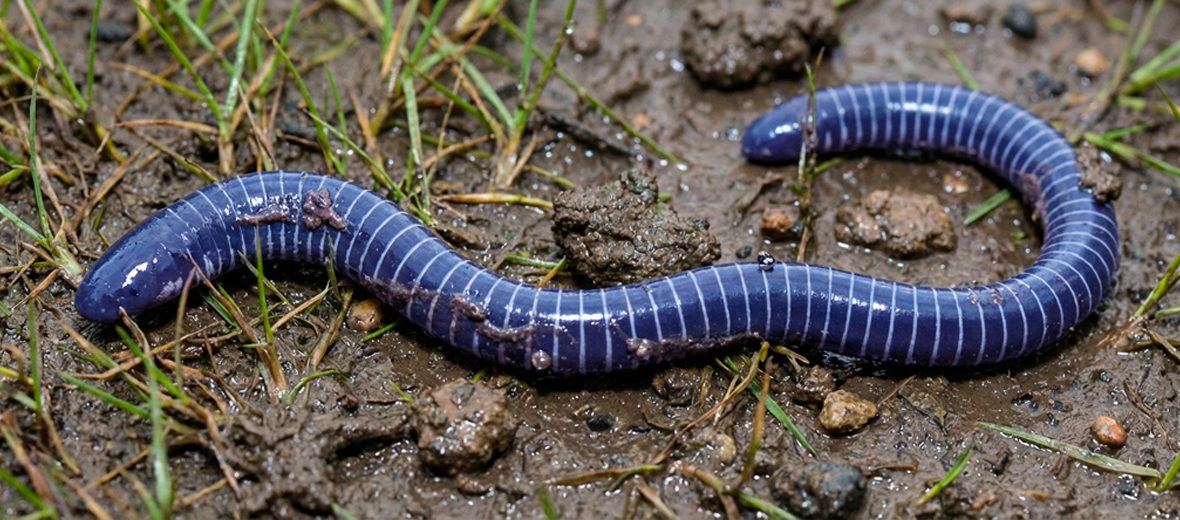
The ringed caecilian has the largest known distribution of any terrestrial species of caecilian. They hail from South America. These caecilians face the threats of habitat loss and destruction at the hands of residential and commercial developments, farming, ranching, and deforestation (due to logging), land pollution, that causes mortality due to chemicals added to the soil, water pollution, from runoff due to agriculture, and climate change that can cause severe droughts. However, these critters are abundant enough to be listed as Least Concern by the IUCN. Their population trend is listed as Unknown at this time.
First the Stats…
Scientific name: Siphonops annulatus
Weight: Up to 4 lbs.
Length: Up to 17.7 inches
Lifespan: Up to 20 years
Now on to the Facts!
1.) Their primary predators are various burrowing mammals, ants, and snakes.
2.) Burrows extend no deeper than 7.87 inches below the surface.
3.) They are highly fossorial (spend most of their life underground).
4.) The skull is highly ossified (rigid or bony), which aids in digging burrows.
5.) These critters dwell in subtropical and tropical moist lowland forests, dry savannas, subtropical and tropical seasonally wet or flooded lowland grasslands, moist savannas, subtropical and tropical moist shrublands, pasturelands, plantationss, rural gardenss, and heavily degraded former forests.
But wait, there’s more on the ringed caecilian!
6.) Mating takes place from the end of August to the beginning of October.
7.) Eggs are laid between November and December.
Did you know…?
They have skin glands with different specialized functions. Their head has glands that excrete a lubricating mucus that helps in burrowing, and the tail is loaded with with poisonous chemicals, similar to the poison glands found in other amphibians like toads and newts.
8.) These caecilians were first described by Austrian biologist Johann Christian Mikan in 1822.
9.) The nestlings come equipped with 44 spoon-shaped teeth in which to feed on the outer layer of mom’s skin.
10.) After feeding all at once, they rest for up to 3 days, while mom regrows the outer layer of skin. This is known as maternal dermatophagy.
But wait, there’s still more on the ringed caecilian!
11.) The young also suckle on a white, viscous liquid from their mother’s cloaca (rectum).
12.) Hatchlings emit high-pitched clicking sounds when they get near their mother and request milk, a behavior that is quite unique among amphibians.
13.) The production of milk in egg laying caecilians suggests a type of evolutionary transition between egg-laying and live birth.
Now a Short Ringed Caecilian Video!
Be sure to share & comment below! Also, check out the Critter Science YouTube channel. Videos added regularly. Be sure to like and subscribe!

Want to suggest a critter for me to write about? Let me know here.
Some source material acquired from: Wikipedia & IUCN




Leave a Reply