
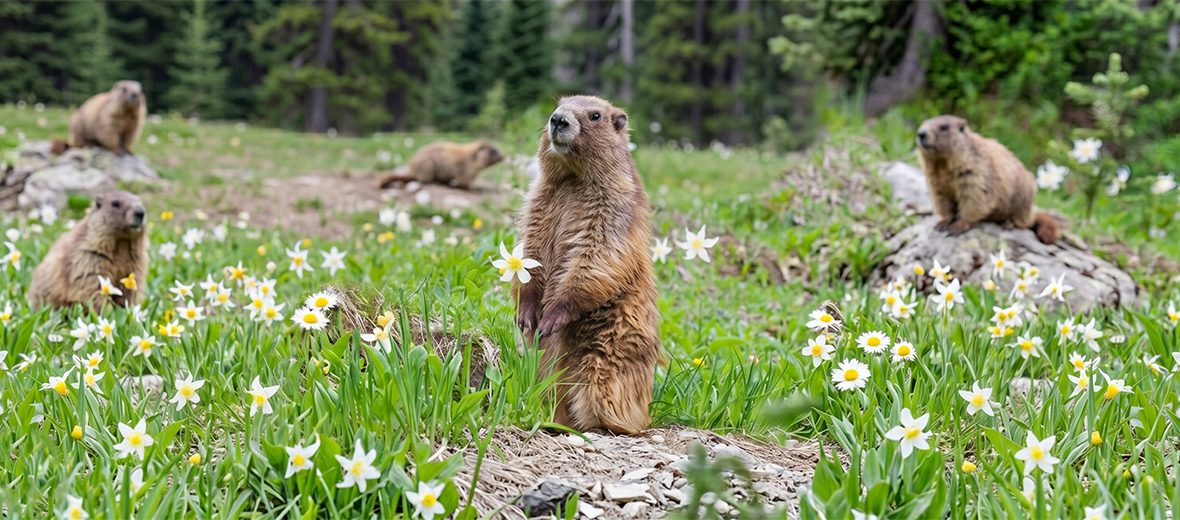
The Olympic marmot is a species of rodent from the squirrel family, Sciuridae. They only dwell in the state of Washington, in the United States. These rodents face the threats of recreational activities that can often result in humans not only interrupting their daily life but also feeding them. When being fed they become quickly acclimated to receiving food rather than foraging. This has an impact on these critters when it comes time to store food for their hibernation. Habitat loss and destruction due to fires and fire suppression is another threat faced. However, they are abundant enough to be listed as Least Concern by the IUCN. But their population trend is listed as Decreasing.
First the Stats…
Scientific name: Marmota olympus
Weight: Up to 18 lbs.
Length: Up to 30 inches, plus up to a 9.4 inch tail
Lifespan: Up to 6 years
Now on to the Facts!
1.) They were named the official endemic mammal of Washington state in 2009.
2.) These marmots were first described by American zoologist and ethnographer Clinton Hart Merriam in 1898.
3.) Olympic marmots are the largest of the 6 known species in North America.
4.) A double-layered coat, consisting of soft, thick underfur, for heat retention, and coarser outer hairs cover the entirety of their body.
5.) They can be found at elevations of up to 6,530 feet.
But wait, there’s more on the Olympic marmot!
6.) The average home range of a family of marmots typically covers up to 5 acres.
7.) Avalanche lilies, glacier lilies, harebells, heather blossoms, mountain buckwheat, mosses, subalpine lupine, and sedges are all foraged. However, these marmots also feast on fruits, insects, hibernating chipmunks, and carrion (dead animals).
Did you know…?
There are only an estimated 4,000 wild individuals remaining, to date.
8.) During the winter months these marmots are capable of snow consumption. They are able to eat snow to obtain their necessary water intake. without the fear of dehydration or core temperature drops.
9.) Bobcats, cougars, coyotes, fishers, golden eagles, and black bears all prey on these critters.
10.) Being very social animals, when greeting each other they will usually touch noses or touch nose to cheek; in courtship rituals they may inter-lock teeth and nibble on each other’s ears and necks.
But wait, there’s still more on the Olympic marmot!
11.) These critters have 4 different types of calls: ascending calls, descending calls, flat calls, and trills.
12.) Hibernation lasts up to 7 months out of the year.
Did you know…?
Unlike some other marmots, these critters are not hosts to the bacterium Yersinia pestis which causes the bubonic plague.
13.) When hibernating, they aren’t easily awoken. Their body temperature drops to below 40°F and their heart rate can slow to just 3 beats per minute!
14.) Females undergo up to a 32 day gestation (pregnancy) that yields up to 6 pups.
15.) This species is very susceptible to climate change due to their sensitivity to habitat change. When the meadows in Olympic National Park dry out, marmots there either died or moved on to other pastures.
Now a Short Olympic Marmot Video!
Be sure to share & comment below! Also, check out the Critter Science YouTube channel. Videos added regularly. Be sure to like and subscribe!

Want to suggest a critter for me to write about? Let me know here.
Some source material acquired from: Wikipedia & IUCN

Leave a Reply