
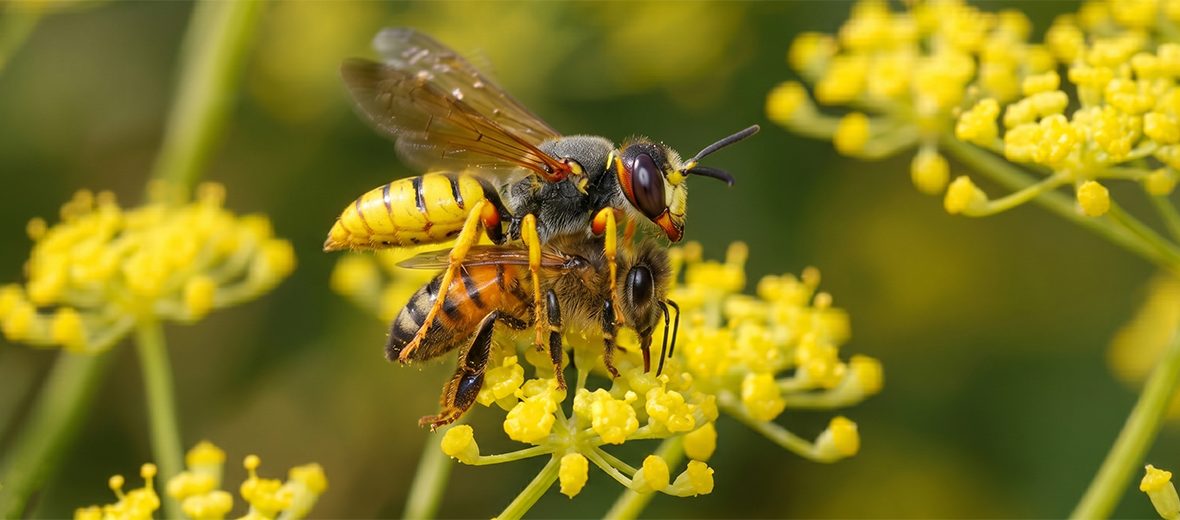
It seems that wherever you go something is trying to kill bees. The European beewolf is no exception. These predatory wasps hail from Europe, Africa, and the Middle East. They may be predatory, but they face the threat of fungal and bacterial pathogens that can infest their nests and kill their larvae. Satellite flies and cuckoo wasps bring about a parasitic invasion. These insects follow females home and lay their eggs in the nest. When their larvae hatch, they feed on the beewolf larvae. Due to the fact that they nest exclusively in open, sunny areas with sandy or loose soils, the loss of flower-rich habitats and sandy terrain poses a major threat to their populations. However, despite these threats, these insects are abundant and listed as Not Evaluated by the IUCN. Their population trend is listed as increasing as well.
First the Stats…
Scientific name: Philanthus triangulum
Weight: Up to .004 ounce
Length: Up to .7 inch
Lifespan: Up to 1 year
Now on to the Facts!
1.) They get their name due to the fact that the inseminated females hunt western honey bees.
2.) Once captured, the female places several of her paralyzed prey together in a pile with an egg in a small underground chamber, to serve as food for her larvae.
3.) These wasps are solitary and only come together to mate.
4.) There are 5 recognized subspecies: Philanthus triangulum abdelcader, Philanthus triangulum diadema, Philanthus triangulum obliteratus, Philanthus triangulum triangulum, and Philanthus triangulum bimaculatus.
5.) Honey bees are paralyzed via a stinger. The female stings her prey through the articular membranes which are located behind the front legs, the female then carries her immobilized prey to the nest in flight with her legs.
But wait, there’s more on the European beewolf!
6.) Each of these predatory wasps are capable of collecting upwards of 100 honey bees in her life.
7.) Females are capable of laying up to 40 eggs in her life.
Did you know…?
The sting of 1 of these wasps can cause mild swelling, redness, and a burning sensation at the site. But unless the victim has a rare allergic reaction to the venom, the sting is not life threatening.
8.) The communal nesting site can house as many as 15,000 burrows from numerous females.
9.) They were first described by the Danish zoologist and entomologist Johan Christian Fabricius in 1775.
10.) Adults feed only on nectar from various flowering plants.
But wait, there’s still more on the European beewolf!
11.) Other names for these critters are bee-eating philanthus or the bee-killer wasp.
12.) These critters are strictly diurnal (active during the day).
Now a Short European Beewolf Video!
Be sure to share & comment below! Also, check out the Critter Science YouTube channel. Videos added regularly. Be sure to like and subscribe!

Want to suggest a critter for me to write about? Let me know here.
Some source material acquired from: Wikipedia & IUCN