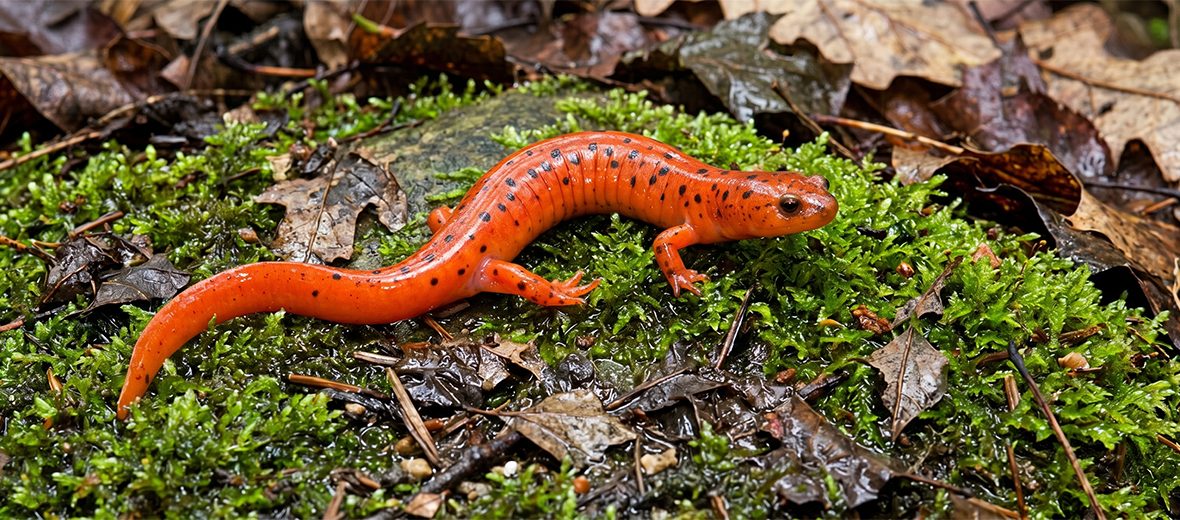
The mud salamander can be found, with a little luck, among seeps, streams, swamps, and underneath leaves, logs, & rocks in the eastern United States. These salamanders face the threats of habitat loss and destruction at the hands of residential and commercial developments, as well as from recreational activities. Roads and railroads divide their territory and can result in vehicle strike (being hit by vehicles). The logging industry also destroys their habitats via deforestation. They also face the eminent threat of the Chytrid fungus Batrachochytrium salamandrivorans, “Bsal”, which is lethal. However, amongst all these threats, these critters are still abundant enough to be listed as Least Concern by the IUCN. Their population trend is listed as stable.
First the Stats…
Scientific name: Pseudotriton montanus
Weight: Up to .53 ounce
Length: Up to 8.1 inches, including their tail
Lifespan: Up to 15 years
Now on to the Facts!
1.) There are 2 geographically isolated populations that are divided by the Appalachian Mountains.
2.) 4 subspecies exist in the mud salamander complex: the Gulf Coast mud salamander, rusty mud salamander, Midland mud salamander, and the eastern mud salamander.
3.) Like other species of salamander, they are ectothermic (thermoregulate via external sources).
4.) They were first described by the prominent American naturalist Spencer Fullerton Baird in 1850.
5.) The larvae feed on small aquatic invertebrates and even other salamander larvae. The adults prey on beetles, earthworms, red worms, spiders, and even smaller species of salamanders.
But wait, there’s more on the mud salamander!
6.) Water snakes prey on larvae while garter snakes prey on adults.
7.) Females reproduce between every 1 – 2 years and lay up to 200 eggs each clutch.
Did you know…?
These salamanders are capable of producing a proteinaceous skin toxin along the backside of their body which can cause symptoms like extreme irritability, hypothermia, and physical weakness in their predators. The poison’s effects on humans can cause severe symptoms, including muscle convulsions and cardiac stress.
8.) The female will stay with her clutch of eggs for up to 3+ months to incubate them and keep them safe.
9.) Once the eggs hatch, the larval stage can last up to 2.5 years.
10.) These salamanders are nocturnal (active at night) and fossorial (spend most of their lives underground or under logs and leaf litter).
Now a Short Mud Salamander Video!
Be sure to share & comment below! Also, check out the Critter Science YouTube channel. Videos added regularly. Be sure to like and subscribe!

Want to suggest a critter for me to write about? Let me know here.
Some source material acquired from: Wikipedia & IUCN