
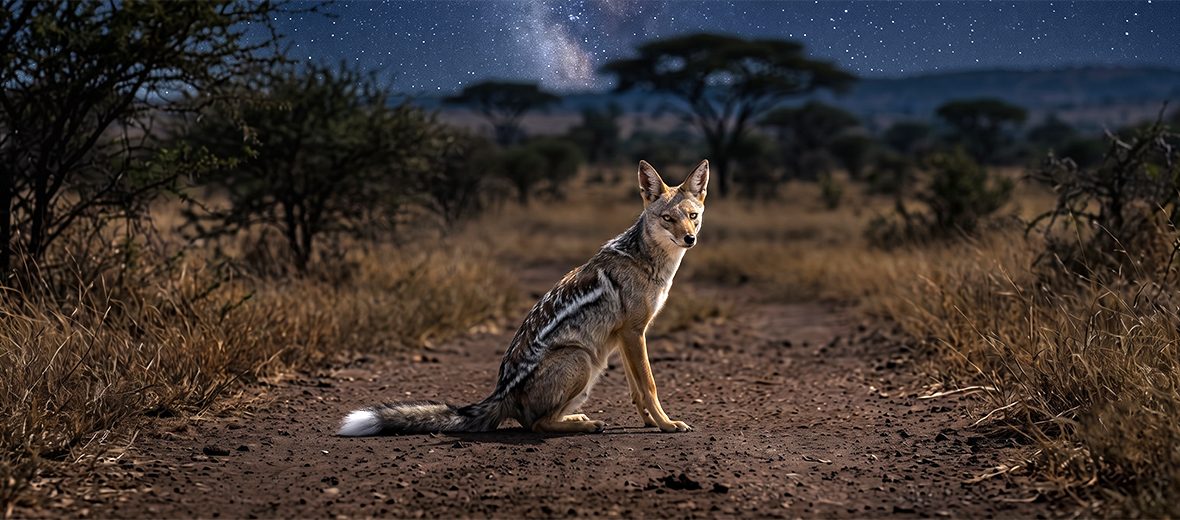
The side-striped jackal has a far wider distribution than the well known black-backed jackal. They hail from central and southern Africa. These canines face the threat of retaliatory killings due to their propensity of killing poultry and small animals. They are often trapped, shot, or poisoned as a result. Jackals are highly susceptible to rabies and canine distemper, and these diseases are 80% – 100% fatal. Habitat loss and destruction at the hands of infrastructure, residential, and commercial developments is another issue these animals face. However, after all this, these critters are abundant enough to be listed as Least Concern by the IUCN. Their population trend is listed as stable to increasing as well.
First the Stats…
Scientific name: Lupulella adusta
Weight: Up to 31 lbs.
Length: Up to 4 feet, including their tail
Height: Up to 20 inches
Lifespan: Up to 12 years
Now on to the Facts!
1.) Like other species of jackal they are nocturnal (active at night).
2.) Carl Jakob Sundevall first described the side-striped jackal in 1847. He had originally named the species Canis adustus. However, German zoologist Max Hilzheimer proposed a different genus as Schaeffia adusta in 1906. Then the name was changed again to Lupulella adusta that same year.
3.) These canids have been around for 5.33 million years, since the Pliocene era.
4.) They are less carnivorous (eat meat) than other jackal species, and are a highly adaptable omnivore (eats plant and animal matter) whose diet changes in accordance to seasonal and local variations.
5.) Insects make up the bulk of their diet in the wet season and then they switch to rodents and lagomorphs, like the springhare in the dry season.
But wait, there’s more on the side-striped jackal!
6.) They also scavenge from the kills of larger predators as well as from campsites. Fruit also comprises up to 30% of their diet.
7.) These critters are sometimes a host of the intestinal acanthocephalan worm, Pachysentis angolensis.
Did you know…?
It has been suggested that jackals form a monophyletic lineage that sits outside of the Canis/Cuon/Lycaon clade, and that they should be placed in a distinct genus, Lupulella.
8.) Females undergo up to a 60 day gestation (pregnancy) that yields up to 6 pups.
9.) Being monogamous (mate for life) these jackals are among the few mammalian species to stay with their partner for life or until their partner dies.
10.) While mostly solitary, they have been documented dwelling in small packs of up to 8 individuals. This is usually representative of a male, female, and their pups.
Now a Short Side-Striped Jackal Video!
Be sure to share & comment below! Also, check out the Critter Science YouTube channel. Videos added regularly. Be sure to like and subscribe!

Want to suggest a critter for me to write about? Let me know here.
Some source material acquired from: Wikipedia & IUCN

Leave a Reply