
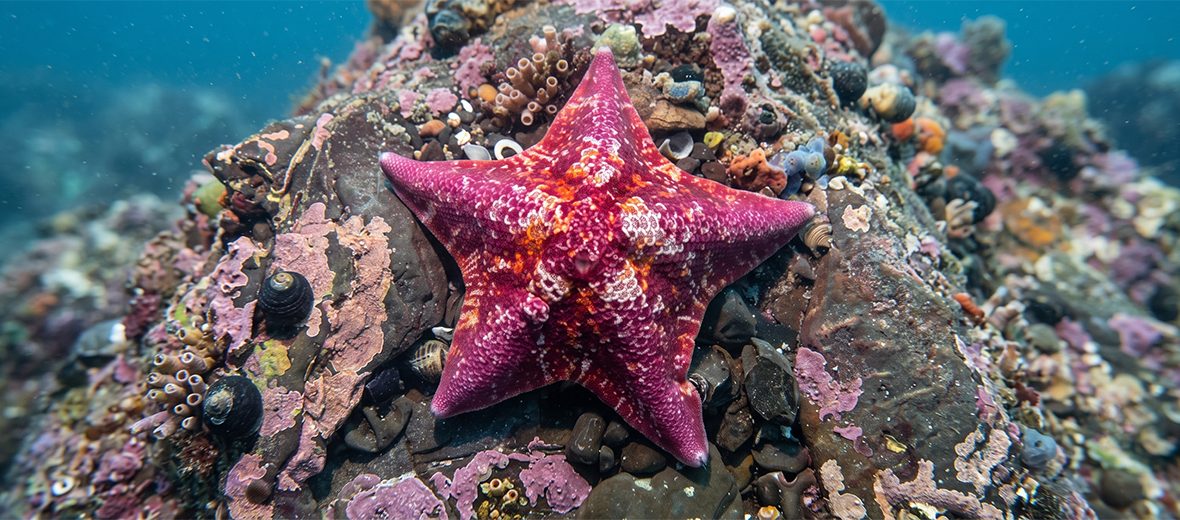
The bat sea star, aka bat star, broad-disk star, sea bat, webbed star, usually has 5 arms, but they can have as many as 9 arms. These sea stars face the threat of sea star wasting disease (SSWD) which causes lesions to form on the body, that eventually decay, causing their arms to fall off and this leads to their death. SSWS is responsible for massive, die-offs across numerous species along the West Coast. Climate change is also responsible for ocean temperatures rising and the shifting environmental conditions weaken the bat star’s immune system and are heavily linked to the outbreaks of SSWD. They are also known to host specific ciliate parasites (like Orchitophrya stellarum) which can castrate male individuals, severely impacting the species’ ability to reproduce. Human interactions pose a localized threat to these critters in the intertidal zone. This includes souvenir harvesting of the animals they feed on, being removed from the water by tourists, as well as general coastal pollution. Additionally, because of their hardiness and long breeding seasons, bat stars are heavily used in embryological experiments. However, these starfish are abundant throughout their range and thus listed as Not Evaluated by the IUCN. Their population trend is listed as stable.
First the Stats…
Scientific name: Patiria miniata
Weight: Up to 8.82 ounces
Length: Up to 8 inches across
Lifespan: Up to 35 years
Now on to the Facts!
1.) They can be found in the intertidal zone at depths of up to 980 feet.
2.) These sea stars were first described by the German zoologist Johann Friedrich von Brandt in 1835.
3.) When eating, they will cover their prey with their stomach and ooze digestive juices over it; this liquefies their food, enabling the sea star to ingest it.
4.) Algae, surfgrass, detritus, smaller invertebrates (like sponges, bryozoans, and tunicates), as well as carrion (dead animals) are all on the menu.
5.) Carnivorous sea stars, cone snails, and crustaceans all prey on these critters.
But wait, there’s more on the bat sea star!
6.) Rather than having a circulatory system bat stars are echinoderms so they have a water-based vascular system. This type of system allows them to be able to use their tube as well as move their food and waste efficiently.
7.) They also utilize their water-based vascular system to serve as their respiratory system. They pull in water using their madreporite (found on the top side of their body) and move it throughout their body using canals and muscular storage sacs.
Did you know…?
Bat stars gently “fight” with one another when they meet. Fighting behavior is comprised of pushing each other and laying an arm over the other.
8.) Females produce up to millions of eggs each spawning season that are fertilized by the male’s sperm. Then the fertilized eggs drift off in the ocean’s current.
9.) These stars are important to the ocean ecosystem in that they serve as janitors tasked with keeping the ocean floor clean of detritus.
10.) In order to deter other animals from taking up a habitat on their body they secret a mucus that deters them from doing so.
Now a Short Bat Sea Star Video!
Be sure to share & comment below! Also, check out the Critter Science YouTube channel. Videos added regularly. Be sure to like and subscribe!

Want to suggest a critter for me to write about? Let me know here.
Some source material acquired from: Wikipedia & IUCN

Leave a Reply