Critter Science
  • Zoology
    • Ecology
      • Animal Conservation
        • CITES: Protecting Wildlife
        • Dame Jane Goodall
        • Endangered Animals
        • Ex Situ Explained
        • In Situ Explained
        • IUCN Statuses
        • Steve Irwin
        • Zoological Branches
      • Animal Immortality and Regeneration
      • Chromatophores and Survival
      • Ecosystems
        • Animal Habitats
        • The Biomes
        • Coastal Erosion
        • Desert Biomes and Wildlife
        • Rainforest Types
      • Evolution. The Facts.
        • Animal Devolution
        • Animal Mimicry
        • Convergent Evolution
        • Carl Linnaeus
        • Charles Darwin
        • Evolution of Amphibians
        • Evolution of Birds
        • Genetic Drift in the Animal Kingdom
        • Naturalism
        • Natural Selection
        • Venom vs Poison
      • Genetic Pollution
      • Invertebrate Families Explored
        • Arthropod Diversity and Adaptations
        • What are Arachnids?
          • Spider Webs
      • Predator vs Prey
      • Producers and Consumers
      • Vertebrate Animal Families
        • Amphibians: Unseen Guardians
        • Snakes vs Legless Lizards
        • What is a Marsupial?
      • The Wild Apothecary
    • Sustainability
      • Climate Change
      • Earth Day: Past, Present, Future
      • Global Warming
      • Pollution
        • Air Pollution
        • Chemical Pollution
        • Land Pollution
        • Light Pollution
        • Microplastics Pollution
        • Noise Pollution
        • Water Pollution
      • Recycling
        • Recycling Plastics
      • Renewable Energy
    • Animal Behavioral Patterns
      • Avian Communication
      • Animal Thermoregulation
      • Cetacean Communication
      • Elephant Communication
      • Herpetofauna Communication
      • Primate Language: The Debate
      • Types of Animal Dormancy
    • What are Species?
      • Amphibians vs Reptiles
      • Animal Reproduction
      • Animal Skin and Scales
      • Claws, Nails, and Talons
      • Fur and Hair
      • Gecko Feet
      • Invasive Species
      • Keystone Species
      • Lazarus Species: Rediscovered Life
      • Speciation
      • Species Complex
      • The Enigmatic Purr
    • About the Critterman
  • Daily Critter Facts
    • Amphibian Facts
      • Frog Facts
      • Newt Facts
      • Salamander Facts
      • Toad Facts
    • Arthropod Facts
      • Arachnid Facts
      • Insect Facts
    • Bird Facts
      • Flightless Bird Facts
      • Predatory Bird Facts
      • Scavenger Bird Facts
      • Wading Bird Facts
    • Cryptozoology
    • Fish Facts
      • Cephalopod Facts
      • Crustacean Facts
      • Jellyfish Facts
      • Reefs
      • Shark and Ray Facts
      • Shellfish Facts
    • Flying Mammal Facts
    • Gastropod Facts
    • Land Mammal Facts
      • Canine Facts
      • Feline Facts
      • Lagomorph Facts
      • Marsupial Facts
      • Mustelid Facts
      • Primate Facts
      • Rodent Facts
      • Ungulate Facts
    • Parasite Facts
    • Reptile Facts
      • Crocodilian Facts
      • Lizard Facts
      • Snake Facts
      • Turtle Facts
    • Sea Mammal Facts
      • Dolphin Facts
      • Porpoise Facts
      • Sea Lion Facts
      • Seal Facts
      • Whale Facts
    • Worm Facts
  • For Teachers
    • Animal Quizzes
      • Amphibian Quiz
      • Bird Quiz
      • Cat Quiz
      • Dog Quiz
      • Dolphin Quiz
      • Insect Quiz
      • Reptile Quiz
    • Animal Word Search
    • Butterfly Life Cycle
      • Butterfly Metamorphosis
      • World’s Largest Butterfly
      • World’s Largest Moth
    • The Cellular Structure of an Animal
    • Coloring Pages
    • Fish and Sharks
    • Frogs vs Toads
    • Insect vs Bug
    • Metamorphosis – A Frog’s Life Cycle
  • Study Guides
    • African Animals
    • Antarctica Animals
    • Asian Animals
    • Australian Animals
    • Central American Animals
    • European Animals
    • North American Animals
    • South American Animals
  • Diseases & Parasites
    • Bsal
    • Canine Distemper Virus (CDV)
    • Chronic Wasting Disease (CWD)
    • The Deadly Chytrid Fungus
    • All About Parasites
    • The Rabies Virus
    • Toxoplasmosis
    • White-Nose Syndrome
  • Contact
    • General Contact
    • Guest Article Submission
      • Guest Articles
        • Guest Articles – 2024
    • What Critter is This?
    • Animal Welfare Organizations
    • Privacy Policy
Subscribe
marbled salamander

The Marbled Salamander

  • 1 May, 2026
  • Critterman
  • No Comments
  • 5 Views
  • 1 Likes
Amphibian Facts, Daily Critter Facts, Salamander Facts

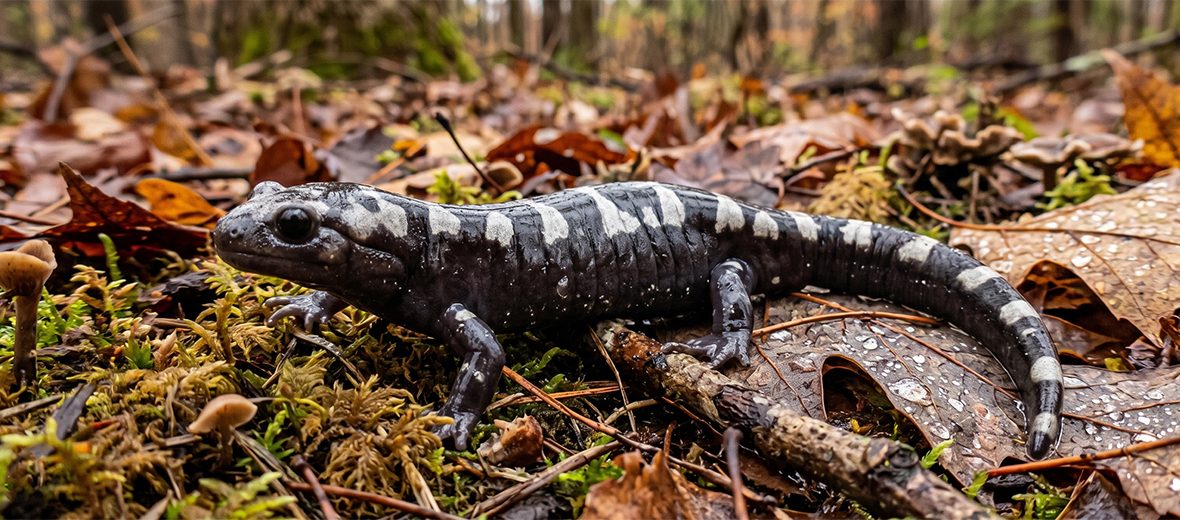
The marbled salamander is a species of mole salamander that is found throughout the eastern half of the United States. Unfortunately, these salamanders face the threats of habitat loss and destruction at the hands of residential and commercial developments, farming, ranching, and logging (which destroys their forests). Roads and railroads not only divide their territory, they also can cause vehicle strike )being hit by vehicles). Many of these sites have become more and more isolated, and could eventually result in detrimental levels of inbreeding and reduced chances of re-establishment for locally depleted subpopulations. However, despite these challenges, these salamanders are still listed as Least Concern by the IUCN. Their population trend is listed as stable as well.

First the Stats…

Scientific name: Ambystoma opacum
Weight: Up to .53 ounce
Length: Up to 4.3 inches, including their tail
Lifespan: Up to 12 years

Now on to the Facts!

1.) Their preferred habitats are damp woodlands, forests, and locations with soft, wet soil.

2.) Not being adept at burrowing, they rely on existing burrows with which to reside within instead.

3.) Protecting various wetlands is paramount to the survival of these salamanders. Conservationists recommend leaving a buffer zone of forested areas around various wetlands to improve survivorship of these salamanders.

4.) Males typically have a better rate of survival than females.

5.) In the northern portions of their range, these sallies undergo torpor (a hibernation state some amphibians partake in that is meant to avoid the colder winter months).

But wait, there’s more on the marbled salamander!

6.) These salamanders hatch early and, in the southern portions of their range, will metamorphose quickly (sometimes in as little as 2 months, compared to their nothern cousins). This gives them an advantage over some other salamanders.

7.) Like most salamanders and nearly all mole salamanders, they are mostly fossorial, spending most of their time in burrows or under logs, stones, and leaf litter.

Did you know…?
They are the state salamander of North Carolina.

8.) Females have clutches of up to 200 eggs. She will also stay with her eggs till the nest floods.

9.) The female will wrap her body around the eggs to form a bowl shape in order to retain water over the eggs. Water needs to make extended contact with the eggs in order for them to begin the hatching process.

10.) That being said, if disturbed, the female will abandon her eggs if threatened by a predator or otherwise bothered.

But wait, there’s still more on the marbled salamander!

11.) Even though most of these salamanders will return to their place of birth to lay eggs, some have been documented traveling nearly 2 miles away.

12.) Due to this dispersal, this means that it’s important to see these populations as a larger metapopulation rather than focusing simply on a single wetland area. A metapopulation consists of a group of spatially separated populations of the same species which interact, or meet up, at some point.

Did you know…?
These salamanders have been found to display prominent biofluorescence under ultraviolet light along the bones in their digits and the cloacal (rectum) region of both males and females. They also have mucus-like secretions that fluoresce green as well.

13.) The larvae are typically positively phototactic until fully developing their rear legs. Then they switch behaviors and become negatively phototactic. Positively phototactic means they move towards the light–like a moth–and negatively phototactic means they move away from light.

14.) Adults feed on worms, insects, centipedes, various other arthropods, snails, slugs, and other salamanders such as spotted salamanders. Larvae feed on zooplankton, and copepods, but larger ones will eat crustaceans like brine shrimp, aquatic insects, snails, worms, and eggs & larvae of other amphibians.

15.) If threatened, they are capable of caudal autonomy (they can drop their tail). They also have the ability to produce noxious chemicals from glands at the base of their tail. These toxins are a noxious, milky secretion excreted from granular glands and can cause irritation or illness if ingested by animals.

Now a Short Marbled Salamander Video!

Be sure to share & comment below! Also, check out the Critter Science YouTube channel. Videos added regularly!

Subscribe


Want to suggest a critter for me to write about? Let me know here.

Some source material acquired from: Wikipedia & IUCN

Trending
The Palo Verde Beetle

amphibianamphibiansmarbledmarbled salamandermole salamandersalamandersalamandersUnited States
Critterman

With over 50 years of critter experience to my credit and hundreds of zoology teaching hours to people around the world, I have amassed not only a continuing thirst for critter knowledge but a desire to teach others all I can about the majesty and wonder of our natural world. Critter Science is a culmination of such knowledge. I have hands on as well as book acquired intel on all kinds of critters. Whether they're on land, sea, or in the air. I will never say that I know everything about all animals. That's impossible, even for a savant. But, that being said, ask me any animal question and I'll answer it. If I don't know the answer, I'll get an answer for you!

The Little Corella
Related Posts
  • little corella
    The Little Corella 30 April, 2026
  • mountain pygmy possum
    The Mountain Pygmy Possum 28 April, 2026
  • Sudan plated lizard
    The Sudan Plated Lizard 27 April, 2026
  • Daily Critter Facts
  • Guest Articles
  • BYET
  • Teachers
  • Study Guides
  • Contact

Copyright © 2025, Critter Science. All Rights Reserved.