
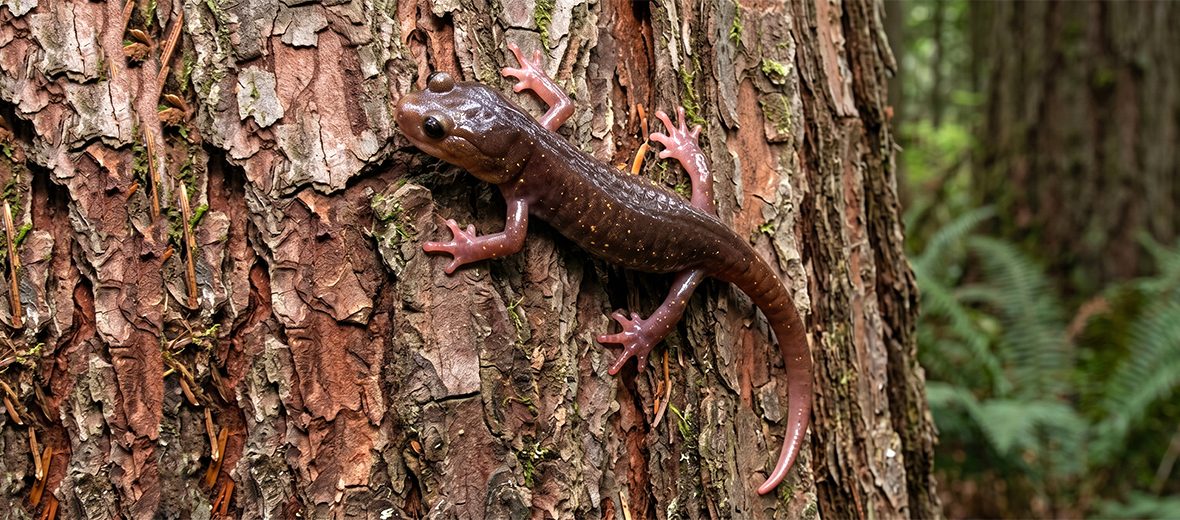
The arboreal salamander is a species of salamander that can actually climb trees. They can be found from California down to Baja California. These salamanders face the threats of habitat loss and destruction at the hands of residential and commercial developments, farming, ranching, deforestation, and logging. However, they are still abundant enough to be listed as Least Concern by the IUCN. Their population trend is also listed as stable.
First the Stats…
Scientific name: Aneides lugubris
Weight: Up to 1.34 ounces
Length: Up to 7 inches, including their tail
Lifespan: Up to 15+ years
Now on to the Facts!
1.) Their teeth are both sharper and longer than other members of the order Urodela.
2.) When falling, these salamanders have the ability to glide in order to slow their decent to the ground, limiting injuries upon landing.
3.) They are nocturnal (active at night).
4.) These salamanders are lungless and breathe through their skin and special membranes in their throat and mouth.
5.) Due to their arboreal (spend most or all of their lives in trees) lifestyle, these salamanders forgo the larval stage of development.
But wait, there’s more on the arboreal salamander!
6.) Their preferred habitats are coastal woodlands, conifer forests, and shrublands.
7.) Females lay up to 24 eggs that hatch in up to 4 months.
Did you know…?
These salamanders can actually produce sounds that resemble that of a barking dog.
8.) The eggs are laid in moist burrows, usually at the base of trees. The hatchlings then enter the burrow made by their parents to develop.
9.) Once hatched, the young salamanders are then guarded by the parents till they’re old enough to care for themselves. This demonstrates parental care, which is not common in amphibians.
10.) During courtship, the male will place his mental gland on the back of a female, then use his teeth to scratch the surface of her skin to inject the pheromones from his mental gland into the female’s blood stream.
11.) This gland is a specialized, pheromone-producing skin gland found in the chin region of many male amphibians.
Now a Short Arboreal Salamander Video!
Be sure to share & comment below! Also, check out the Critter Science YouTube channel. Videos added regularly. Be sure to like and subscribe!

Want to suggest a critter for me to write about? Let me know here.
Some source material acquired from: Wikpedia & IUCN


Leave a Reply