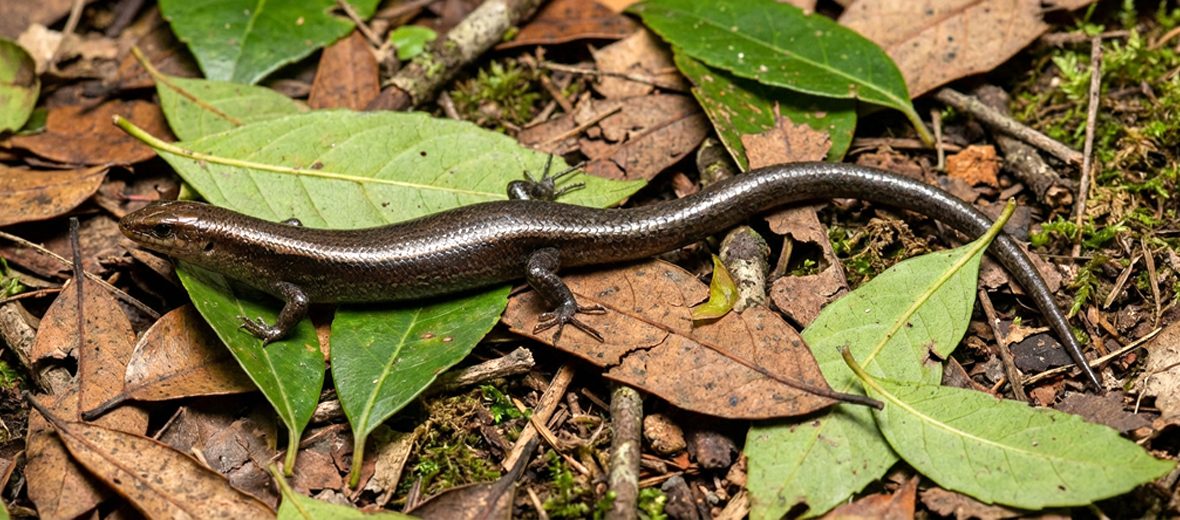
The delicate skink, aka dark-flecked garden sun skink, garden skink, delicate garden skink, rainbow skink, plague skink, or metallic skink, while native to Australia, are invasive in New Zealand, Lord Howe Island, and Hawaii. These lizards face the threats of feral and domestic cats, that can sometimes wipe out entire populations of these lizards. Habitat loss and destruction at the hands of residential and commercial developments is another threat faced, along with fires and fire suppression that destroys the availability of food and their habitat, climate change that causes droughts, which also affect their availability of food and shelter. Another issues is accidental poisoning, when they consume a poisoned insects. Their existence often causes misidentification and the subsequent killing of other native skinks of similar appearance, too. However, despite all these issues, they are abundant and (as mentioned) invasive in 3 locales. Therefore, they are listed as Least Concern by the IUCN. Their population trend is listed as stable and increasing.
First the Stats…
Scientific name: Lampropholis delicata
Weight: Up to 0.06 ounce
Length: Up to 2.17 inches, plus up to a 4.33 inch tail
Lifespan: Up to 4 years
Now on to the Facts!
1.) They were first described by zoologist, ornithologist, and paleontologist Charles Walter De Vis in 1888.
2.) Like most other lizards, they are diurnal (active during the day).
3.) Due to the fact that males have broader, longer heads and females have a larger abdomen and body size, these lizards are sexually dimorphic.
4.) These skinks are capable of caudal autonomy (they can drop their tail and regrow a new tail in response to a threat).
5.) Their preferred habitats are rainforest edges, sclerophyll forests (woody plants with hard, leathery, evergreen leaves adapted to hot, dry climates and nutrient-poor soils), woodlands, and suburban gardens.
But wait, there’s more on the delicate skink!
6.) Spiders, insects, snails, crustaceans, bees, wasps, springtails, beetles, termites, and ants are all readily consumed.
7.) Females lay a clutch of up to 7 eggs that hatch in up to 8 weeks.
Did you know…?
These skinks don’t only have the ability to drop their tail, but they can do so at any point in the length of it; the tip, the middle and tip, or the entire tail.
8.) There are 2 color morphs known: a prominent white stripe and the lacking of the stripe along the lateral to midsection of the body.
9.) Redbacked spiders are known to prey on these lizards, when they become entangled in their web.
10.) These lizards have become the most numerous skink on the main Hawaiian Islands
Now a Short Delicate Skink Video!
This video talks about skinks in general.
Be sure to share & comment below! Also, check out the Critter Science YouTube channel. Videos added regularly. Be sure to like and subscribe!

Want to suggest a critter for me to write about? Let me know here.
Some source material acquired from: Wikipedia & IUCN