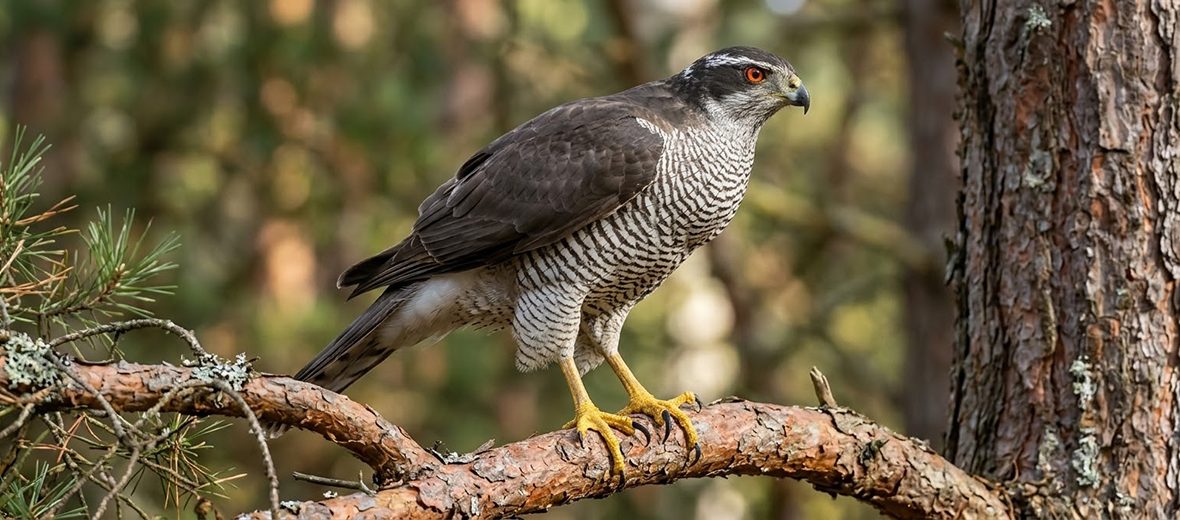
The Eurasian goshawk, aka goshawk, hails from the same family of raptors as buzzards, eagles, and harriers. They can be found in Europe, Asia, and Africa. Due to their widespread distribution, these raptors face a multitude of threats. Commercial timber harvesting and land development destroys mature, closed-canopy forests these goshawks rely on for nesting and hunting. Removing large, old trees directly reduces breeding territory occupancy and fragments forest habitats. Although killing goshawks is illegal across most of Europe, localized persecution remains a constant issue, mainly in Fennoscandia and parts of the United Kingdom. Hunters and gamekeepers sometimes target them to protect gamebirds like grouse or smaller livestock. Goshawks are highly sensitive to human activity close to their nests during the breeding season. Logging operations, road building, and recreational foot traffic close to active nesting trees can cause breeding pairs to abandon their eggs and/or chicks. As goshawks increasingly adapt to fragmented landscapes and even colonize urban parks, they face higher risks of fatal collisions with windows, power lines, and vehicles. During the 19th and early 20th centuries, intensive predator-control efforts drove this species to near extinction in regions such as Great Britain. Thousands of birds were also killed annually in countries like Norway between circa 1880 – 1930. In the 1950s and 1960s, the widespread utilization of organochlorine pesticides such as DDT caused severe reproductive failures and sharp population crashes in Western Europe. Populations only began to recover after these chemicals were banned and legal protections were subsequently enforced. However, despite these threats, these birds are abundant and widespread. Thus the IUCN lists them as Least Concern. Their population trend is listed as unknown at this time.
First the Stats…
Scientific name: Astur gentilis
Weight: Up to 3.77 lbs.
Length: Up to 27.2 inches
Wingspan: Up to 50 inches
Lifespan: Up to 20 years
Now on to the Facts!
1.) These birds of prey were formally described in 1758 by the Swedish naturalist Carl Linnaeus in the tenth edition of his Systema Naturae.
2.) Their scientific name, astur, is Latin and translates to “hawk” and gentilis which means “noble” or “gentle” because in the Middle Ages only the nobility were permitted to fly goshawks for falconry.
3.) In Europe alone, 12 subspecies were described between 1758 – 1990. Today, 7 weakly differentiated subspecies are recognized: A. g. gentilis, A. g. arrigonii, A. g. buteoides, A. g. albidus, A. g. schvedowi, and A. g. fujiyamae.
4.) These raptors prefer habitats with mature, extensive coniferous, deciduous, and mixed forests with dense upper canopies and typically open understories.
5.) There have been random reports of these birds in Alaska in the United States, as well as in Newfoundland, in Canada.
But wait, there’s more on the Eurasian goshawk!
6.) Their call is a fast, high-pitched kew-kew-kew when providing food or a very different croaking guck or chup, other times.
7.) Being highly territorial, these raptors dwell alone or in pairs, but never in flocks.
Did you know…?
There are an estimated 2,499,999 wild individuals remaining, to date.
8.) Territorial flights can occur throughout a majority of the year, but peak from January – April. These flights can include slow-flapping with exaggerated high deep beats interspersed with long glides and undulations. In general though, territorial fights are often resolved without any physical contact.
9.) These birds of prey are considered to be a partial migrant, in that only the northernmost individuals will migrate south for the winter.
10.) Pigeons, doves, grouse, pheasants, partridges, jays, crows, magpies, woodpeckers, songbirds, rabbits, hares, squirrels, mice, rats, moles, voles, and more are all on the menu.
But wait, there’s still more on the Eurasian goshawk!
11.) Like other similar raptors, they are diurnal (active during the day).
12.) Copulation is brief & frequent, totaling up to 520 times per clutch (averaging up to 10 times a day or up to 300 throughout the season), and may be the male’s way of ensuring paternity seeing as he’s often away gathering food by the time of egg-laying, however, extra-pair copulations are very rare.
13.) Females lay a clutch of up to 6 eggs that hatch in up to 40 days.
14.) The name “goshawk” hails from the traditional Anglo-Saxon name gōshafoc, which literally translates to “goose hawk”. This name implies prowess against larger quarry like wild geese, but were also flown against crane species and other large waterbirds.
Now a Short Eurasian Goshawk Video!
Be sure to share & comment below! Also, check out the Critter Science YouTube channel. Videos added regularly. Be sure to like and subscribe!
Buy My Book
Select the image below to see everywhere my book is sold.


Want to suggest a critter for me to write about? Let me know here.
Some source material acquired from: Wikipedia & IUCN