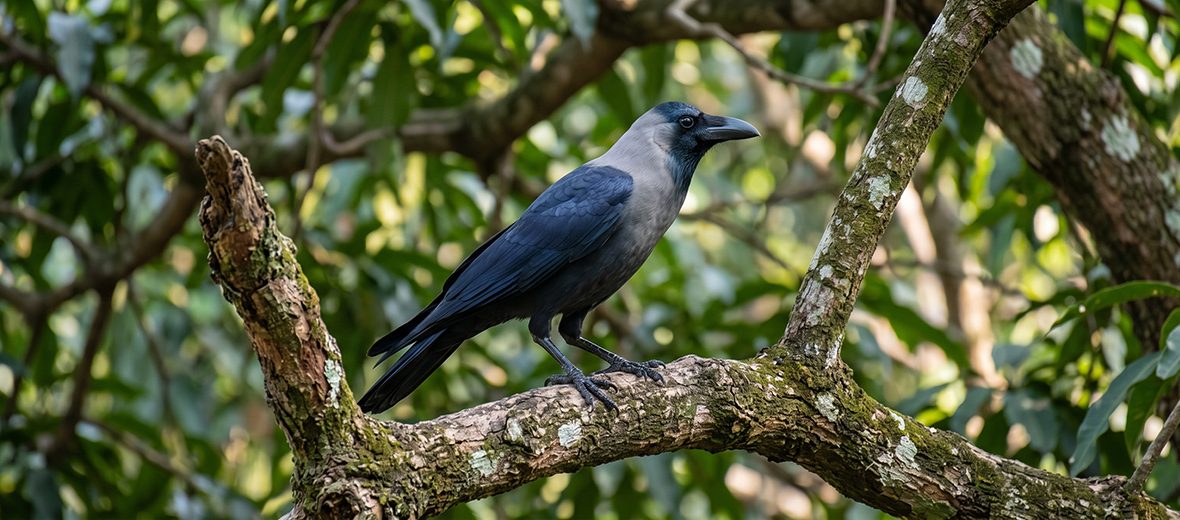
The house crow, aka Indian crow, greynecked crow, Ceylon, or Colombo crow, can be found in India, the Middle East, Africa, Australia, and other locales. They are similar in size to the carrion crow and the jackdaw. Outside their native range they are considered an invasive species. They are often the subject of targeted avian poisons used to systematically cull their populations. Global municipalities (like Singapore and South Africa) utilize wide-scale trapping operations and bounty systems to control their populations. Local councils frequently destroy these crow’s nests and aggressively prune trees during breeding seasons to stop their reproductive cycles. In their native home of India, other large corvids (such as ravens and jungle crows) compete with them heavily for territorial dominance and food resources, thus keeping them in check. Due to their global numbers and invasive tendencies, these crows are listed as Least Concern by the IUCN. Their population trend is listed as stable.
First the Stats…
Scientific name: Corvus splendens
Weight: Up to .82 lb.
Length: Up to 17 inches
Wingspan: Up to 35 inches
Lifespan: Up to 15 years
Now on to the Facts!
1.) They are preyed on by hawks, eagles, owls, monkeys, and snakes.
2.) These crows were officially described in 1817 by the French ornithologist Louis Vieillot.
3.) Their specific epithet hails from the Latin splendens, splendentis and translates to “brilliant” or “glittering”.
4.) They have recently arrived in Europe and have been breeding in the Dutch harbor town Hook of Holland since 1998.
5.) House crows are typically associated with humans from suburban to urban settlements. Thus, when the human population explodes, so does the population of house crows.
But wait, there’s more on the house crow!
6.) Insects, other small invertebrates, eggs, nestlings, grains, fruits, small lizards, small snakes, mice, juvenile rats, baby squirrels, carrion (dead animals), and human refuse are all on the menu for these scavenging and opportunistic birds.
7.) Females lay up to 5 eggs that hatch in up to 17 days.
Did you know…?
In 2016, these crows were added to the list of invasive alien species of Union concern.
8.) Their call is a harsh “kaaw-kaaw” sound.
9.) They are among the few corvid species who’s tool usage is well documented and extraordinary.
10.) A testament to their intelligence, they are currently the only known species of corvid with an ability to successfully perform the mirror-mark test used for identifying the self-recognition behavior in animals in a laboratory setting.
11.) These crows have been found to carry Cryptococcus neoformans, which can cause cryptococcosis (a serious fungal infection) in humans.
Now a Short House Crow Video!
Be sure to share & comment below! Also, check out the Critter Science YouTube channel. Videos added regularly. Be sure to like and subscribe!

Want to suggest a critter for me to write about? Let me know here.
Some source material acquired from: Wikipedia & IUCN