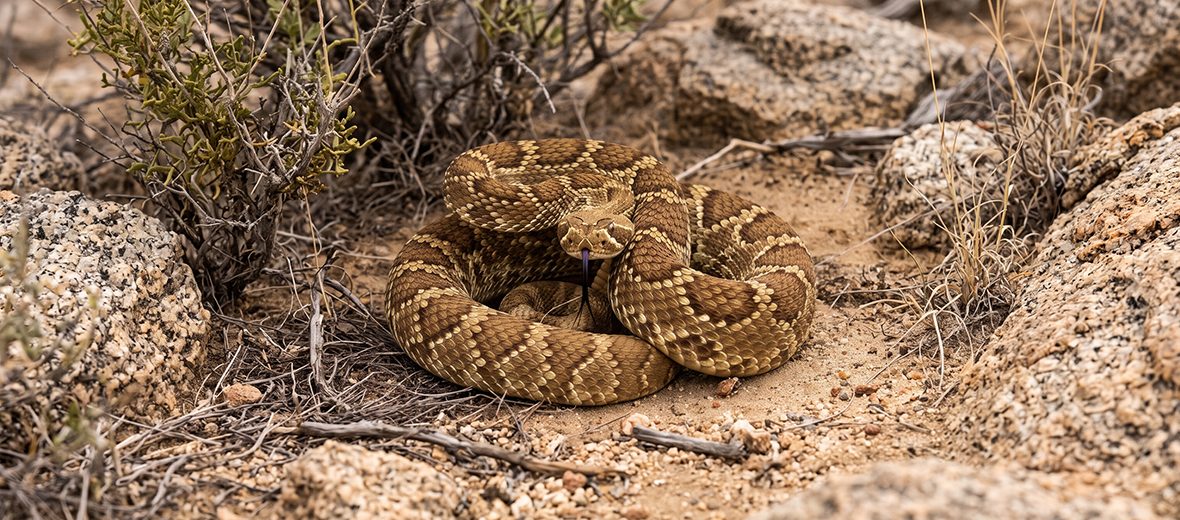
The Mojave rattlesnake, aka Mohave rattlesnake, northern Mohave rattlesnake, Mojave green rattlesnake, and Mojave green, is a highly venomous pitviper found throughout the deserts of the southwestern United States and far into mainland Mexico. It is perhaps best known for producing 2 distinctly different venom types from different populations. Extensive urban development, residential construction, and agriculture across the Mojave and Sonoran deserts destroy their native scrublands and grasslands. This forces displaced individuals into neighborhoods and backyards. Because they are primarily active during the evening hours and often cross warm desert roads at night, high numbers of individuals are killed by passing vehicles. Due to their reputation for having potent neurotoxic venom and myths about aggression (properly termed defensiveness), people frequently kill them on sight rather than leaving them alone or calling for relocation. Due to climate change, rising temperatures and prolonged droughts in the American Southwest and Mexico alter prey availability and force populations to shift their geographic ranges. Despite these threats, these rattlers are still abundant enough to be listed as Least Concern by the IUCN. Their population trend is listed as stable at this time.
First the Stats…
Scientific name: Crotalus scutulatus
Weight: Up to 1.5 lbs.
Length: Up to 53 inches
Lifespan: Up to 25 years
Now on to the Facts!
1.) ) These rattlers were first scientifically described by American naturalist Robert Kennicott in 1861.
2.) Their preferred habitats are open, arid deserts and scrubland landscapes, rather than thick forests or rugged, rocky slopes.
3.) They are most active from April – September.
4.) These rattlesnakes are primarily ambush predators that prey on mice, rats, gophers, moles, and lizards.
5.) If the temperatures get to cold or hot, they will estivate in burrows excavated by animals like rodents, tortoises, and kit foxes.
But wait, there’s more on the Mojave rattlesnake!
6.) They’re preyed on by bobcats, coyotes, and various raptors.
7.) For decades, the bite of this rattlesnake has been considered to be particularly deadly, and often described as “the” (or “1 of the”) deadliest or most dangerous rattlesnakes in North America.
Did you know…?
Based on their region, there are 3 types of venom: Type A, type B, and type A & B. Type A is a potent presynaptic neurotoxin. Type B is like that of other rattlesnakes, causing severe local tissue destruction and blood-clotting disorders. Type A & B results in a combined neurotoxic and tissue-damaging effect.
8.) The effects are as follows… Type A: Severe systemic neurotoxicity, muscle weakness, and potential respiratory paralysis with minimal local swelling or tissue damage. Type B: Extensive local tissue destruction, severe swelling, internal bleeding, and blood clotting disorders without neurotoxic symptoms. Type A & B: Combined symptoms featuring both rapid local tissue damage/bleeding and systemic neurological deficits.
9.) Typical effects are muscle fiber necrosis (tissue death & myotoxicity), involuntary muscle spasms, neurotoxic or hemotoxic effects, and death, if immediate medical treatment (antivenin) is not administered in time.
10.) Females undergo up to a 170 day gestation (pregnancy) that can yield up to 17 live young.
11.) Like other rattlesnakes, these critters are nocturnal (active at night).
Now a Short Mojave Rattlesnake Video!
Be sure to share & comment below! Also, check out the Critter Science YouTube channel. Videos added regularly. Be sure to like and subscribe!
Buy My Book
Select the image below to see everywhere my book is sold.

Want to suggest a critter for me to write about? Let me know here.
Some source material acquired from: Wikipedia & IUCN