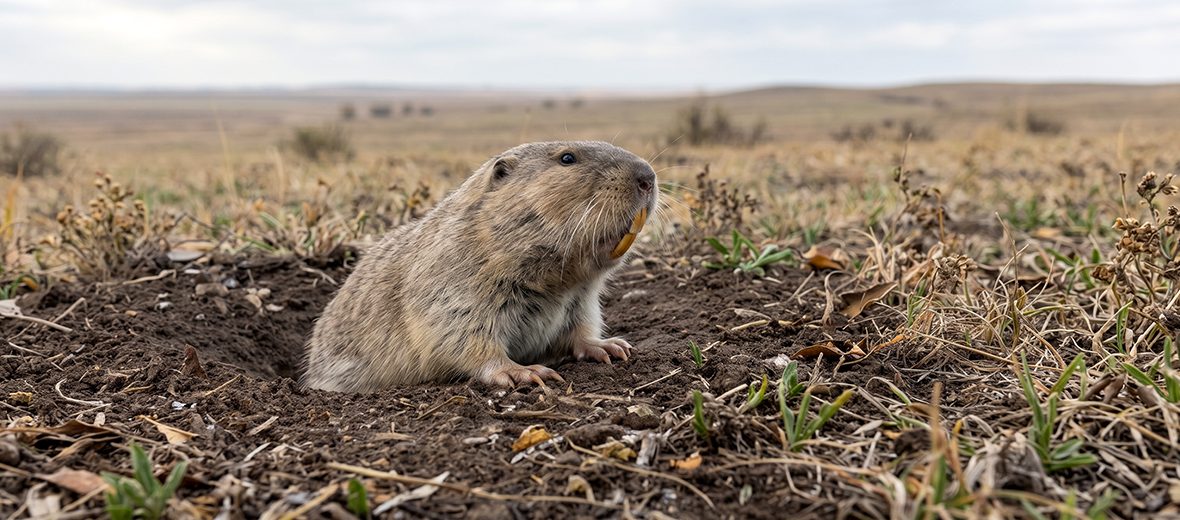
The yellow-faced pocket gopher can be found from central United States down to northern Mexico. These, like all gophers are considered agricultural pests. They are naturally plagued by blood-sucking mites (like Echinonyssus femuralis, which infests their cheek pouches, and also Androlaelaps geomys), alongside a variety of species of lice, fleas, and ticks, which can not only weaken the animals but impact their natural mortality rates. These rodents are also easily drowned in areas that flood, as they are weak swimmers. They are abundant throughout their range though, and thus listed as Least Concern by the IUCN. Their population trend is listed as stable as well.
First the Stats…
Scientific name: Cratogeomys castanops
Weight: Up to 13.9 ounces
Length: Up to 12 inches, including their tail
Lifespan: Up to 13 months
Now on to the Facts!
1.) In Texas they begin to molt in August and continue into March. The new pelage (fur coat) has been found to be thicker, but has no change in coloration.
2.) There is sexual dimorphism in this species of rodent in that males are notably larger than females.
3.) Males from all genera of pocket gophers continue to grow after reaching sexual maturity. However, females grow very little after reaching sexual maturity.
4.) The majority of plants consumed are actually pulled into the burrow by the roots and consumed.
5.) Roots, tubers, bulbs, rhizomes, grasses, clover, dandelion, perennial ragweed, stems, leaves, cultivated roots, alfalfa, carrots, and potatoes are all on the menu.
But wait, there’s more on the yellow-faced pocket gopher!
6.) During mating and copulation, the males produce low guttural squeaks throughout their exploratory activities, and when body contact is made the male bites the female and holds onto her while copulating.
7.) Females undergo up to a 27 day gestation (pregnancy) that yields up to 4 pups.
Did you know…?
Their burrows can extend to 635 square feet and are up to 4.3 feet deep, with up to a 4 inch in diameter opening.
8.) When the pups are nearly fully grown, they disperse from the parental burrow to start life on their own.
9.) Their preferred habitats are arid and semi-arid regions that feature deep, loose, well-drained soils.
10.) Hawks, owls, eagles, snakes, badgers, weasels, coyotes, foxes, and bobcats all prey on these gophers.
11.) These rodents are cathemeral (active both day and night).
Now a Short Yellow-Faced Pocket Gopher Video!
This video talks about the pocket gopher, in general.
Be sure to share & comment below! Also, check out the Critter Science YouTube channel. Videos added regularly. Be sure to like and subscribe!

Want to suggest a critter for me to write about? Let me know here.
Some source material acquired from: Wikipedia & IUCN