
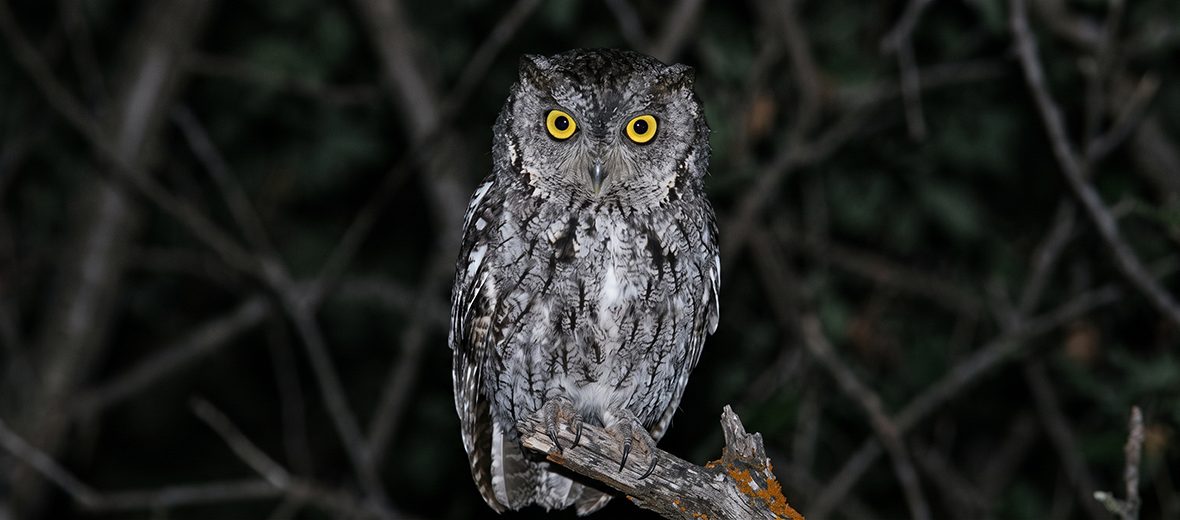
The western screech owl is a small species of owl that hails from Canada, United States, Mexico, and Central America. They are related to the eastern screech owl. These owls face the threats of habitat loss and destruction seeing as these owls rely on natural cavities and old woodpecker holes in mature, standing dead trees, aka snags, and large cottonwoods for nesting and roosting. The removal of these hides reduces their ability to roost and nest. Clearing riparian woodlands, forest fragmentation, and removing “hazardous” dead trees in parks or forestry operations destroys vital territories. Over the years the expansion of larger barred owls into western forests has created intense competition for food and living space, alongside direct predation on these smaller owls. Secondary poisoning from rodenticides is another threat faced. Roads bring about the possibility of vehicle strike (being hit by vehicles). Finally, climate change can cause severe droughts, changing precipitation patterns, and the possibility of forest fires that degrade local habitats and alter the availability of food. However, due to their wide range and abundant numbers these owls are listed as Least Concern by the IUCN. Their population trend is listed as decreasing though.
First the Stats…
Scientific name: Megascops kennicottii
Weight: Up to 8.8 ounces
Length: Up to 10 inches
Wingspan: Up to 22 inches
Lifespan: Up to 14 years
Now on to the Facts!
1.) Multiple morphs exist, such as the brown Pacific, grey Pacific, Great Plains, Mojave, and Mexican morphs.
2.) Their brown and gray streaked coloration affords these owls with camouflage among the trees in order to hide from predators.
3.) Their primary call is that of an accelerating series of short whistles at an increasing rate or a short then long trill falling a little towards the end. Their other calls consist of barking and chuckling, like the eastern screech owl. They also produce a high pitched screech.
4.) It has been documented that on average, male bounce songs were -30% lower in frequency than the bounce and trill songs of females. However, song length, note length, number of notes per bout, and internote length was the same for both male and female.
5.) Their preferred habitats are temperate forests, subtropical forests, tropical montane forests, shrublands, deserts, rural fields, and even suburban parks and gardens.
But wait, there’s more on the western screech owl!
6.) When wooing a female, a male will bring her food and will create a series of clicking sounds. During courtship, the pair will preen one another’s feathers and then sing duets with each other.
7.) Females produce up to 7 eggs that hatch in up to 34 days.
Did you know…?
There are an estimated 180,000 wild individuals remaining, to date.
8.) The female incubates the eggs while the male tends to bringing food for her and their chicks, once hatched.
9.) They are preyed on by great horned owls, spotted owls, the aforementioned barred owl, Cooper’s hawks, crows, ravens, jays, raccoons, skunks, weasels, squirrels, and gopher snakes.
10.) Like so many other owls, they are nocturnal (active at night).
But wait, there’s still more on the western screech owl!
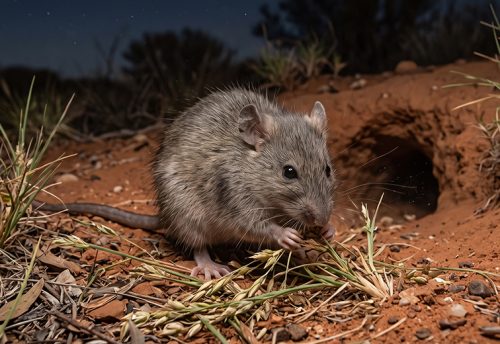
11.) Mice, rats, flying squirrels, rabbit kits, bats, northern cardinals, cicadas, smaller trout, worms, scorpions, crayfish, various reptiles, and amphibians are all on the menu.
12.) Hatching of their young is often synchronized with the spring migration of other birds; after migrant birds pass through the territories of these owls, they take the fledglings of these smaller birds.
Now a Short Western Screech Owl Video!
Be sure to share & comment below! Also, check out the Critter Science YouTube channel. Videos added regularly. Be sure to like and subscribe!

Want to suggest a critter for me to write about? Let me know here.
Some source material acquired from: Wikipedia & IUCN


Leave a Reply