
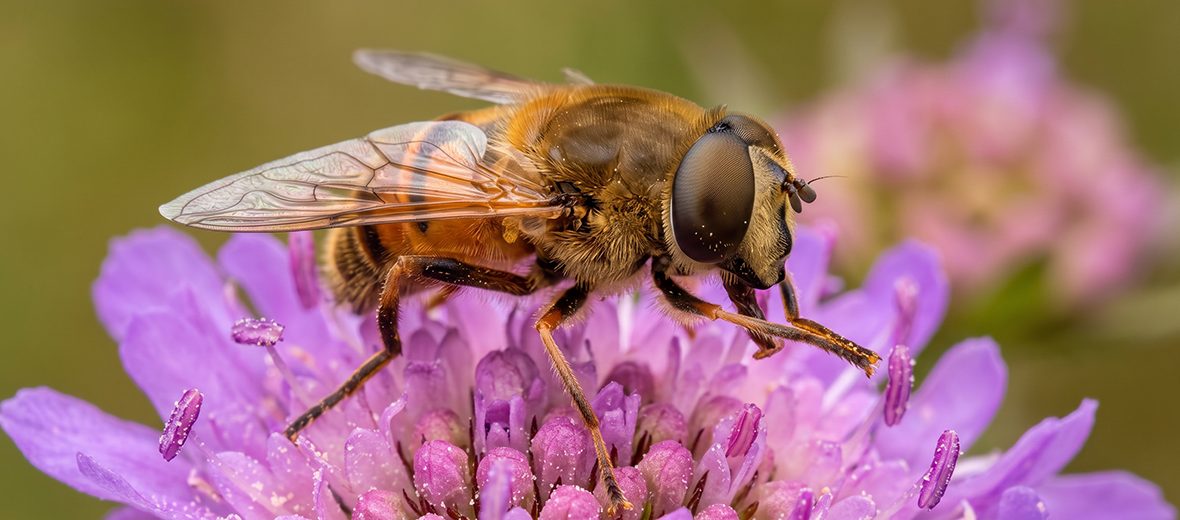
The common drone fly is the most globally distributed species of syrphid in the world, and exists in all regions except the Antarctic. They have been introduced into North America and are heavily established. These flies can be found in gardens and fields in Europe and Australia, and have also been found in the Himalayas. They face the threat of ingesting microplastics from polluted water. Insecticides are another formidable hazard. They also face the threats of habitat loss and destruction due to the conversion of natural grasslands, heathlands, and diverse woodlands into dense urban infrastructure or intensive agricultural monocultures which reduces the availability of continuous flower borders. Finally, climate change causes severe or unpredictable weather shifts that confine males to their territory or alter resource availability, they become increasingly aggressive, which disrupts natural foraging and mating patterns. However, due to their global distribution and massive numbers, they are listed as Least Concern by the IUCN. Their population trend is listed as stable.
First the Stats…
Scientific name: Eristalis tenax
Weight: Up to .005 ounce
Length: Up to .6 inch
Wingspan: Up to .59 inch
Lifespan: Up to 4 weeks
Now on to the Facts!
1.) Males are known to be highly territorial throughout summer, guarding territories like flowerbeds or bushes to ensure an opportunity to mate.
2.) They hover motionless in the air and chase after intruders to scare them out of their territory.
3.) When away from their home territory, males rarely react to other insects. But when they’re stationed in their own territory in their mating site, the male becomes so territorial that they even attack bees, wasps, and butterflies when they venture near the male’s flowers.
4.) These flies are easily differentiated from honey bees due to the fact that they do not have a constricted “waist” between the thorax and the abdomen.
5.) They are sexually dimorphic in that males typically have lighter patterns than females. They can also be easily distinguished from females due to their large eyes that nearly touch each other, whereas females have smaller eyes that are spaced further apart.
But wait, there’s more on the common drone fly!
6.) In extremely rare conditions, there have been documented cases of human intestinal myiasis of the rat-tailed maggot. This is where the maggot enters the anus and survives by consuming feces (poop), sticking their siphon out of the anus in order to breathe. But this is very rare!
7.) Females can lay up to 3,000 eggs in her lifetime, in batches of up to 200 at a time.
Did you know…?
These insects are called drone flies due to their resemblance to honey bee drones.
8.) The larvae are aquatic and have an exceedingly long “tail” segment. They are also known as rat-tailed maggots. This segment is actually not a tail but rather a breathing siphon.
9.) Larvae are saprophagous (feed on dead or decaying matter). They develop in drainage ditches, pools around manure piles, sewage, and similar places where water is polluted with organic matter, where they feed on bacteria present in these locales.
10.) Their sheer toughness and resilience increases with age; their skin is insoluble even when exposed to strong alkaline solutions. There have been documents of decapitated drone flies living for 3 days and nights on the stage of a microscope. With their abdomen removed, an adult drone fly buzzed for more than an hour.
But wait, there’s still more on the common drone fly!
11.) The thorax has be sliced open for examination, and the muscular bundles inside still twitched when an irritant or needle-point was applied.
12.) Even removing their wings seems to result in very little inconvenience to these flies, when put on a flower the fly without wings immediately plunged its proboscis into the center of the flower, then continued to feed for several minutes.
Did you know…?
They may look just like a honey bee, but they are incapable of stinging like one. They are totally harmless.
13.) Nectar and pollen makes up the bulk of their diet. They will also drink standing water and dew when present.
14.) The morphological and behavioral similarities between these flies and honey bees is an excellent example of convergent evolution in response to the same food-gathering requirements.
15.) Considering their quest for nectar and pollen, these insects are important to the ecosystems in which they reside due to the pollination and cross-pollination that occurs as a result.
Now a Short Common Drone Fly Video!
Be sure to share & comment below! Also, check out the Critter Science YouTube channel. Videos added regularly. Be sure to like and subscribe!

Want to suggest a critter for me to write about? Let me know here.
Some source material acquired from: Wikipedia & IUCN

Leave a Reply