
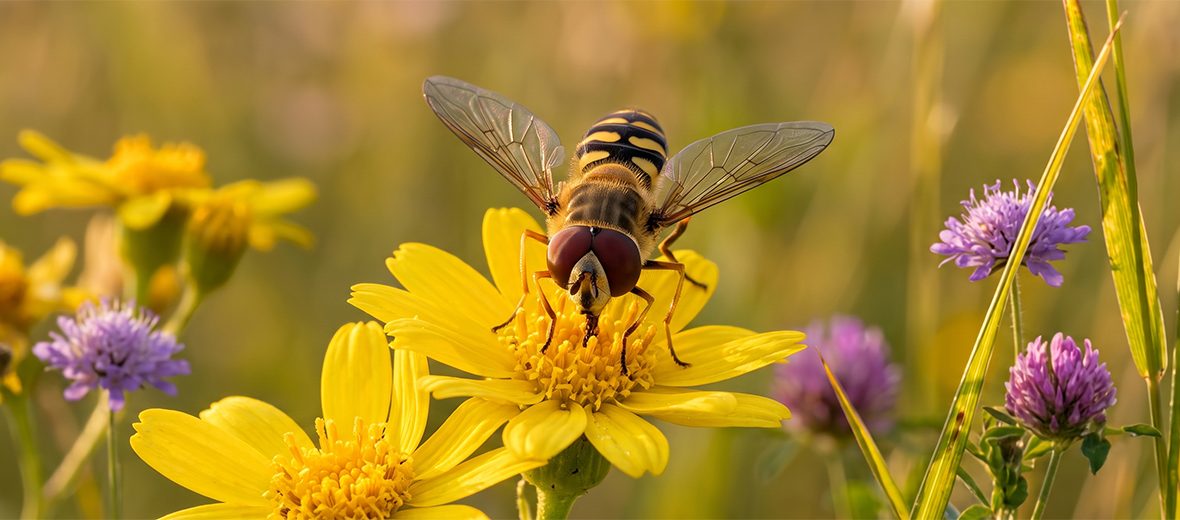
The European hoverfly, aka syrphid or Terrasjeskommazweefvlieg (yes that’s a name), hails primarily from Europe, but also inhabits Asia and some African territories. They face the threats of habitat loss and destruction at the hands of residential and commercial developments. They’re also mildly threatened by the harlequin ladybird. However, due to their shear numbers and wide, 3 continent distribution, they are listed as Least Concern by the IUCN. Their population trend is listed as stable as well.
First the Stats…
Scientific name: Eupeodes corollae
Weight: Up to 0.001 ounce
Length: Up to .43 inch
Lifespan: Up to 24 days (23 days are spent as a larvae)
Now on to the Facts!
1.) The larvae feed on aphids, mites, and mealybugs. Adults feed on pollen and nectar.
2.) Their preferred habitats are open, flowery biomes where nectar and aphid prey are abundant.
3.) The favored flowers visited by adults are umbellifers, Achillea millefolium, Campanula rapunculoides, Chrysanthemum, Cirsium, Eschscholzia californica, Galeopsis, Hypericum, Leontodon, Origanum vulgare, Potentilla erecta, Ranunculus, Rubus fruticosus, Salix, Senecio, Tripleurospermum inodoratum, and Tussilago.
4.) The aphid-eating larvae are economically and ecologically important. The larvae are potential agents for utilization in biological control, while the adults are beneficial pollinators.
5.) To date, there are approximately 6,000 species in 200 genera of hoverflies described.
But wait, there’s more on the European hoverfly!
6.) Hovering in general is a means of finding a source of food. Male hovering is typically a territorial display used to seek out females, while female hovering serves as a method of inspecting ovipositing sites.
7.) These flies date back to the Eocene aged Florissant Formation, Green River Formation and Baltic amber (56 million years ago).
Did you know…?
Although exceptionally rare, some hoverfly larvae have caused accidental myiasis in humans. This happens when the larvae are accidentally ingested from contaminated food or the maggot burrows into a host human or animal. Accidental ingestion, aka enteric pseudomyiasis, can cause nausea, gastrointestinal upset, and vomiting.
8.) Females can lay up to 1,000 eggs in her short lifetime.
9.) These insects are diurnal (active during the day).
10.) Spiders, lacewings, ladybugs, assassin bugs, beetles, and ants all prey either intentionally or opportunistically on these flies.
Now a Short European Hoverfly Video!
This video talks about hoverflies in general.
Be sure to share & comment below! Also, check out the Critter Science YouTube channel. Videos added regularly. Be sure to like and subscribe!

Want to suggest a critter for me to write about? Let me know here.
Some source material acquired from: Wikipedia & IUCN


Leave a Reply