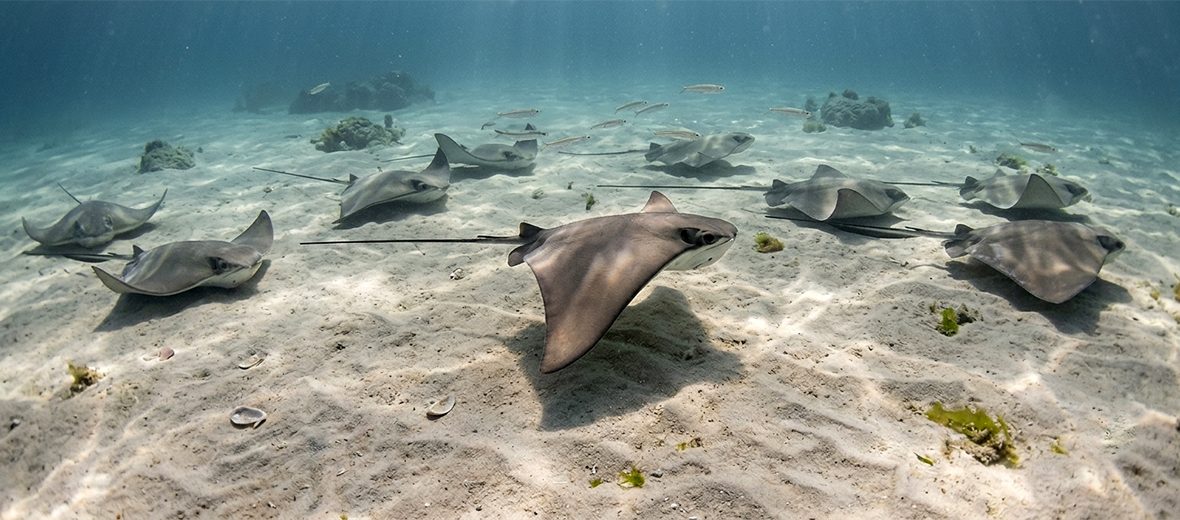
The cownose ray gets its name from the 2 lobes at the front of their head that resemble a cow’s nose. They prefer shallower waters and estuaries. Being migratory, these critters will dwell as far north as Chesapeake Bay in the summer and as far south as southern Brazil in the winter. They face the threats of overfishing and persecution due to their long history of negative interactions with the commercial shellfish industry. Cownose Rays have been implicated in negatively affecting the recovery of bay scallop stocks in North Carolina and oyster restoration and commercial aquaculture efforts in Chesapeake Bay. The ‘Save the Bay, Eat a Ray’ campaign was promoted as a way to restore the health of Chesapeake Bay by managing the recovery of collapsed oyster populations. The fishery was promoted by state fishery managers, seafood companies, certain environmental organizations, and regional ‘eco-friendly’ restaurants, and there were even several attempts to develop export markets for the meat in Europe and Asia. Even though the previously mentioned campaign has declined in popularity, there are still many charter captains that take customers out to bow hunt cownose rays between Texas and Virginia. All this pressure has resulted in a large decline in their numbers, resulting in the IUCN listing them as Vulnerable. Their populations are also decreasing.
First the Stats…
Scientific name: Rhinoptera bonasus
Weight: Up to 100 lbs.
Length: Up to 28.3 inches, plus up to a 39.62 inch tail
Width: Up to 48 inches
Lifespan: Up to 21 years
Now on to the Facts!
1.) Their generic name Rhinoptera hails from the Ancient Greek words for nose (rhinos) and wing (pteron). Their specific name bonasus hails from the Ancient Greek word for bison (bonasos).
2.) They prefer to dwell near coastal waters and in estuary ecosystems, and are able to tolerate a wide range of salinities from full saltwater to brackish water specific gravities. Specific gravity is the measurement of salt levels in water.
3.) Having a durophagous diet (feeds upon hard-shelled organisms, such as mollusks and crustaceans), they prefer to feast upon clams, oysters, and scallops.
4.) Feeding typically occurs in the benthic zone, aka at the bottom of the ocean or bottom of bays and estuaries.
5.) Their jaws are incredibly powerful and have teeth with the hardness that is comparable to that of concrete.
But wait, there’s more on the cownose ray!
6.) Their predators include cobia, hammerhead sharks, and of course humans.
7.) These and other rays are ovoviviparous, meaning that the embryo grows within its mother until it’s ready to hatch.
Did you know…?
When threatened, they can utilize the barb at the base of their tail to defend themselves from threats. Their spine that possesses a toxin, sits close to their body. This spine has teeth lining the lateral edges, and is coated with a weak venom that causes symptoms similar to that of a potent bee sting.
8.) Females undergo up to a 12 month gestation (pregnancy) that yields a single pup.
9.) The pup is born tail first and is precocial (fully developed) at birth.
10.) Males have been seen leaving the bay earlier than the females to move to a second feeding ground, however the reason for taking a longer migration route is not fully known. A hypothesis is that males leave the bay to reduce competition of resources, like food and shelter.
But wait, there’s still more on the cownose ray!
11.) Females remain in the estuaries to watch over their pup for a while.
12.) While a sting from a cownose ray can cause a very painful wound that requires medical attention their sting is not usually fatal, however, it can be if their barb strikes the abdomen.
13.) These rays are diurnal (active during the day) and their migration route is heavily guided by the sun.
Now a Short Cownose Ray Video!
Be sure to share & comment below! Also, check out the Critter Science YouTube channel. Videos added regularly. Be sure to like and subscribe!

Want to suggest a critter for me to write about? Let me know here.
Some source material acquired from: