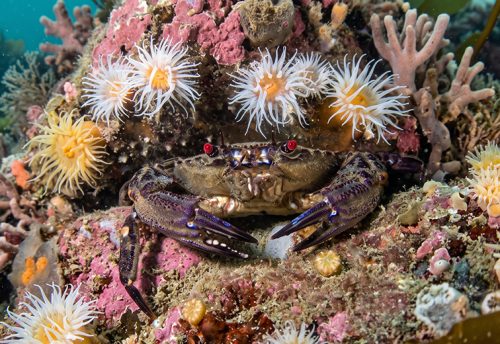
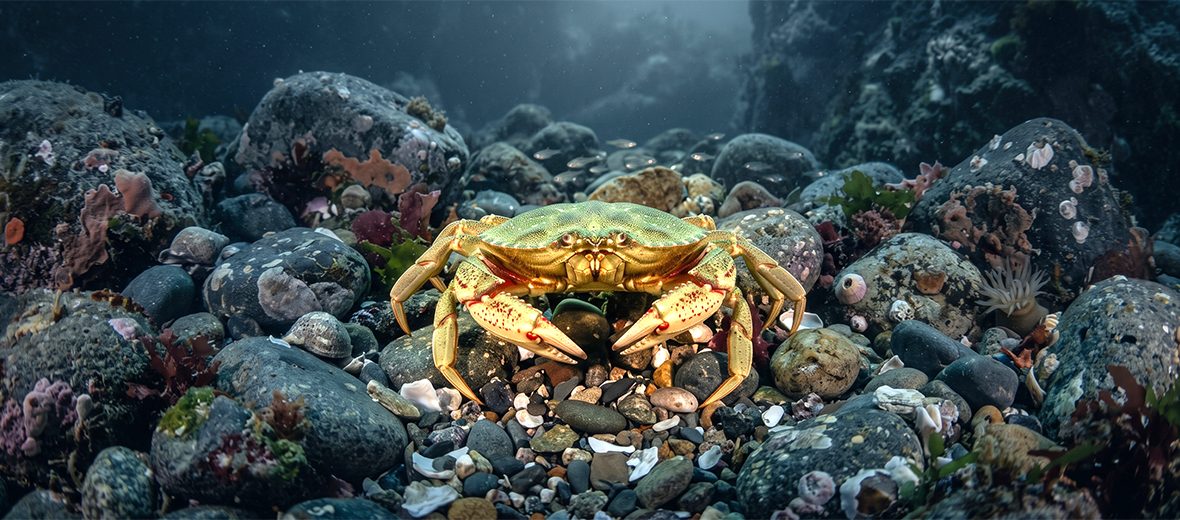
The Atlantic rock crab, aka peekytoe crab, can be found from Iceland to South Carolina, in the United States. These crustaceans dwell at depths of up to 2,600 feet. They face the threat of being outcompeted for food and habitat by the highly invasive green crab. These crabs also face the threat of overfishing, as they are heavily fished for not only food, but used as bait for lobsters. Climate change can affect the temperature of the ocean which can, in turn, alter their metabolism and increase their susceptibility to disease. They are susceptible to shell disease caused by chitin-destroying bacteria. This disease erodes the protective outer layer of the crustacean’s exoskeleton, making them vulnerable to fatal septicemic infections or complications during molting. However, these critters are abundant throughout their range and thus listed as Not Evaluated by the IUCN. Their population trend is listed as stable to increasing.
First the Stats…
Scientific name: Cancer irroratus
Weight: Up to 7.1 ounces
Length: Up to 5.5 inches
Lifespan: Up to 8 years
Now on to the Facts!
1.) Molting takes place between April – July. During this time they are very vulnerable and thus will find a nice hiding spot to complete the molt.
2.) Clams, mussels, sea urchins, shrimps, worms, and even other crabs are all on the menu.
3.) To help in preventing overfishing, regulations have been put in place, such as keeping captured crabs. Captured crabs can only be kept if their carapace measures at least 4.02 inches. Females, regardless of their size, are to be returned to the ocean unhamred.
4.) Up until 1997 these crabs were considered a nuisance species due to the fact that they could enter lobster traps and eat all the bait.
5.) These crabs are mostly nocturnal (active at night).
But wait, there’s more on the Atlantic rock crab!
6.) Due to a portion of their diet consisting of shrimps and crabs, these crustaceans are, for the most part, beneficial to the ocean’s ecosystem.
7.) Females lay up to 500,000 eggs from October to early December.
Did you know…?
As of 2014, these crustaceans are the most abundant brachyuran (true crabs) in the areas studied in southwest Iceland.
8.) The eggs produced are carried by the female under her carapace and hatch in up to 10 months.
9.) These crustaceans are a recently popular culinary item.
10.) They are preyed on by fish, such as the flounder. Sea otters and seals also prey on these critters, along with lobsters.
Now a Short Atlantic Rock Crab Video!
Be sure to share & comment below! Also, check out the Critter Science YouTube channel. Videos added regularly. Be sure to like and subscribe!

Want to suggest a critter for me to write about? Let me know here.
Some source material acquired from: Wikipedia & IUCN