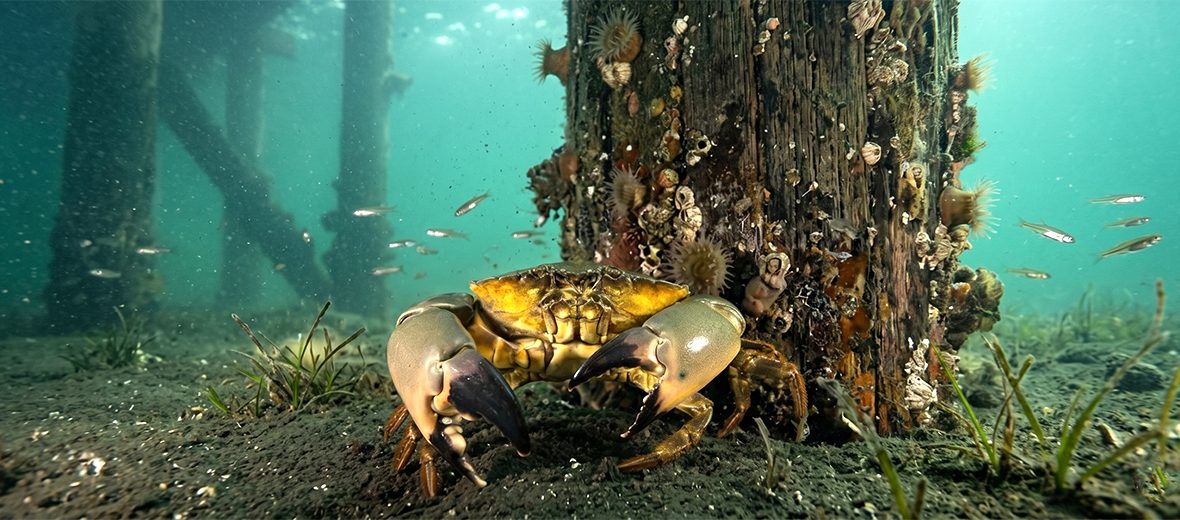
The Florida stone crab can by found in the western North Atlantic, from Connecticut to Colombia, including Texas, the Gulf of Mexico, Belize, Mexico, Jamaica, Cuba, the Bahamas, and the East Coast of the United States. These crustaceans face the threats of overfishing, predation (from the common octopus), and even cannibalization. However, they are abundant throughout their range. These critters are listed as Not Evaluated by the IUCN. Their current population status is listed as overexploited, due to overfishing.
First the Stats…
Scientific name: Menippe mercenaria
Weight: Up to 1 lb.
Length: Up to 6.5 inches wide by up to 3.5 inches front to back
Lifespan: Up to 9 years
Now on to the Facts!
1.) These crabs have been around for approximately 3 million years, since the Pliocene epoch.
2.) They dwell in deep holes near dock pilings in water that is up to 5 feet deep.
3.) Oysters, mollusks, polychaete worms, shrimps, and other crabs are all on the menu.
4.) In turn, they are preyed on by horse conchs, groupers, sea turtles, cobias, and octopuses.
5.) Males need to wait for the females to molt before mating. After mating, the male will stay behind and guard his partner till her exoskeleton hardens.
But wait, there’s more on the Florida stone crab!
6.) The females can spawn up to 6 times each season. Each spawning event yields up to 1,000,000 eggs!
7.) The larvae undergo 6 stages in about 4 weeks before emerging as juvenile crabs.
Did you know…?
These crabs utilize shells as a digging tool for constructing burrrows.
8.) The crabs are capable of limb autonomy (able to lose their limbs) in order to fit into tight places or to escape the jaws of a predator.
9.) If they need to molt and the sun is up, they release a hormone from a gland located on 1 of their eye stalks called the x-organ. This hormone prohibits them from molting from their shell until they find a safe place to molt or it’s dark enough to molt in safety.
10.) Only their claws are harvested, as the rest of the crab is not usually eaten. So, fisheries will often catch these critters and tear their claws off, then discard them back into the water, where their claws will—in time—regrow.
Now a Short Florida Stone Crab Video!
Be sure to share & comment below! Also, check out the Critter Science YouTube channel. Videos added regularly. Be sure to like and subscribe!

Want to suggest a critter for me to write about? Let me know here.
Some source material acquired from: Wikipedia & IUCN