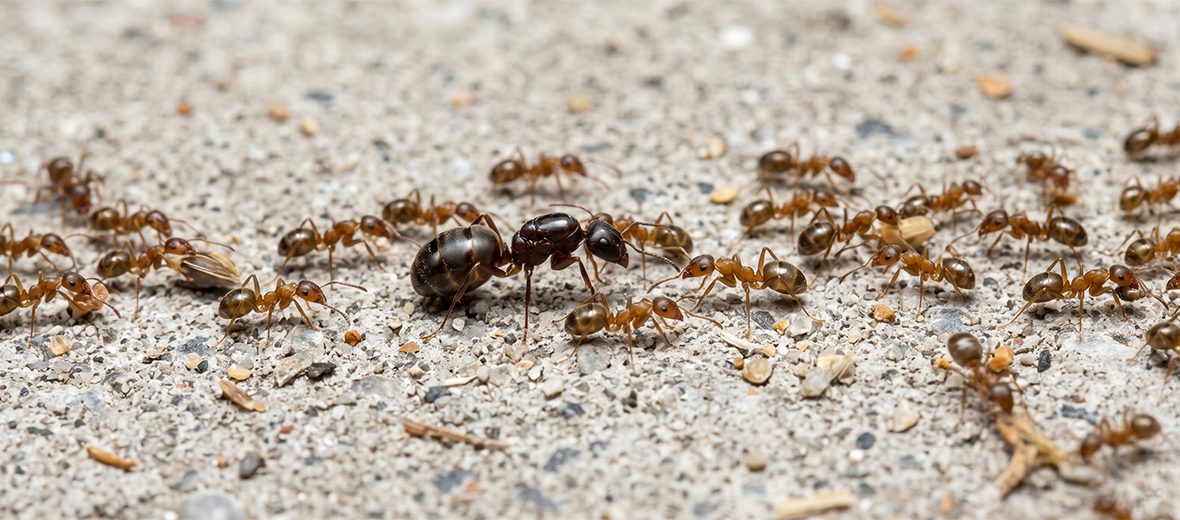
The Argentine ant is a highly invasive species of ant that causes an incredible amount of harm to communities of native arthropods, vertebrates, and plants within their invaded range. They hail, originally, from Argentina in South America. They face the threat of being outcompeted by fire ants. Their extreme genetic similarity allows for the massive territorial spread, but it also makes them highly vulnerable to specific parasites, fungal infections, and viruses. The spread of single-stranded RNA viruses, for example, has the potential to wipe out entire colonies. However, these ants are resilient and widespread to multiple continents. Thus they are listed as Least Concern by the IUCN. Their population trend is listed as unknown.
First the Stats…
Scientific name: Linepithema humile
Weight: Up to 0.0001 ounce
Length: Up to .25 inch
Lifespan: Up to 2+ years, for queens, up to 1 year for workers
Now on to the Facts!
1.) Colonies are large and often overlap with other colonies, forming super colonies of trillions of ants.
2.) Being generalists in where they build their nests, colonies have been seen in the ground, in cracks within concrete walls, in the spaces between boards and timbers, and even among belongings in human habitations.
3.) As is the case with numerous species of ants, if their nests become flooded with water, workers will collect their brood and the entire colony will relocate to dry ground.
4.) They were first described in 1866 by Austrian entomologist Gustav L. Mayr.
5.) Their native range is limited to riparian habitats in the lowland areas of the Paraná River drainage, that stretches across northern Argentina, Uruguay, Paraguay, and southern Brazil.
But wait, there’s more on the Argentine ant!
6.) Even though they typically thrive in Mediterranean climates, over the past century they have spread across the globe due to human-mediated transport. They now exist on every continent, sans Antarctica, including numerous islands.
7.) Colonies have an average of 1 queen per every 125 workers.
Did you know…?
These ants do not possess a stinger, rather they rely solely on swarming their perceived threat and biting said invader.
8.) These ants don’t take seeds underground and are instead left on the surface, resulting in ungerminated plants and the loss of Fynbos seed reserves after veld fires.
9.) Queens lay up to 60 eggs per day and during the course of her lifetime she can lay upwards of 10,000+ eggs.
10.) These critters are diurnal (active during the day).
Now a Short Argentine Ant Video!
Be sure to share & comment below! Also, check out the Critter Science YouTube channel. Videos added regularly. Be sure to like and subscribe!

Want to suggest a critter for me to write about? Let me know here.
Some source material acquired from: Wikipedia & IUCN