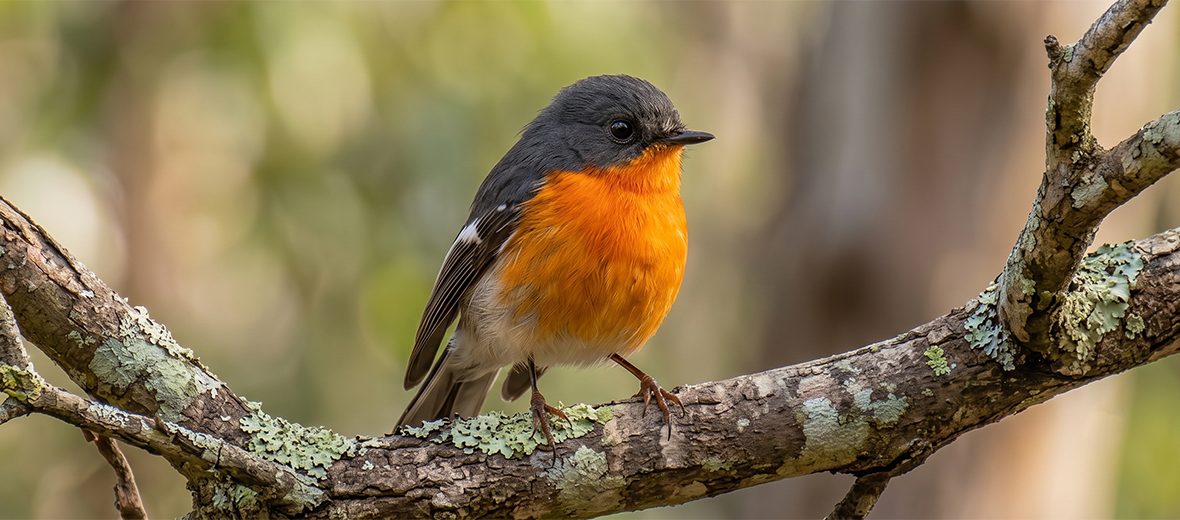
The flame robin, aka robin redbreast, is a small sized passerine bird native to southeastern Australia. While not closely related to either the European or American robins, they do appear to be an early offshoot of the Passerida group of songbirds. These birds face the threat of habitat loss due to agriculture. Fires and fire suppression efforts also drive away these birds. Finally climate change causes droughts and flooding that alters their habitats. However, these birds are abundant throughout their range and thus listed as Least Concern by the IUCN. Their population trend is listed as decreasing though. They get their common name from the brilliant, fiery orange-red chest and throat of the adult male.
First the Stats…
Scientific name: Petroica phoenicea
Weight: Up to .56 ounce
Length: Up to 5.5 inches
Wingspan: Up to 9.4 inches
Lifespan: Up to 5 years
Now on to the Facts!
1.) These birds are a perch and pounce hunter, that primarily eat insects, and typically return to their favorite low perch numerous times to stand erect and motionless, scanning the leaf-litter for more insect prey.
2.) Beetles, wasps, ants, flies, bugs, caterpillars, spiders, millipedes, and earthworms are all preyed upon.
3.) They were first described by the French naturalists Jean René Constant Quoy and Joseph Paul Gaimard in 1830.
4.) These birds tolerate a range of habitats, based on the season, such as eucalypt forests, woodlands, open understories, slopes, ridges, open and grassy landscapes, pastures, farmlands, agricultural paddocks, and urban parks.
5.) This critter is nervous and jumpy, flicking its wings alternately when otherwise sitting still.
But wait, there’s more on the flame robin!
6.) Their flight is fast and undulating with speeds reaching up to 35 mph.
7.) Females lay up to 4 eggs that hatch in up to 17 days.
Did you know…?
There are an estimated 9,700,000 individuals, to date.
8.) The female feeds her chicks with food obtained by the male.
9.) Like other robin species, they are diurnal (active during the day).
10.) They are preyed on by the eastern brown snake, birds of prey, cats, and foxes.
Now a Short Flame Robin Video!
This video talks about robins in general.
Be sure to share & comment below! Also, check out the Critter Science YouTube channel. Videos added regularly. Be sure to like and subscribe!

Want to suggest a critter for me to write about? Let me know here.
Some source material acquired from: Wikipedia & IUCN