
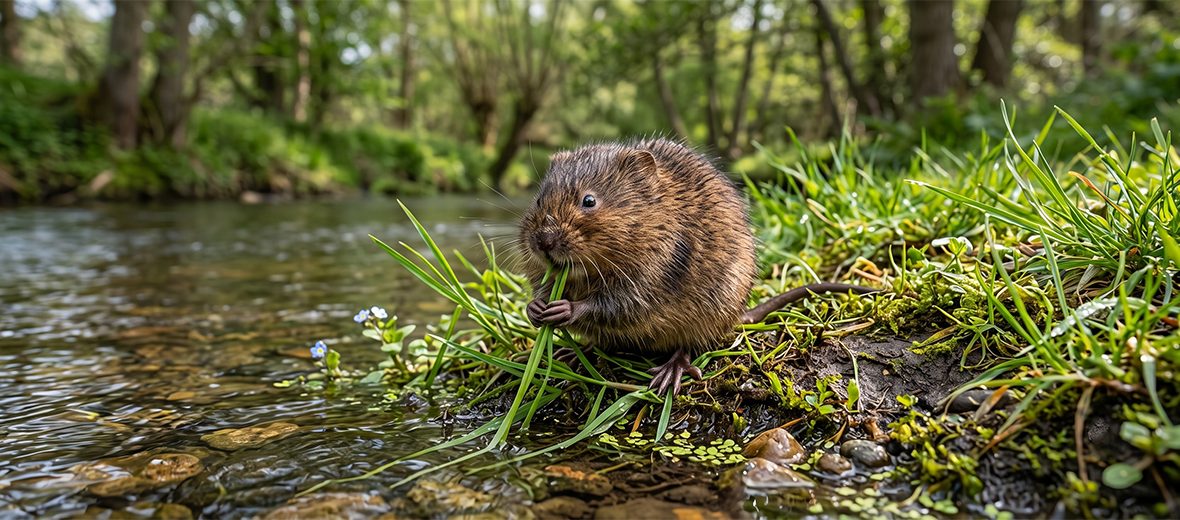
The European water vole, aka northern water vole or water rat, is an aquatic rodent found throughout Europe and northern Asia. These critters face the threat of predation by the introduced American Mink. They also face the threats of habitat loss and destruction at the hands of residential and commercial developments, farming, and ranching. The effects of water pollution as well as land pollution and chemical pollution are also felt. Finally, seeing as these rodents are considered an agricultural pest, they are often trapped, poisoned, and killed. however, they are abundant enough to be listed as Least Concern by the IUCN. Their population trend is listed as unknown at this time.
First the Stats…
Scientific name: Arvicola amphibius
Weight: Up to 10.6 ounces
Length: Up to 8.7 inches, plus up to a 5.5 inch tail
Lifespan: Up to 2.5 years
Now on to the Facts!
1.) They were first described by the Swedish zoologist and taxonomist Carl Linnaeus in 1758.
2.) Their preferred habitats are slow-flowing or still freshwater habitats, rich bankside vegetation habitats, and soft earthen banks.
3.) These voles excavate burrows along the banks of rivers, ditches, ponds, and streams.
4.) Grass, sedges, rushes, herbs, other water vegetation, fruits, seeds, bulbs, twigs, buds, and roots are all readily feasted upon. Water snails, freshwater mussels, other mollusks, frogs, and tadpoles are also preyed on as an additional source of protein.
5.) Unfortunately, in Europe, high harvest periods can cause water vole “plagues” to occur, during which time the voles will eat ravenously, destroying entire fields of grass and leaving the fields full of nothing but abandoned burrows.
But wait, there’s more on the European water vole!
6.) Females undergo up to a 21 day gestation (pregnancy) that yields up to 8 pups.
7.) At birth, pups weigh in at just 0.4 ounce.
Did you know…?
Water voles are currently being reintroduced as a threatened species in Yorkshire, England. In the Massif Central area of France, however, farmers are campaigning for immediate action to be taken against water voles, where plagues of these rodents are causing serious damage to crops.
8.) Appropriately enough, these voles are expert divers and swimmers.
9.) Wildcats, red foxes, a variety of hawks, barn owls, Eurasian eagle-owls, and falcons all prey on these voles.
10.) A water vole by the name of “Ratty” is the main character in the 1908 children’s book The Wind in the Willows by Kenneth Grahame.
Now a Short European Water Vole Video!
Be sure to share & comment below! Also, check out the Critter Science YouTube channel. Videos added regularly. Be sure to like and subscribe!

Want to suggest a critter for me to write about? Let me know here.
Some source material acquired from: Wikipedia & IUCN

Leave a Reply