
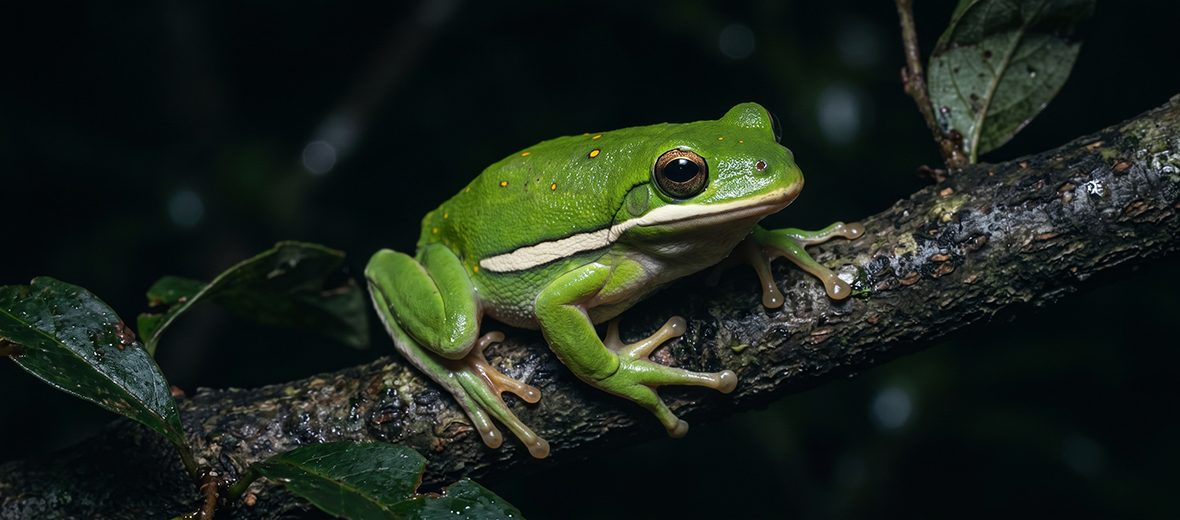
The American green tree frog is an arboreal species of New World tree frog belonging to the family Hylidae. They are usually found throughout the central and southeastern United States. These frogs face the threat of wetland destruction due to draining or altering shallow ponds, swamps, and sloughs which reduces available breeding and foraging grounds. Their permeable skin makes the tadpoles and adults highly susceptible to water pollution in the form of agricultural runoff, pesticides, and elevated salt levels in freshwater systems. Finally, light pollution disrupts their nighttime behaviors, mating call timing, and natural evening activity cycles. However, these frogs are still quite abundant and therefore listed as Least Concern by the IUCN. Their population trend is listed as stable.
First the Stats…
Scientific name: Hyla cinerea
Weight: Up to .18 ounce
Length: Up to 2.5 inches
Lifespan: Up to 6 years
Now on to the Facts!
1.) Like so many other species of frog, these critters are nocturnal (active at night).
2.) They can be bright green to reddish-brown in coloration.
3.) These frogs are often mistaken for the green frog, which also lives throughout the southeastern United States.
4.) To escape predation, they will leap into the water or scale trees.
5.) Like most frog species, they are sexually dimorphic in that females are larger than males. This is an evolutionary adaptation that allows the female to be able to carry the male on her back while in amplexus (their mating position).
But wait, there’s more on the American green tree frog!
6.) During the mating competitions, the males will listen in on neighboring rival males and either adjust the timing of their signal or remain silent to intercept call signals and mate with approaching females.
7.) Females can have up to 400 eggs per clutch and produce multiple clutches each season, totalling up to 1,000 eggs. The eggs hatch into tadpoles in up to 14 days. The tadpoles metamorphose into adults in up to 63 days.
Did you know…?
Frogs respirate (breathe) in part through their skin. They also don’t drink standing water, but rather absorb water through their permeable skin.
8.) The male’s call is a loud, rhythmic, and nasal “queenk… queenk… queenk”. It is said to resemble an abrupt honk, a mechanical bark, or the ringing of a distant cowbell.
9.) Their preferred habitats are moist, open-canopies near permanent or semi-permanent fresh water sources like ponds, marshes, lakes, and swamps.
10.) Seeing as the majority of amphibians have narrow habitat tolerances and migration constraints, these tree frogs desperately need alternative shelters for survival as forest canopies recover from fires and destruction from residential and commercial developments.
But wait, there’s still more on the American green tree frog!
11.) Ants, beetles, crickets, cockroaches, flies, grasshoppers, mosquitoes, spiders, and other small invertebrates are all on the menu.
12.) In a study, it was found that frogs find prey more appealing when it moves more than when it stays still. The more it wiggles, the tastier it must be.
13.) While in captivity, these nervous and easily frightened frogs often do not do well with frequent handling. Some specimens do seem to tolerate it on occasions, but handling frequency should be determined on an individual basis.
14.) Their loud choruses can be heard from up to 2 miles away!
Now a Short American Green Tree Frog Video!
Be sure to share & comment below! Also, check out the Critter Science YouTube channel. Videos added regularly. Be sure to like and subscribe!

Want to suggest a critter for me to write about? Let me know here.
Some source material acquired from: Wikipedia & IUCN

Leave a Reply