
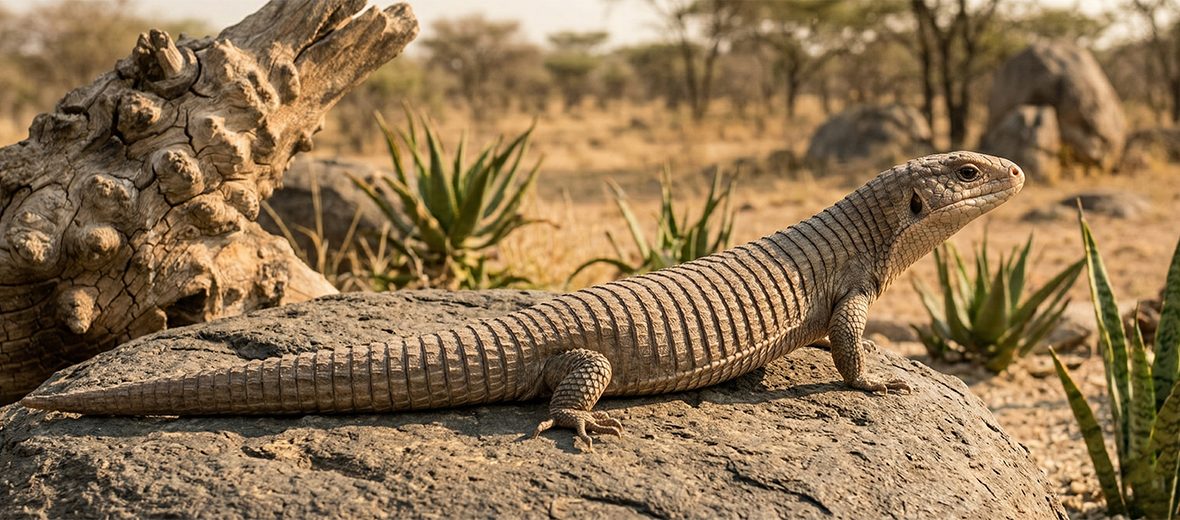
The Sudan plated lizard, aka western plated lizard, great plated lizard, or Broadley’s rough-scaled plated lizard, hails from eastern and central Africa. These lizards face the threats of habitat loss and destruction at the hands of residential developments, farming, and ranching. They are also collected for the pet trade, which can affect their numbers. However, these lizards are abundant enough to be listed as Least Concern by the IUCN. There population trend is listed as unknown at this time.
First the Stats…
Scientific name: Broadleysaurus major
Weight: Up to 10 ounces
Length: Up to 24 inches, including their tail
Lifespan: Up to 25 years
Now on to the Facts!
1.) These lizards are diurnal (active during the day).
2.) During the mating season, males tend to develop a brightly colored throat to better attract a mate.
3.) Their preferred habitats consist of rocky, semi-open areas in coastal woodlands, thickets, moist Savannahs, and dry Savannahs.
4.) Insects, mice, juvenile rats, various vegetation, fruits, and vegetables are all feasted upon.
5.) Being very shy, they tend to flee when approached. In captivity, they do shy away from movements, but frequent handling tames them quite well.
But wait, there’s more on the Sudan plated lizard!
6.) They dig burrows under rocks and roots to aid in thermoregulation and escaping predators.
7.) Snakes, honey badgers, foxes, jackals, wildcats, hawks, and eagles all prey on these lizards.
Did you know…?
A defense mechanism of these lizards is to wedge themselves in a burrow or between rocks and inflate their body, which makes them nearly impossible to extract.
8.) There are 2 subspecies: Broadleysaurus major major and Broadleysaurus major bottegoi.
9.) Females lay up to 6 eggs that hatch in up to 4 months.
10.) These lizards are capable of caudal autonomy (they can drop their tail), which leaves behind a squirming tail for a predator to eat, affording the lizard a chance to escape.
Now a Short Sudan Plated Lizard Video!
Be sure to share & comment below! Also, check out the Critter Science YouTube channel. Videos added regularly. Be sure to like and subscribe!

Want to suggest a critter for me to write about? Let me know here.
Some source material acquired from: Wikipedia & IUCN

Leave a Reply