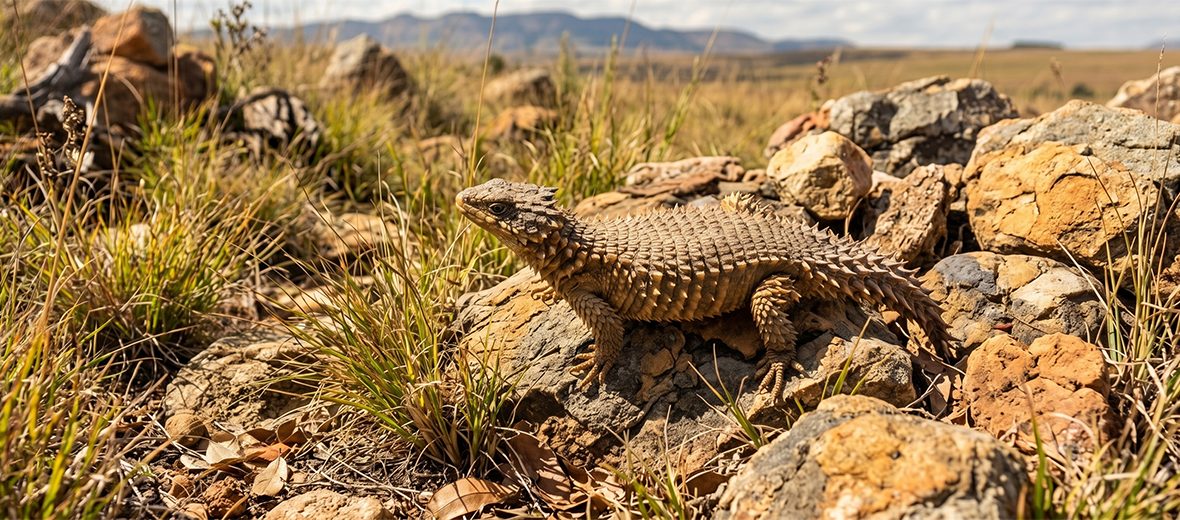
The giant girdled lizard, aka sungazer, giant dragon lizard, ouvolk, and/or giant zonure, dwells in South Africa. These lizards, that appear to look more like dragons than lizards, face the threats of habitat loss and destruction at the hands of farming of products such as maize and sunflowers. They are also threatened by mining and quarrying of coal. Capture for the exotic pet trade is another challenge these lizards face. The IUCN lists these lizards as Vulnerable. Their population trend is listed as decreasing as well.
First the Stats…
Scientific name: Smaug giganteus
Weight: Up to 10+ ounces
Length: Up to 15.75 inches
Lifespan: Up to 20+ years
Now on to the Facts!
1.) The genus Smaug is named after the dragon Smaug from J.R.R. Tolkien’s novel The Hobbit. This name was chosen in 2011 by researcher Ed Stanley because they are heavily armored, live in underground tunnels in South Africa—near where Tolkien was born—and represent a “dragon-like” species.
2.) They prefer a grassland habitat.
3.) These lizards are known as sungazers because of their distinctive thermoregulatory behavior of raising the anterior (frontal) parts of the body by extending their forelimbs, usually near the entrance of their burrow almost as if looking directly at the sun.
4.) Giant girdled lizards are also known as “Pathakalle” by the Sotho-speaking people, and as “mbedla” by the Zulu-speaking people.
5.) These lizards are rupicolous (live among rocks and/or boulders).
But wait, there’s more on the giant girdled lizard!
6.) Burrows are self constructed and can be 1.3 feet deep and up to 6 feet long.
7.) Various insects, a variety of other invertebrates, mice, and juvenile rats and all on the menu.
Did you know…?
There were only approximately 677,000 wild individuals remaining as of 2022.
8.) They are ovoviviparous (produce eggs which hatch inside the mother’s body, leading to live birth without placental nourishment).
9.) Females produce only 1 – 2 offspring every couple of years.
10.) After birth, the female provides significant protection for her offspring till they are ready to take care of themselves.
11.) Jackals, honey badgers, and mongooses will excavate these lizards from their burrows, while avian predators like secretary birds attach them when they are outside their burrows. Snakes will also enter their lairs to prey on themm.
Now a Short Giant Girdled Lizard Video!
Be sure to share & comment below! Also, check out the Critter Science YouTube channel. Videos added regularly. Be sure to like and subscribe!

Want to suggest a critter for me to write about? Let me know here.
Some source material acquired from: Wikipedia & IUCN

Leave a Reply