
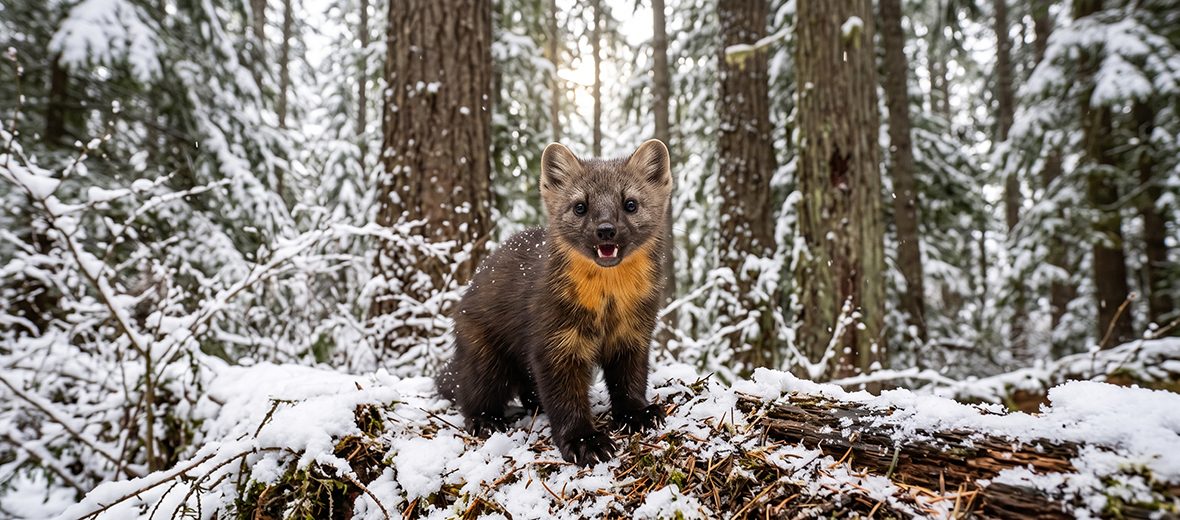
The Pacific marten was once considered conspecific with the American marten, however several studies using molecular genetics indicate that they are a distinct species. They face the threats of habitat loss, destruction, and degradation at the hands of logging and industrial clearcutting. Catastrophic forest fires and severe pest infestations—such as the bark beetle or spruce budworm outbreaks—can rapidly wipe out large blocks of the mature forest canopies they depend on. Martens are highly reliant on deep, powdery snow cover. In the winter, they navigate the “subnivean” zone (tunnels underneath the snowpack) to rest and hunt for small rodents, and climate change is bringing about warmer weather, globally, that is severely affecting snow pack. As global warming reduces annual snowfall, martens lose their unique competitive advantage. Lighter snow allows larger, heavier predators like fishers, bobcats, coyotes, and foxes to easily infiltrate marten hunting grounds and compete for limited winter prey. While modern legal trapping is highly regulated and monitored, accidental or incidental trapping and snaring (when martens accidentally stumble into traps set for other fur-bearing mammals) remain a high-concern mortality factor, particularly for vulnerable populations recolonizing areas outside of protected wildlife zones. However, through all this, these critters are abundant and widespread throughout their ranges, and thus listed as Least Concern by the IUCN. Their population trend is listed as decreasing though.
First the Stats…
Scientific name: Martes caurina
Weight: Up to 4 lbs.
Length: Up to 25 inches, plus up to an 8.5 inch tail
Lifespan: Up to 14.5 years
Now on to the Facts!
1.) American zoologist, mammalogist, ornithologist, and ethnographer Clinton Hart Merriam first described the Pacific marten in 1890.
2.) There are 6 subspecies recognized: M. c. humboldtensis, M. c. nesophila, M. c. origenes, M. c. sierrae, M. c. vulpina, and M. c. caurina.
3.) Their preferred habitats are late-successional, mature coniferous, or mixed forests with high canopy cover and complex structural ground elements.
4.) In the winter they are nocturnal (active at night), during the rest of the year they’re diurnal (active during the day).
5.) Mice, rats, rabbits, birds, and fish are all on the menu.
But wait, there’s more on the Pacific marten!
6.) Various raptors are also a threat to these martens. They are also preyed on by grizzly bears, mountain lions, grey wolves, wolverines, and black bears.
7.) Females undergo up to a 290 day gestation (pregnancy) that yields up to 4 kits.
Did you know…?
They can run up to 16 mph.
8.) Due to their more fragmented distribution than the American marten, these martens are more vulnerable to inbreeding and the island effect.
9.) Due to their status as commercially valuable fur bearers, these martens have frequently been translocated throughout North America, and this can often lead to anthropogenic hybridization, genetic polution, and/or outbreeding depression.
10.) They have a strong bite force that measures 42.4 Newtons (9.53 lbs. per square inch) at the canines.
Now a Short Pacific Marten Video!
Be sure to share & comment below! Also, check out the Critter Science YouTube channel. Videos added regularly. Be sure to like and subscribe!

Want to suggest a critter for me to write about? Let me know here.
Some source material acquired from: Wikipedia & IUCN

Leave a Reply