
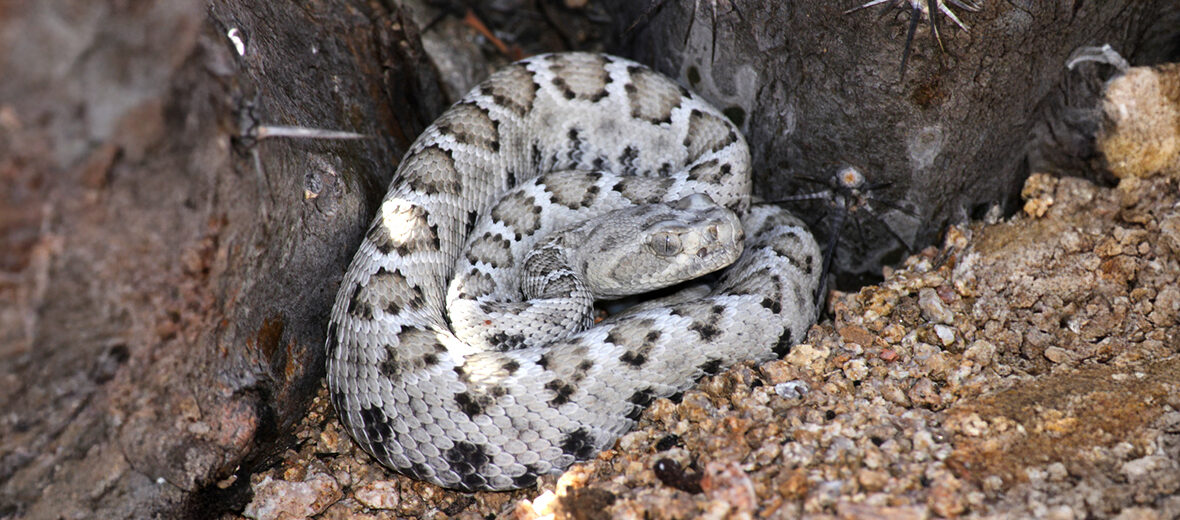
The Santa Catalina rattlesnake hails only from Isla Santa Catalina in the Gulf of California. These rattlers are unique in that they lack a rattle at the end of their tail. These vipers face the threats of hunting; trapping, for distribution via the illegal pet trade; disturbances from recreational activities; and invasive species, that can result in predation. The IUCN lists these snakes as Critically Endangered. Their population trend is listed as decreasing.
First the Stats…
Scientific name: Crotalus catalinensis
Weight: Up to 2 lbs.
Length: Up to 2.5 feet
Lifespan: Up to 15+ years
Now on to the Facts!
1.) Like many other rattlesnakes, they are nocturnal (active at night).
2.) The base of the tail, aka button, has devolved to such an extent that the rattle immediately falls off with each shed rather than forming a new segment, as is the case in other species of rattlesnakes.
3.) It is believed that the lack of large predators or hoofed animals has made having a rattle unnecessary.
4.) This trend of devolution of the rattle seems to be occurring in other rattlers, such as the red diamond rattlesnakes on the island of San Lorenzo Sur and San Esteban island black-tailed rattlesnakes.
5.) It seems that the phenomenon of losing the tail buttons is confined to populations limited to islands in the Gulf of California.
But wait, there’s more on the Santa Catalina rattlesnake!
6.) Due to natural selection, this snake has a more elongated body than that in related mainland forms, and much longer teeth. These are both characteristics associated with snakes that hunt in trees and shrubs like this species.
7.) They also lack the standard bite-and-release tactic utilized by other rattlesnakes, preferring instead to hold their prey in their jaws until the venom can take effect. This way the prey doesn’t fall to the ground, rendering it lost to perhaps another opportunistic passer by.
Did you know…?
There are currently no efforts towards the conservation of these rattlesnakes. Bahía de Loreto National Park termed this rattlesnake as “very difficult to observe” which adds to the lack of conservation efforts.
8.) Other threats to their existence is their late maturation, slow growth rate, few offspring, and long periods of time between each breeding period.
9.) Researchers have hypothesized that the ability of these rattlesnakes to climb, combined with their lack of a rattle allow them to hunt roosting birds. That being said, they still tend to hunt terrestrial mammals, such as rats, mice, gophers, squirrels, and lizards.
10.) These rattlers tend to climb off of the hot ground and into bushes to thermoregulate (control their body’s temperature) during hot summer months.
But wait, there’s still more on the Santa Catalina rattlesnake!
11.) Females undergo up to a 110 day gestation (pregnancy).
12.) Up to 10 juvenile snakes are born between July – August.
Did you know…?
Their venom is hemorrhagic and cytotoxic, damaging tissues and blood vessels. Death is possible, but not likely. Especially if antivenin is applied.
13.) Like all viper species the female births live young, she does not lay eggs.
14.) Bite symptoms like tissue damage, bleeding, paralysis, and organ failure (if untreated), are all common.
15.) Island vipers display an increased biting frequency and venom yield compared to their mainland cousins, making bites particularly risky despite their smaller size. Plus, they tend to hold on to inject more venom than the bite and release tactic of other species.
Now a Short Santa Catalina Rattlesnake Video!
Be sure to share & comment below! Also, check out the Critter Science YouTube channel. Videos added regularly!

Want to suggest a critter for me to write about? Let me know here.
Some source material acquired from: Wikipedia & IUCN
Photo credit: iNaturalist