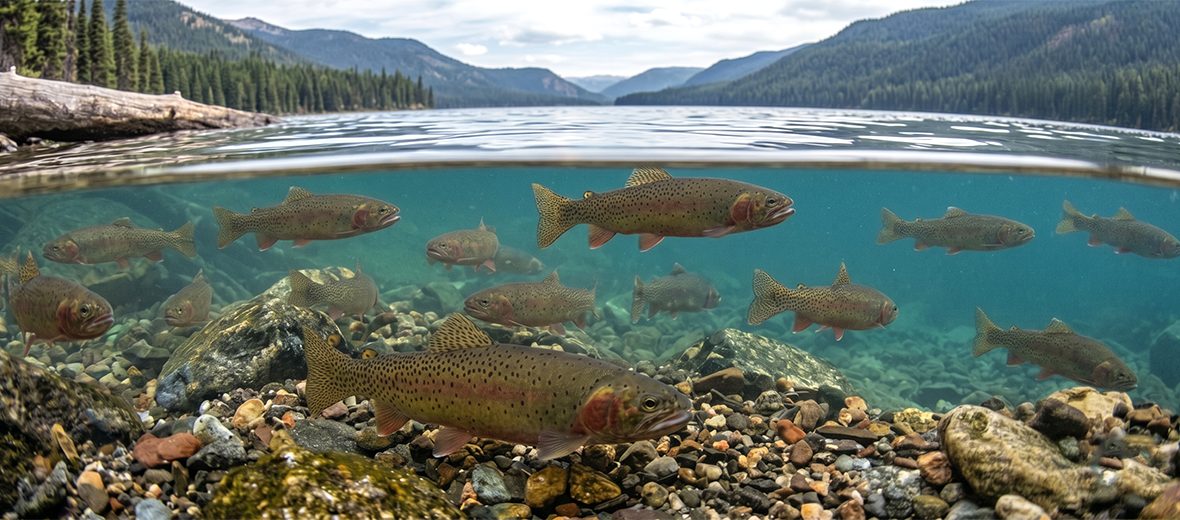
The cutthroat trout is actually a clade of 4 species of the family Salmonidae that are native to the cold-water tributaries of the Pacific Ocean, Rocky Mountains, and Great Basin in North America. They face the threats of habitat loss, destruction, and division at the hands of dams and waterway modifications. Invasive species of trout have also resulted in genetic pollution due to hybridization. They are also affected by overfishing, urbanization, and habitat loss as a result of mining, livestock grazing, and logging. However, these fish are still abundant enough to be listed as Least Concern by the IUCN. Their population trend is listed as decreasing though.
First the Stats…
Scientific name: Oncorhynchus clarkii clade
Weight: Up to 41 lbs.
Length: Up to 39 inches
Lifespan: Up to 10 years
Now on to the Facts!
1.) These trout were first described in the journals of the explorer William Clark from various specimens gathered during the Lewis and Clark Expedition from the Missouri River near Great Falls, Montana.
2.) There are 14 subspecies of cutthroat trout recognized that are each native to a separate geographic location.
3.) They prefer to dwell in cold, clear, well-oxygenated environments. Ideal habitats feature silt-free gravel substrates used for spawning, abundant structural cover (such as woody debris, boulders, and undercut banks), and a robust, well-vegetated riparian zone.
4.) Numerous subspecies of cutthroat trout are raised in commercial, state, and federal hatcheries for the purpose of introduction into acceptable native and non-native riverine and lacustrine (related to, formed in, or living in lakes) environments.
5.) They are prized as a gamefish, primarily by fly anglers. They’re regulated as a gamefish in every state and province in which they occur.
But wait, there’s more on the cutthroat trout!
6.) The largest specimen ever caught was from Pyramid Lake in Nevada and weighed in at a whopping 41 lbs.!
7.) Females lay upwards of 4,400 eggs each spawning season.
Did you know…?
These critters are the state fish of Idaho, Montana, and Wyoming, whereas particular subspecies of cutthroat are listed as the state fish of Colorado, Nevada, New Mexico, and Utah.
8.) Fry hatch in up to 4 weeks, and in up to 2 weeks, they begin feeding on zooplankton.
9.) Grizzly bears, raccoons, otters, mink, harbor seals, golden eagles, pelicans, herons, kingfishers, mergansers, osprey, and larger fish all prey on this species.
10.) Aquatic and terrestrial insects, crustaceans, and small fish are all on the menu.
Now a Short Cutthroat Trout Video!
Be sure to share & comment below! Also, check out the Critter Science YouTube channel. Videos added regularly. Be sure to like and subscribe!

Want to suggest a critter for me to write about? Let me know here.
Some source material acquired from: Wikipedia & IUCN