
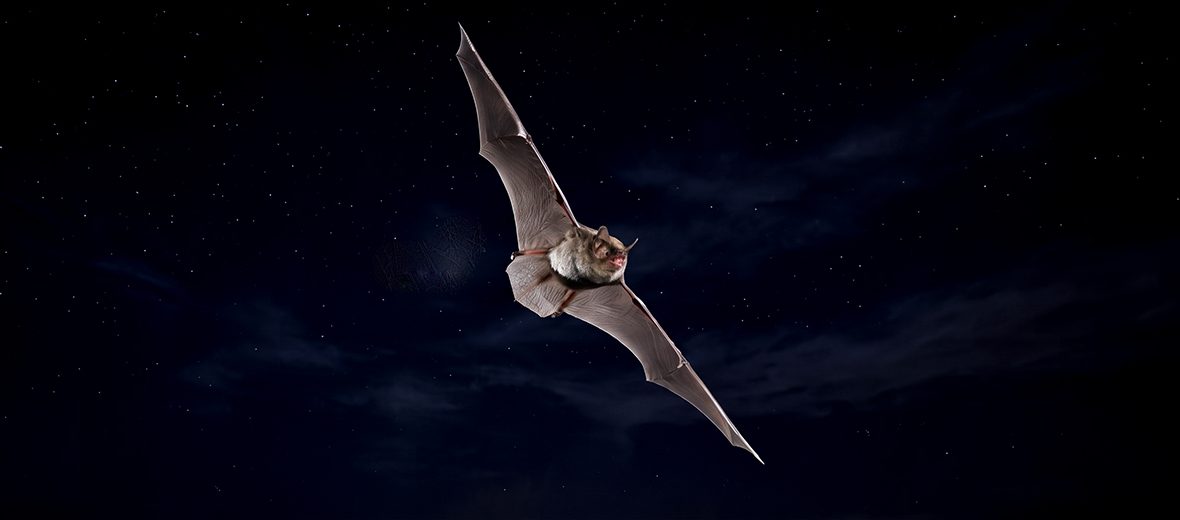
The Indiana bat, while similar in appearance to the more common little brown bat, is told apart by the size of their feet, pink lips, length of hair on their feet, and the keel on the calcar (spur of cartilage rising from inner side of ankle and running along part of outer wing membrane). These bats face the threat of human disturbances at wintering caves, which causes the aroused individuals to deplete energy reserves trying to relocate or escape. The handling of hibernating bats by researchers can result in these creatures moving to the use of less suitable hibernacula (hibernation locations), causing additional loss of fat reserves. Commercialization of caves can result in excessive disturbance or intentional elimination by cave owners. Altered exchange of air with the outside environment due to opening more cave entrances can cause drastic changes in cave temperature and humidity, and may cause the bats to abandon the cave(s). Habitat loss and destruction as a result of residential and commercial developments as well as clearcutting for agricultural use, or incompatible forest management practices that result in a shortage of the microhabitats used for maternity roosts may be the primary factors in recent declines in their populations as well. Finally, white-nose syndrome caused by the fungus Geomyces destructans that affects hibernating individuals in caves through eastern United States is another threat these critters have to contend with. As a result of all these adversities, these bats are listed as Near Threatened by the IUCN. Their population trend is listed as stable though, at this time.
First the Stats…
Scientific name: Myotis sodalis
Weight: Up to .34 ounce
Length: Up to 3.9 inches
Wingspan: Up to 10.5 inches
Lifespan: Up to 20 years
Now on to the Facts!
1.) These bats have suffered a dramatic population decline, estimated to be over 50% in the past 10 years.
2.) Their population is estimated to be approximately 244,000.
3.) They hibernate in huge, tight clusters that can contain thousands of individuals.
4.) A testament to the importance of bats is that Indiana bats alone can consume millions of insects every night.
5.) These bats are protected by the Federal Cave Resources Protection Act of 1988, to protect hibernacula on federal lands.
But wait, there’s more on the Indiana bat!
6.) In October 2007, Lonnie W. Skaggs of Olive Hill, Kentucky, and Kaleb Dee Carpenter, of Grayson, Kentucky, entered Laurel Cave in Carter Caves State Park, Kentucky, and killed 23 Indiana bats. Skaggs re-entered the cave 3 days later and killed another 82 individuals.
7.) The 2 men admitted to knowingly slaughtering an endangered species, using flashlights and rocks to knock hibernating bats off their roosts, and smashing them with rocks. Skaggs got 8 months in Federal prison, while Carpenter only got 3 years probation for these senseless killings.
Did you know…?
Bat mortality due to wind turbines has been confirmed, even resulting in a December 2009 injunction against a West Virginia wind farm.
8.) The case marked the first time in the nation that individuals were sentenced for killing endangered Indiana bats.
9.) As of 2013, only 5 Indiana bat fatalities have been documented as a result of wind farms.
10.) Other anthropogenic effects have contributed to the loss of bat populations, including pesticide use, improper application of cave gates, climate change, and agricultural development. As a result, these bats have faced a nationwide 57% population decline from 1960 – 2001.
But wait, there’s still more on the Indiana bat!
11.) These bats utilize at least 29 tree species during the summer as roosts.
12.) In the winter they hibernate in limestone caves and abandoned mines with stable, cool temperatures ranging from 39°F – 46°F. In the summer they prefer bottomland and riparian forests near streams, rivers, and wetlands, however they also use upland forests depending on the region.
Did you know…?
Contrary to ongoing fear, less than 1% of wild bats in nature are infected with rabies.
13.) Moths, beetles, mosquitoes, midges, lacewings, spiders, mayflies, mites, ticks, and lice are all readily feasted upon.
14.) They can eat up to 3,000 insects per feeding, or roughly half their body weight in total potential pests every night.
15.) Rat snakes, raccoons, skunks, opossums, cats, hawks, and owls all prey on these critters.
But wait, there’s still a little more on the Indiana bat!
16.) In Florida, these bats face predation by invasive species such as Burmese pythons, reticulated pythons, African rock pythons, boa constrictors, yellow anacondas, and green anacondas, to name a few.
17.) Females undergo up to a 68 day gestation (pregnancy) that yields a single pup.
18.) The pup develops quickly and can usually fly in up to 4 weeks.
19.) In 2020, the American field recorder Stuart Hyatt released a music album which combines sounds made by the Indiana bat along with music from ambient and experimental artists. The ultrasonic echolocations were recorded and then modulated in order to make the sounds audible to humans.
Now a Short Indiana Bat Video!
Be sure to share & comment below! Also, check out the Critter Science YouTube channel. Videos added regularly. Be sure to like and subscribe!

Want to suggest a critter for me to write about? Let me know here.
Some source material acquired from: Wikipedia & IUCN

Leave a Reply