
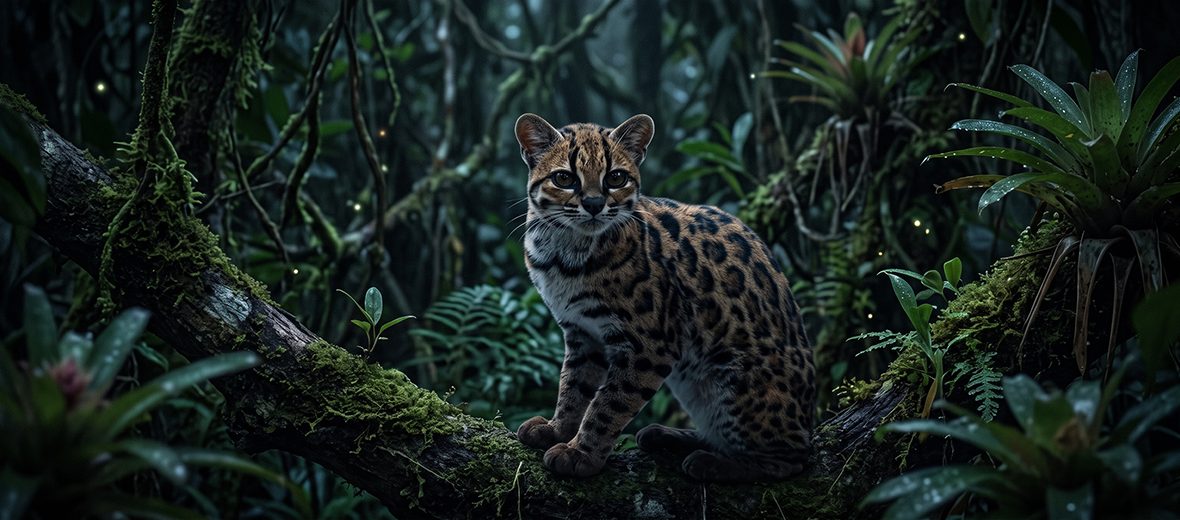
The tilcayo is the first extant species of wild cat formally described since 1923. While already known to the locals, it is new to science. Their native range is Bolivia’s Yungas cloud forests is disappearing rapidly due to agricultural expansion, logging, and mining operations. The clearing of trees breaks up the forest, isolating small groups of cats, and limiting their access to mates, which lowers genetic diversity. Fires intentionally or accidentally set by humans destroys critical portions of their mountain cloud forest habitat. These felines face direct risks from hunting and human conflicts, even though they are small, shy, and pose no threat to humans. Diseases, such as feline leukemia and more, spread by nearby farm or domestic animals threaten their fragile local populations. Lastly, climate change causes shifts in temperature and rainfall and is expected to severely alter and shrink their specific cloud forest habitat. Seeing as these cats were just recently documented by zoologists, they are listed with the IUCN as Not Evaluated. Their population trend is also not yet listed. This article is dedicated to my friend Shawn.
First the Stats…
Scientific name: Leopardus tilcayo
Weight: Up to 3 lbs.
Length: Up to 19.7 inches, plus up to a 10.4 inch tail
Height: Up to 8+ inches, at the shoulders
Lifespan: Up to 20 years
Now on to the Facts!
1.) Paola Nogales-Ascarrunz and an international team of scientists first formally described these cats in September 2026.
2.) They can be found at elevations of around 5,150+ feet.
3.) These cats dwell among the mountainous Yungas forest region, a cloud forest, on the eastern slope of the Andes mountain range.
4.) A genetic analysis of approximately 38 cats from South America and Central America, including 26 individuals in the Leopardus tigrinus species complex, revealed that the tigrinus complex contains 5 unique species, including the tilcayo, which is believed to have split off from other Leopardus species over 1.4 million years ago.
5.) Tilcayos are nocturnal (active at night).
But wait, there’s more on the tilcayo!
6.) Mice, rats, and other small vertebrates are preyed upon.
7.) It is believed that larger cats, snakes, and various raptors all prey on these critters.
Did you know…?
The sole individual that came to the attention of Nogales-Ascarrunz continues to dwell in protective captivity at the Senda Verde animal refuge in Bolivia as of 2026. The individual is 10 years old and is nicknamed “Tigrino”.
8.) While not yet known, typically speaking, tiger cat females undergo up to a 76 day gestation (pregnancy).
9.) It is also presumed that they have up to 3 kittens a year.
10.) Other names for these cats are tilcayo cat, tigrino, and tiger cat.
Now a Short Tilcayo Video!
Be sure to share & comment below! Also, check out the Critter Science YouTube channel. Videos added regularly. Be sure to like and subscribe!

Want to suggest a critter for me to write about? Let me know here.
Some source material acquired from: Wikipedia & IUCN


Leave a Reply