
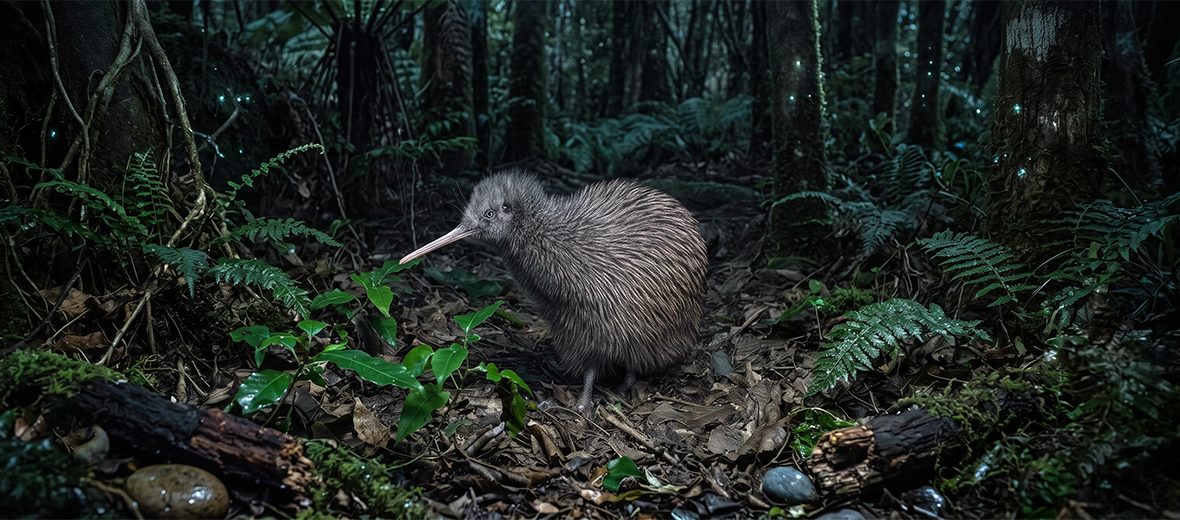
The Ōkārito kiwi, aka rowi or Ōkārito brown kiwi, was only recently discovered in 2003. They are part of the brown kiwi species complex. These birds can only be found in the small western portion of New Zealand’s Ōkārito forest, on the south island. They face the threats of habitat loss and destruction due to farming and ranching. Roads and railroads also not only divide their territory but also can cause vehicle strike (being hit by vehicles). Invasive species, such as stoats and dogs, also cause a heavy toll on their numbers. The IUCN lists these birds as Vulnerable. Their population trend is listed as increasing though.
First the Stats…
Scientific name: Apteryx rowi
Weight: Up to 8.8 lbs.
Length: Up to 22 inches
Wingspan: Up to 1.97 inches
Lifespan: Up to 100 years
Now on to the Facts!
1.) These kiwis are a monotypic species (meaning there are no subspecies documented).
2.) Their genus name Apteryx hails from Greece and translates to “without wings”.
3.) These birds are ratites (flightless birds) and have similarities to the others such as the emu, ostrich, rhea, and cassowary.
4.) Their sternum has no keel, their wings are minimal, and they lack a preen gland. The palate is also distinctive, and their feathers lack barbules (thread-like branches that project from the barbs of a bird’s feather) and an aftershaft (a smaller, accessory feather). They also have a weak gizzard and lack a tail.
5.) Seeing as they lack a tail, they instead have a pygostyle (a skeletal condition where the final few caudal vertebrae are fused into a single ossified structure that supports the tail feathers and musculature).
But wait, there’s more on the Ōkārito kiwi!
6.) On June 29, 2010, 3 breeding pairs were released onto Blumine Island as part of a breeding program. In 2012, 20 individuals were released on Mana Island. A new population was later established in the Omoeroa Ranges near Fox Glacier in late 2018.
7.) Females lay up to 3 eggs, each in a different nest. Both the male and the female attempt to incubate all the eggs. The eggs are very large, as they weigh 20% of the female’s weight (just as in all species of kiwi). The eggs hatch in up to 85 days.
Did you know…?
As of 2021, there were only an estimated 400+ wild individuals remaining.
8.) These kiwis are monogamous (mate for life).
9.) Conservation efforts like Operation Nest Egg and the Stoat Control Regime have been marginally successful in restoring their populations.
10.) These birds are nocturnal (active at night).
11.) Earthworms, beetle larvae, moths, and cicadas are all on the menu, along with other invertebrates.
Now a Short Ōkārito Kiwi Video!
Be sure to share & comment below! Also, check out the Critter Science YouTube channel. Videos added regularly. Be sure to like and subscribe!

Want to suggest a critter for me to write about? Let me know here.
Some source material acquired from: Wikipedia & IUCN

Leave a Reply