
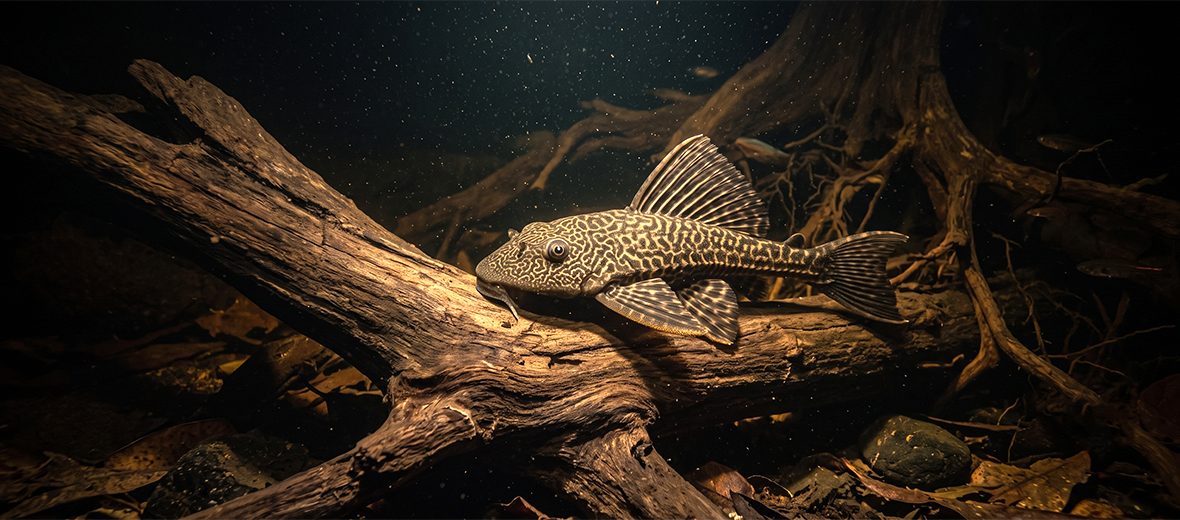
The plecostomus, aka suckermouth catfish or common pleco, are members of the armored catfish family (Loricariidae), named for the rows of armor-like scutes that cover the upper parts of their head and body. Even though their name Hypostomus plecostomus is typically used in reference to the common plecostomus that is sold in aquarium stores, most are actually members of other genera than Hypostomus. In their natural habitats in South America, these fish face the threat of water pollution from sewage, industrial waste, and chemical pollution from cities, & fertilizers as well as pesticides from agriculture. The Guiana Shield has undergone extensive gold mining, although the distribution of this species just barely makes it into mining areas. A majority of this mining and quarrying is done by eroding river banks, running the sediments through a sluice, and then extracting the gold with mercury, which leads to high mercury levels in fishes, the release of toxic materials to the soil, increased turbidity (cloudiness or haziness in the water), and altered hydrology. They also face the threats of habitat loss and destruction at the hands of residential and commercial developments as well as from logging. However, these critters are abundant enough to be listed as Least Concern by the IUCN. Their population trend is listed as unknown.
First the Stats…
Scientific name: Hypostomus plecostomus
Weight: Up to 4.4 lbs.
Length: Up to 19.7 inches
Lifespan: Up to 20 years
Now on to the Facts!
1.) While providing little to no value as a food fish, they are often utilized in the aquarium trade as an algae-eating fish and bottom feeder.
2.) Their preferred water temperatures are from 72° – 86°F, with a pH from 6.5 – 7.5.
3.) The mouths of these catfish have evolved to hold on to surfaces in turbid waters and to eat and rasp at young apple snails and Malaysian trumpet snails.
4.) These omnivores (eat plant and animal matter) feast on algae, aquatic plants, and small crustaceans. They have also been known, in a pinch, to attempt to latch onto the bodies of passing fish to obtain their tasty slime coating.
5.) There are presently over 1,000 scientifically described species of plecos in the family Loricariidae. However, it is estimated that there could likely be over 2,000!
But wait, there’s more on the plecostomus!
6.) In Bangladesh, India, Malaysia, Indonesia, and Sri Lanka these, among some other suckermouth catfishes, have become invasive. The government is currently considering imposing a ban on the farming, hatchling production, breeding, marketing, and trading of these fish.
7.) In circa 1970s they were introduced by the aquarium trade and have since become highly invasive in the Laguna de Bay (including the tributaries Marikina River), and Agusan Marsh in the Philippines.
Did you know…?
Even though they primarily use their gills for respiration in normal and slightly hypoxic water, the less oxygen present in the water, the more frequently they will surface to breathe air. The air is taken to the stomach where the oxygen is absorbed, and the air can be kept in the stomach to increase buoyancy, which sometimes helps them to feed on floating vegetation.
8.) Other common names for these critters are algae sucker, algae eater, pez diablo (devil fish), vieja de la agua (water old lady), janitor fish, municipal fish, sweeper fish, and misnamed the crocodile fish.
9.) They were first described by the Swedish zoologist Carl Linnaeus in 1758.
10.) Their scientific name, Hypostomus plecostomus, hails from the Greek words hupó (υπό ‘under’), stóma (στόμα ‘mouth’), and plékō (πλέκω ‘fold’).
But wait, there’s still more on the plecostomus!
11.) Females lay upwards of 300 eggs each spawning that hatch in up to 7 days.
12.) These fish are nocturnal (active at night).
Now a Short Plecostomus Video!
Be sure to share & comment below! Also, check out the Critter Science YouTube channel. Videos added regularly. Be sure to like and subscribe!

Want to suggest a critter for me to write about? Let me know here.
Some source material acquired from: Wikipedia & IUCN

Leave a Reply