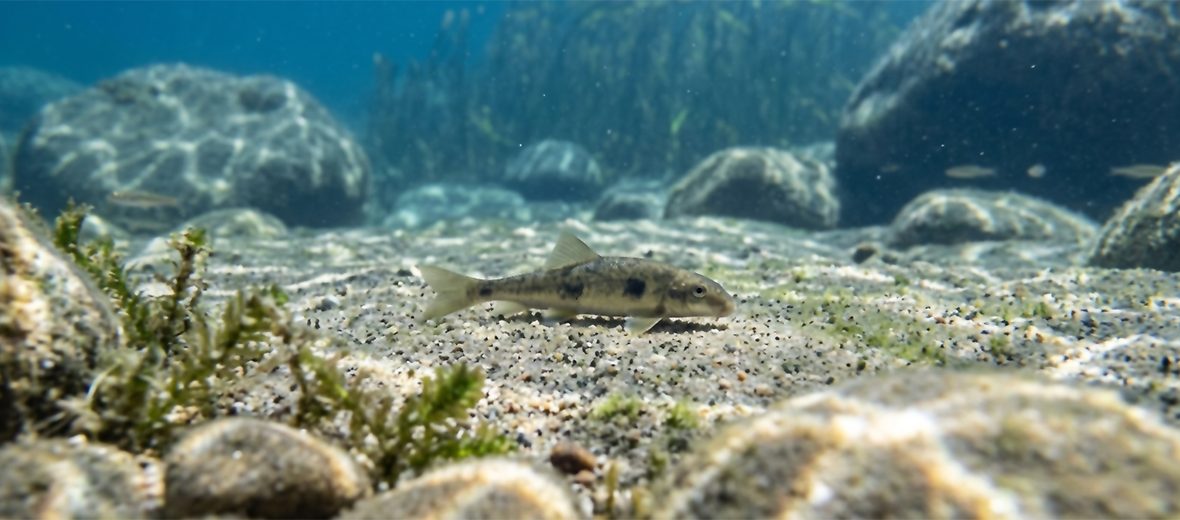
The Sacramento sucker, aka western sucker, is an inferiorly mouthed (lower positioned mouth) fish that hails primarily from lakes, rivers, and streams of California, but can also be found in Oregon and Nevada. They face the threat of water diversions that drastically reduce natural streamflows, while heavy groundwater pumping lowers lake levels and depletes the deep pools these fish rely on for survival. Poor land management practices lend to bank erosion and an excess of sedimentation, which smothers the gravel substrates these fish need for spawning. Also, manmade structures such as dams and poorly designed culverts act as physical barriers that block migration routes. Extended drought cycles can critically reduce water levels in lakes and tributary streams, leaving them highly vulnerable to desiccation (drying out) and higher water temperatures. Climate change exacerbates these chronic dry periods, threatening critical rearing and spawning habitats. The introduction of non-native species—like brown trout, yellow perch, and fathead minnows—poses a dramatic biological threat. These invaders directly compete with suckers for food and cover, and they also prey on sucker eggs and fry. Finally, in certain localized areas, there has been concern about hybridization between Sacramento suckers and threatened native species like the Modoc sucker. However, despite these threats, they are listed as Least Concern by the IUCN. Their population trend is listed as stable.
First the Stats…
Scientific name: Catostomus occidentalis
Weight: Up to 5 lbs.
Length: Up to 24 inches
Lifespan: Up to 30 years
Now on to the Facts!
1.) They have a terminally located mouth and medium to large sized lips that are covered with sensitive papillae which are largest in the middle rows. These help in removing algae from surfaces.
2.) These fish are sexually dimorphic as females are larger than males.
3.) Sacramento suckers were first formally described by the American biologist and physician W.O. Ayres in 1854.
4.) There are 4 subspecies recognized: C. occidentalis occidentalis, C. occidentalis humboldtianusi, C. occidentalis lacusanserinus, and C. occidentalis mniotilus.
5.) They are also hosts to several individual parasitic trematode flukes.
But wait, there’s more on the Sacramento sucker!
6.) The preferred habitats are deep pools, undercut banks, and/or clear streams of river ecosystems from cold to warm temperatures ranging from 68ºF – 77ºF, and can be found at a maximum elevation of up to 1,969 feet.
7.) This fish is nocturnal (active at night).
Did you know…?
They are an important food fish for the Native Americans of California.
8.) After a 1982 study, it was determined that these fish are not in competition with rainbow trout for habitat or food, seeing as suckers are bottom feeders and trout are mid to upper level feeders.
9.) Bald eagles often prey on these fish.
10.) Females lay up to 100,000 eggs each spawning season that hatch in up to 4 weeks.
Now a Short Sacramento Sucker Video!
Be sure to share & comment below! Also, check out the Critter Science YouTube channel. Videos added regularly. Be sure to like and subscribe!

Want to suggest a critter for me to write about? Let me know here.
Some source material acquired from: Wikipedia & IUCN