
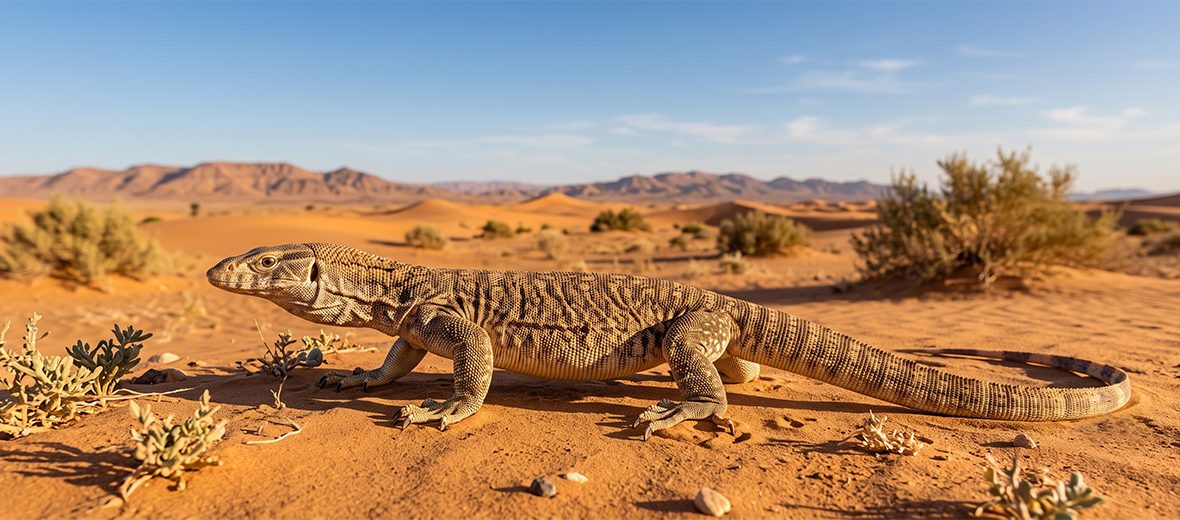
The desert monitor can be found in northern Africa, as well as central and southern Asia. They are part of the order Squamata, like all monitor lizards. These lizards face the threats of habitat loss and destruction at the hands of residential and commercial developments, farming, and ranching. Their daily routines, as well as reproduction attempts, are also interrupted by recreational activities. They are hunted for meat as well as trapped for the exotic pet trade as well as killed and sold as preserved curios to tourists. However, they are widespread and abundant in numbers, so the IUCN lists them as Least Concern. Their population trend is listed as decreasing though.
First the Stats…
Scientific name: Varanus griseus
Weight: Up to 6.3 lbs.
Length: Up to 5 feet, including the tail
Lifespan: Up to 17 years
Now on to the Facts!
1.) This monitor thrives in highly arid and semi-arid environments such as sandy deserts, sand dunes, steppe-like grasslands, and occasionally dry riverbeds (oueds), as well as rocky outcrops.
2.) Just like all species of lizards, they undergo periods of molting where they shed their outer layer of skin in order to expand their overall body size.
3.) They are superb swimmers and divers and have been documented diving into the water to hunt for prey.
4.) There are 3 recognized subspecies: the Caspian monitor, the Indian desert monitor, and the grey monitor.
5.) It has been disputed that all 3 subspecies should technically be elevated to full species status due to their parapatric distribution and genetic distance. Parapatric distribution is when a species whose geographic range(s) do not significantly overlap but are immediately adjacent to one another.
But wait, there’s more on the desert monitor!
6.) These monitors brumate (hibernation for reptiles) from September – April, exiting brumation in April in large numbers.
7.) Being cold-blooded ectotherms their body temperature and activity level is based upon the surrounding ambient temperature.
Did you know…?
As is the case in most, if not all, monitors they possess venom glands. Their bite causes nausea, vomiting, dizziness, muscle pain of eventually the entire body, rapid heartbeat, breathing complications, and diarrhea. Symptoms start in up to 20 minutes and can last upwards of 24 hours.
8.) Besides prey immobilization, their venom also contains protease, which is known to cause blood clotting disorders. However, it also helps to digest food through breaking down proteins.
9.) Mice, rats, gerbils, young hares, eggs, fish, smaller lizards, snakes, tortoises, birds, toads, beetles, orthopterans (grasshoppers), heteropteran bugs, ants, snails, centipedes, scorpions, and carrion (dead animals) are all on the menu.
10.) Females lay a clutch of up to 20 eggs each season that hatch in up to 120 days.
Now a Short Desert Monitor Video!
Be sure to share & comment below! Also, check out the Critter Science YouTube channel. Videos added regularly. Be sure to like and subscribe!

Want to suggest a critter for me to write about? Let me know here.
Some source material acquired from: Wikipedia & IUCN

Leave a Reply