
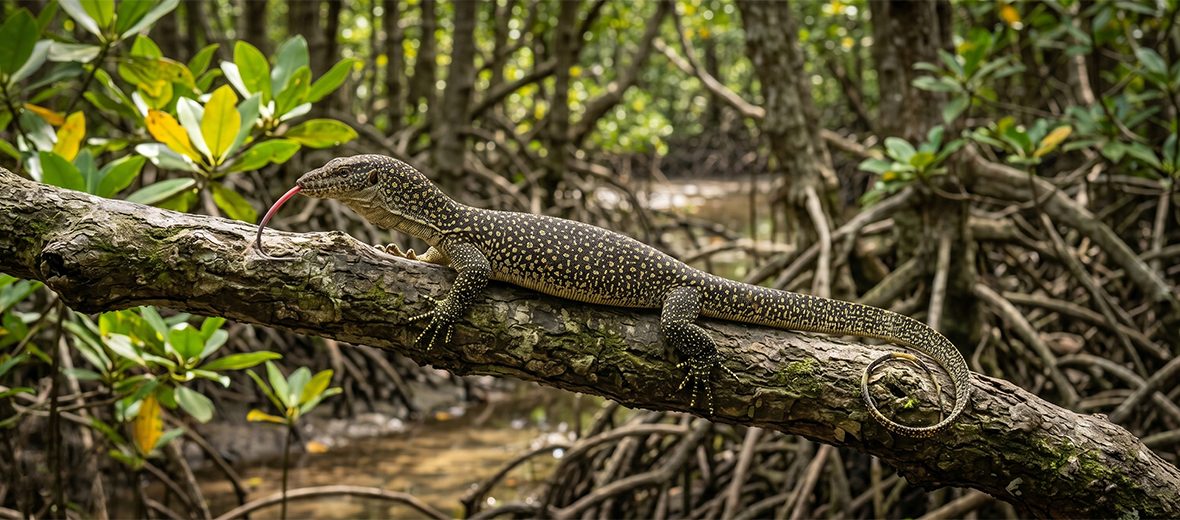
The mangrove monitor, aka mangrove goanna, western Pacific monitor lizard, or wbl yb in the Kalam language of Papua New Guinea can be found from northern Australia and New Guinea, to the Moluccas, and the Solomon Islands. These lizards face the threat of hunting for their meat and skin (which is used for making drums). They are also trapped and exploited for the pet trade. Finally, they are persecuted as agricultural pests, due to the chance they will attack and kill poultry and other smaller domesticated animals, like small dogs and domestic cats. However, these lizards are abundant enough to be listed as Least Concern by the IUCN. Their population trend is listed as unknown at this time though. Without further ado, enjoy Critter Science’s 2,000th article!!
First the Stats…
Scientific name: Varanus indicus
Weight: Up to 4 lbs.
Length: Up to 4.5 feet, including the tail
Lifespan: Up to 20+ years
Now on to the Facts!
1.) These monitors were first described by French herpetologist François Marie Daudin in 1802.
2.) The generic name Varanus hails from the Arabic word waral (ورل), which translates to “monitor”. Their specific name, indicus, is Latin for the country of India, however in this instance it relates to Indonesia or the East Indies, where these lizards were first described.
3.) Due to their large geographical range, these monitors are considered a species complex of at least 4 species: Varanus indicus, Varanus doreanus, Varanus spinulosus, and Varanus jobiensis.
4.) They prefer to dwell among damp forests close to coastal rivers, mangroves, as well as permanent inland lakes.
5.) These monitors have also been introduced to Japan back in circa 1940s.
But wait, there’s more on the mangrove monitor!
6.) Like other lizards, these critters have a Jacobson’s organ, which they use to detect prey, sticking their tongue out to gather scents and touching it to the opening of the organ when the tongue is retracted. This gives them a readout of their surroundings.
7.) Being an opportunistic predator, they eat a variety of items, such as eggs of reptiles and birds, mollusks, rats, mice, insects, crabs, smaller lizards, fish, juvenile crocodiles, and carrion (dead animals). They can also dive for fish.
Did you know…?
These monitors have the ability to increase the size of their mouth by spreading the hyoid apparatus and dropping their lower jaw to eat large prey, a process similar in appearance to that of snakes, although the jaw of these lizards stays rigid.
8.) Females lay up to 12 eggs that measure up to 1.97 inches in length.
9.) The eggs hatch in up to 8 months.
10.) In 1993, the first successful captive breeding of this species was achieved at the Philadelphia Zoo.
But wait, there’s still more on the mangrove monitor!
11.) In the Reptilian Zoo in Vlissingen, the Netherlands, there was a report of successful parthenogenetically hatched eggs. Parthenogenetic reproduction is where a female can reproduce offspring without the aid of a male’s fertilization.
12.) Since circa 1930s humans have both accidentally and intentionally introduced these lizards to numerous Pacific Islands. Much to the dismay of the existing local fauna.
Did you know…?
These monitors are frequently kept in zoos and private collections, as they are active and alert, and generally can be handled if tamed properly. Most specimens, however, will defecate (poop) on their handlers if stressed. They are also capable of delivering a painful bite.
13.) Individuals from Japan introduced these lizards to the Marshall Islands before World War II to eliminate the rat population; the lizards flourished and soon began to raid the local chicken coups.
14.) Even though international trade in this species is considered minute, they are thought to be 1 of the most heavily exploited monitor lizards.
15.) These lizards are diurnal (active during the day).
Now a Short Mangrove Monitor Video!
Be sure to share & comment below! Also, check out the Critter Science YouTube channel. Videos added regularly. Be sure to like and subscribe!

Want to suggest a critter for me to write about? Let me know here.
Some source material acquired from: Wikipedia & IUCN

Leave a Reply