
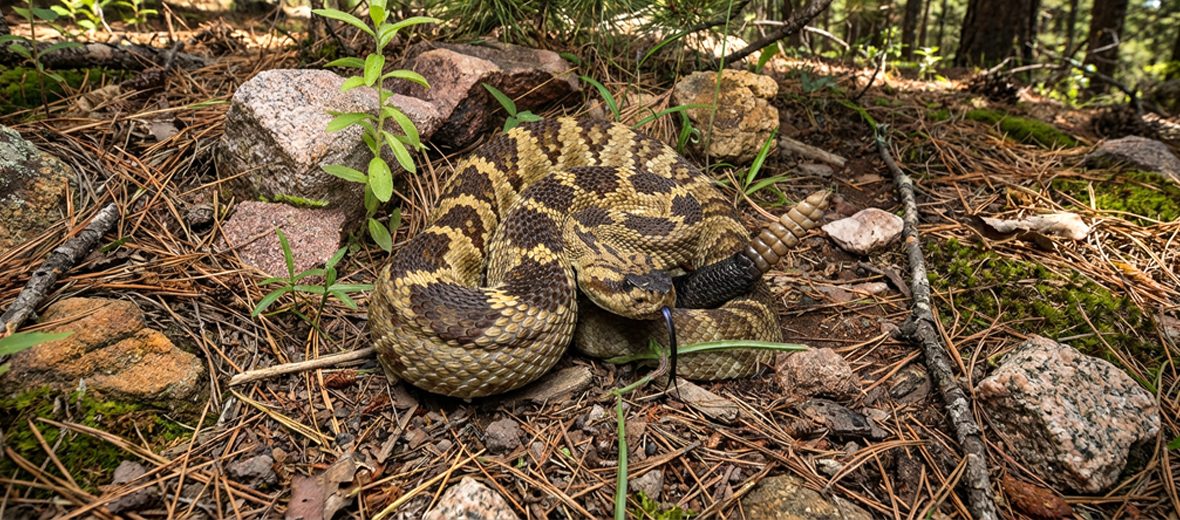
The black-tailed rattlesnake, aka green rattler or northern black-tailed rattlesnake, dwells in Mexico and southwestern United States. These rattlers face the threats of habitat loss and destruction at the hands of residential and commercial developments, farming, and ranching; division of habitats via roads and railroads, that can result in vehicle strike (being hit by vehicles); persecution, for fear of bites to livestock and humans; and climate change, that can cause habitat shifting and alteration via droughts and flooding. However, they are abundant enough to be listed as Least Concern by the IUCN. Their population trend is listed as stable.
First the Stats…
Scientific name: Crotalus molossus
Weight: Up to 10+ lbs.
Length: Up to 51 inches
Lifespan: Up to 20 years
Now on to the Facts!
1.) Like most other rattlesnakes, they have a rattle composed of keratin on the end of their tail. Each time they shed their skin, a new segment is added to the rattle.
2.) That being said, counting the buttons on a rattler’s tail is not an effective measurement of their age. This is due to the fact that buttons can break off and they can also shed several times a year.
3.) They can be found at elevations of up to 22,637 feet.
4.) Rats, mice, moles, gophers, squirrels, birds, and lizards are all on the menu.
5.) Throughout the fall and spring these rattlers are diurnal (active during the day), but during the summer months they shift to a nocturnal (active at night) lifestyle.
But wait, there’s more on the black-tailed rattlesnake!
6.) During the colder winter months, they will brumateThey will (hibernation for reptiles).
7.) They will change between sidewinding or rectilinear movement based on the type of substrate they’re traveling on.
Did you know…?
The venom of these rattlesnakes is primarily hemotoxic (destroys red blood cells & disrupts blood clotting), just like most rattlesnakes. However, they are only about 2/3rds as toxic as the western diamondback and are usually not fatal to humans. CroFab antivenom is often used to treat bites.
8.) These snakes have larger venom glands than most other rattlesnakes in their region. Because their venom is less toxic than that of most other rattlesnakes, they need to inject larger quantities into their prey to be effective.
9.) These rattlesnakes are mostly terrestrial (spend their lives on the ground), even though they are capable swimmers and can climb well.
10.) Their preferred habitats are grasslands, desert areas, rocky regions, mountainous areas, and high-altitude forests.
But wait, there’s still more on the black-tailed rattlesnake!
11.) Breeding happens in the spring, when the male tracks females via the pheromone trail she leaves behind.
12.) Mating can sometimes last for several hours and occur multiple times over a period of a few days. After mating, the male typically stays near the female for several days to prevent any other males from mating with her.
13.) Females undergo up to a 5 month gestation (pregnancy) that can yield up to 12 young.
14.) Breeding takes place every year, for the majority of the female’s life.
Now a Short Black-Tailed Rattlesnake Video!
Be sure to share & comment below! Also, check out the Critter Science YouTube channel. Videos added regularly!

Want to suggest a critter for me to write about? Let me know here.
Some source material acquired from: Wikipedia & IUCN

Leave a Reply