
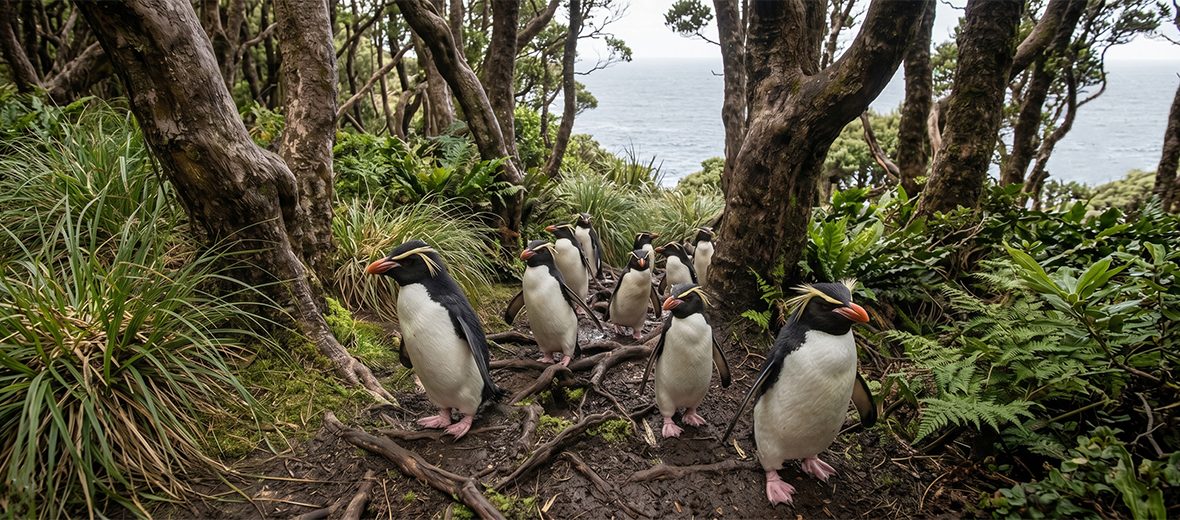
The Snares penguin, aka Snares crested penguin, Snares Islands penguin, or Pokotiwha (Māori), hails from the small island chains of New Zealand. These penguins face the threats of commercial fisheries, primarily squid fisheries, that these critters have to compete with for food. Pollution, mainly from oil spills, is another challenge these birds face. Finally climate change causes ocean warming which can drive their prey away, making it harder to find food. The IUCN lists these penguins as Vulnerable. Their population trend is listed as stable, for now.
First the Stats…
Scientific name: Eudyptes robustus
Weight: Up to 8.8 lbs.
Length: Up to 27.5 inches
Wingspan: Up to 27+ inches
Lifespan: Up to 25 years
Now on to the Facts!
1.) While Frederick Hutton originally collected these birds in 1874, these penguins were officially described by New Zealand ornithologist Walter Reginald Brook (W.R.B.) Oliver in 1953.
2.) These penguins are named after their breeding grounds—the Snares Islands.
3.) Little is known of their range outside of the breeding season, but sightings have been documented off the coasts of Tasmania, southern Australia, the Chatham Islands, Stewart Island, and the southern New Zealand mainland as well.
4.) Their calls range from hisses to explosive cries (when threatened), to a rhythmical braying and trumpeting that is audible from long distances at sea.
5.) Krill, smaller fish, squids, and octopuses are all on the menu, with krill being the most commonly taken prey. Broken down to 60% krill, 30% fish, and 10% cephalopods.
But wait, there’s more on the Snares penguin!
6.) Sea lions, leopard seals, and New Zealand fur seals all prey on adult penguins, while skuas and gulls attack chicks and any unattended eggs.
7.) These penguins nest in condensed colonies under the cover of the Olearia forests or among coastal rocks.
Did you know…?
There were only an estimated 63,000 wild individuals remaining, as of 2018.
8.) Nests consist of shallow holes dug in the ground with a layer on the bottom of grass, leaves, peat, pebbles, and/or twigs. A small rim of mud is also added to the rim of the nest to raise it slightly above ground level.
9.) Females lay 2 eggs up to 5 days apart. The 1st egg is smaller than the 2nd. However, the 2nd egg hatches before the 1st and the 2nd, larger chick typically outcompetes the 1st for food. Thus, the 1st chick ends up starving to death. This is known as siblicide. The 2nd egg hatches in up to 37 days.
10.) Both parents participate in egg incubation duties, as well as in taking turns searching for food for their chicks.
Now a Short Snares Penguin Video!
Be sure to share & comment below! Also, check out the Critter Science YouTube channel. Videos added regularly. Be sure to like and subscribe!

Want to suggest a critter for me to write about? Let me know here.
Some source material acquired from: Wikipedia & IUCN

Leave a Reply