
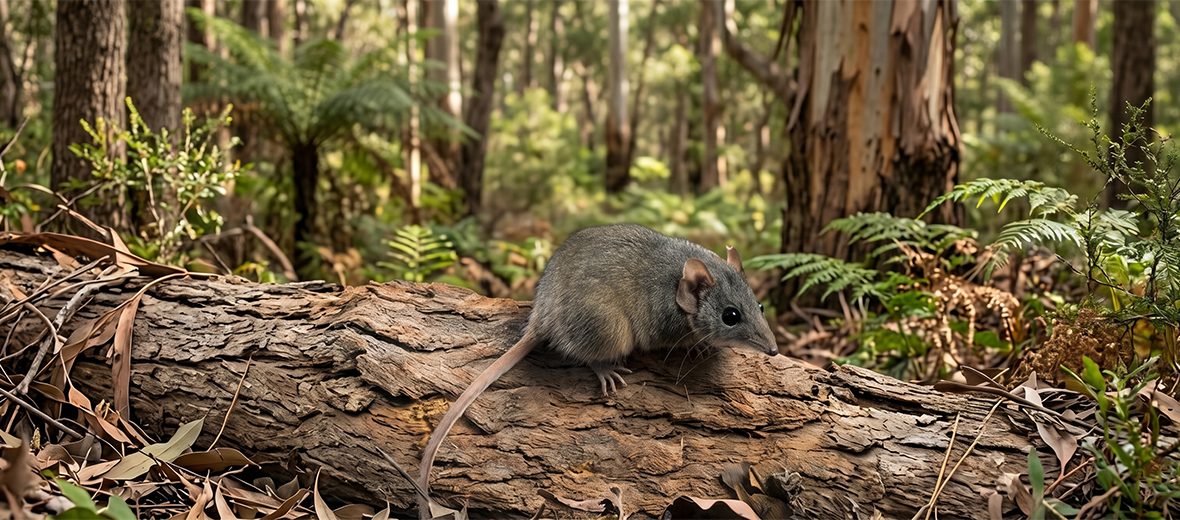
The Antechinus, aka broad-footed marsupial mouse, pouched mouse, or Antechinus shrew looks like a mouse but with the bristly fur and long face of a shrew. These small marsupials hail from Australia. They face the threat of climate change that causes warming temperatures which forces high-altitude antechinuses into shrinking mountaintop refuges. Another result of climate change is droughts and reduced rainfall that drives away their insect prey. Invasive species, like the red fox and feral cats, also threaten their survival. Habitat loss and destruction is another threat which comes in the forms of logging, urban development, and land clearing that destroys tree hollows, logs, and understories that they use for nesting and avoiding predators. Livestock and feral horses also trample their fragile ecosystems. Finally, intense megafires (like those that burned vast areas of the Bulburin National Park) destroy the critical leaf litter and vegetation cover they require to survive. That being said, most species of Antechinus are still listed as Least Concern by the IUCN. However, there are some species that are more imperiled.
First the Stats…
Scientific name: Antechinus
Weight: Up to 6 ounces
Length: Up to 12.2 inches, including their tail
Lifespan: Up to 3 years
Now on to the Facts!
1.) There are 15 recognized species of Antechinus that are separated into 4 clades.
2.) These critters tolerate a range of habitats such as forests, woodlands, rainforest, as well as heaths, and grasslands.
3.) Beetles, insect larvae, spiders, millipedes, and centipedes are all on the menu. However, after a fire, ants make up the bulk of their diet.
4.) Skinks and even feathertail gliders are also sometimes preyed on.
5.) These marsupials vary from arboreal (spend their lives in trees) to terrestrial (spend their lives on the ground), and these lifestyles are based mainly on the size of the species. Larger species tend to be ground dwelling, whereas smaller ones can be more arboreal.
But wait, there’s more on the Antechinus!
6.) Some individuals have been documented scraping slugs on rocks and other objects to remove the mucus to make them more palatable.
7.) Mating occurs over the course of a short 3-week period.
Did you know…?
Mating is quite intense and can last up to 12 hours in some species. Most males die as a result of breeding stress due to their bodies being flooded with the stress hormone cortisol, which causes systemic organ failure.
8.) The female can mate up to 3 times in their lifetime. Males mate only once.
9.) Females undergo up to a 35 day gestation (pregnancy) that yields up to 14 joeys.
10.) Joeys are weaned in up to 100 days.
But wait, there’s still more on the Antechinus!
11.) There are a few potential evolutionary advantages to the evolution of synchronous mating. It might ensure that as many matings as possible happen during the mating period. It also may ensure that males are able to focus all their effort into a single, short breeding season.
12.) These critters enter into torpor (a hibernation-like state) as a means of survival.
13.) Seeing as they are small mammals and have a high surface/volume ratio which results in high heat loss, as well as having a high metabolic rate and normothermic temperatures of around 95°F, torpor helps them to regulate their temperature and metabolic rate, and aids in survival.
14.) These marsupials are nocturnal (active at night) and spend their days in communal nests hidden from predators like boobook owls, tawny frogmouths, goshawks, and snakes.
Now a Short Antechinus Video!
Be sure to share & comment below! Also, check out the Critter Science YouTube channel. Videos added regularly. Be sure to like and subscribe!

Want to suggest a critter for me to write about? Let me know here.
Some source material acquired from: Wikipedia & IUCN

Leave a Reply