
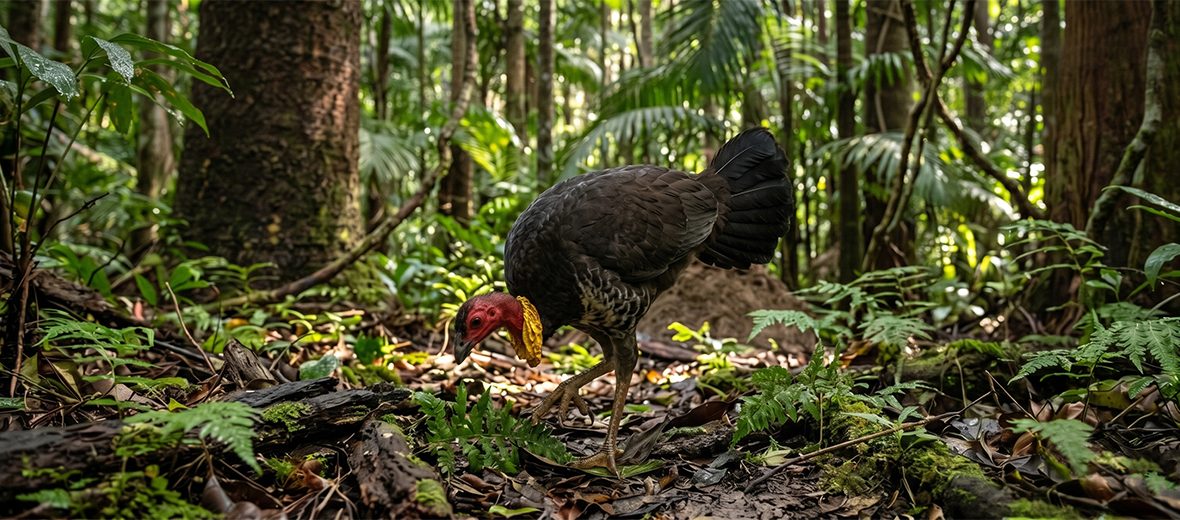
The Australian brushturkey, aka Australian brush-turkey, gweela, bush turkey, scrub turkey, or brushturkey, hails from eastern Australia. They can be found in Far North Queensland, the south coast of New South Wales, and has been introduced to Kangaroo Island in South Australia. These birds face the threat of habitat loss and destruction due to rainforests and coastal scrublands clearing for residential and commercial developments. Invasive feral pigs also dig up their mounds which often leads to the death of entire clutches. They also face vehicle strike (being hit by vehicles). Uncontrolled wildfires and fire management tactics also destroy valuable leaf litter used to build nests. However, these birds are abundant enough to be listed as Least Concern by the IUCN. Their population trend is listed as decreasing though.
First the Stats…
Scientific name: Alectura lathami
Weight: Up to 6.6 lbs.
Length: Up to 29.5 inches
Wingspan: Up to 33.5 inches
Lifespan: Up to 25 years
Now on to the Facts!
1.) Contrary to their resemblance to other game birds, these critters are not closely related to the American turkey.
2.) These birds prefer rainforests, wet sclerophyll forests (dominated by trees or shrubs with hard, leathery, evergreen leaves), drier scrubs, and open areas.
3.) They are now quite common in urban environments and can often be found in backyards in both Brisbane and Sydney.
4.) Being clumsy flyers, these birds only take to flight when approached by a predator or to roost in trees at night or during hotter days. But they cannot fly long distances.
5.) Large nests are built on the ground and constructed of leaves, other compostable material, and dirt. They typically measure up to 4.9 feet across.
But wait, there’s more on the Australian brushturkey!
6.) Females lay up to 27 eggs that hatch in up to 65 days. However, nests are often communal, so up to 58 eggs can sometimes be found in a single nest.
7.) Chicks are born precocial (fully developed at birth) and can fly in just hours after hatching.
Did you know…?
Just like some reptiles, nest/egg temperature dictates gender. The hotter the temperature, the more females will develop. Whereas cooler temperatures yield mostly males.
8.) Dingoes, dogs, goannas, snakes, and Aboriginal Australians all prey on their eggs.
9.) They exhibit little fear and frequently and boldly attempt to steal food from tables at camping and picnic areas, and also raid compost bins.
10.) These birds are fully protected in Queensland. Under the Nature Conservation Act 1992 it is an offense to harm them and carries a steep fine and the potential of up to 2 years in prison.
11.) Brushturkeys are diurnal (active during the day).
Now a Short Australian Brushturkey Video!
Be sure to share & comment below! Also, check out the Critter Science YouTube channel. Videos added regularly. Be sure to like and subscribe!

Want to suggest a critter for me to write about? Let me know here.
Some source material acquired from: Wikipedia & IUCN

Leave a Reply