
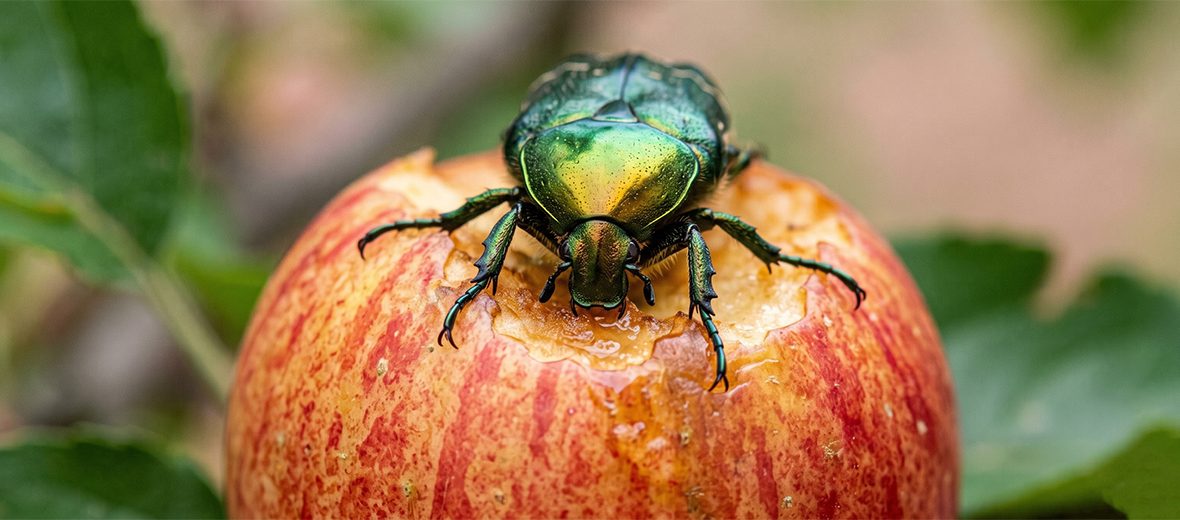
The copper chafer, aka rose chafer, can be found from the Canary Islands, to Portugal, and Spain, west towards Vladivostok in the Russian far east, to Mongolia, and North China. These insects face the threat of habitat loss and destruction at the hands of forest management that removes leaf matter and decaying logs. Due to the fact that they forage for pollen and nectar in orchards and flowering plants, and develop in the soil, broad-spectrum insecticides pose a direct threat to their survival. Because they depend on stable, moist environments for egg-laying and larval development, prolonged droughts or rapid, extreme weather fluctuations brought on by climate change disrupt their sensitive life cycles. However, these beetles are abundant and wide spread and thus listed as Not Evaluated by the IUCN. Their population trend is listed as stable.
First the Stats…
Scientific name: Protaetia cuprea
Weight: Up to .05 ounce
Length: Up to .91 inch
Wingspan: Up to .82 inch
Lifespan: Up to 2 years
Now on to the Facts!
1.) Blackbirds and jays dig up soil and excavate decaying logs to get at the fat, tasty grubs. While orb weaver spiders and huntsmen spiders snare adults in their webs. Lizards feast on the adults as well.
2.) The adult beetles feast on pollen from flowers and also on fruits, such as apples, from trees. Grubs feed on rotting wood and decaying plant matter.
3.) They have a strong flight ability which allows them to target and land on flowers with ease.
4.) Copper chafers tolerate a wide range of habitats from dense forests to the more open and arid steppe regions, indicating their broad ecological tolerance.
5.) A study highlighted the possible agricultural benefits of utilizing the larvae of these beetles in composting organic materials, including kitchen waste and various types of leaves.
But wait, there’s more on the copper chafer!
6.) Females lay up to 100 eggs that hatch in up to 4 weeks.
7.) Once the eggs hatch, female beetles have been documented showing maternal care by actively tending to her larvae, ensuring they have access to suitable food resources and protection from predators, parasites, and environmental issues.
Did you know…?
Compost derived from kitchen waste processed by the larvae of these beetles contained higher levels of essential nutrients such as nitrogen, potassium, and phosphorus compared to traditional vermicompost (composting using worms).
8.) Their flight speed is up to .9 mph.
9.) Even though these beetles are beneficial in the larval stage, adults are considered pests, as they feast on fruit from trees.
10.) The application of insecticides is typically restricted during phases such as flowering and just before harvest to protect beneficial insects like honey bees and to avoid health hazards. Mass trapping is a preferred method to slow the adult’s destruction of fruit production.
Now a Short Copper Chafer Video!
Be sure to share & comment below! Also, check out the Critter Science YouTube channel. Videos added regularly. Be sure to like and subscribe!

Want to suggest a critter for me to write about? Let me know here.
Some source material acquired from: Wikipedia & IUCN


Leave a Reply