
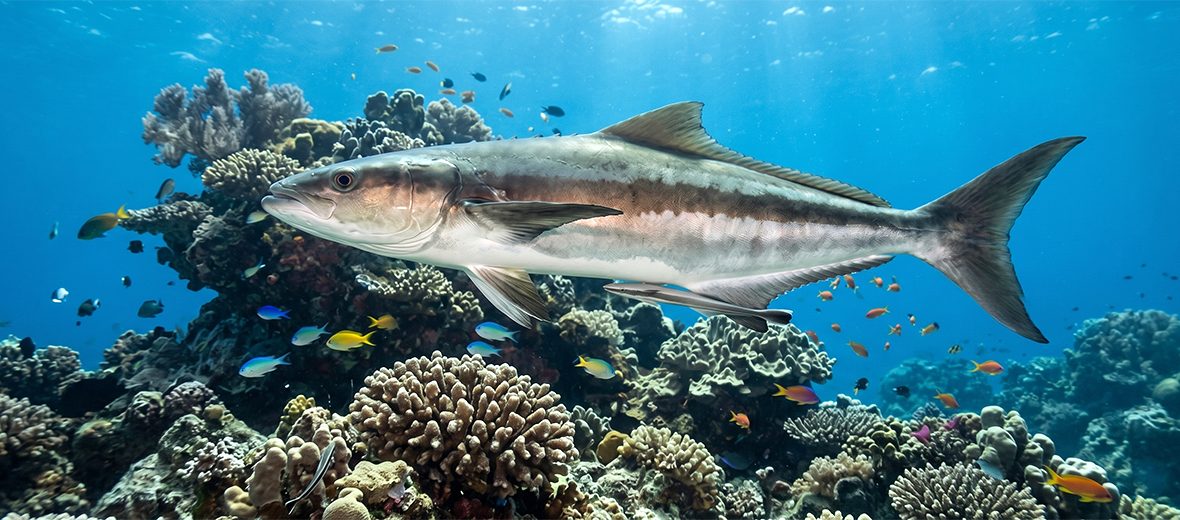
The cobia, aka black kingfish, black salmon, codfish, crabeater, ling, lemonfish, prodigal son, and black bonito, is a migratory fish that can be found in the Pacific, Atlantic, and Indian Oceans. They face the threat of overfishing from commercial and sport fishing ventures. Climate change effects water temperatures and alters oxygen levels in estuaries and spawning bays affect food availability and reproduction success. Habitat loss and degradation in the form of coastal development, water pollution, and the loss of reef and seagrass structures degrade essential feeding and nursery grounds. In captive and commercial aquaculture environments, these fish are particularly sensitive to high nutritional and environmental requirements. They are highly susceptible to parasitic, bacterial, and viral infections, that can lead to high mortality rates. However, these fish are widespread and abundant so they are listed as Least Concern by the IUCN. Their population trend is listed as unknown.
First the Stats…
Scientific name: Rachycentron canadum
Weight: Up to 175.5 lbs.
Length: Up to 6.5 feet
Lifespan: Up to 15 years
Now on to the Facts!
1.) They prefer warm-temperate to tropical waters.
2.) In several locations these fish have been reported as an introduced species, that likely escaped from mariculture establishments.
3.) Cobias are typically solitary sans for annual spawning aggregations, and they sometimes congregate around reefs, wrecks, harbors, buoys, and other structural oases.
4.) There is a resemblance to their close relatives, the remora. But these critters lack a sucker shaped mouth.
5.) These fish undergo seasonal migrations. They winter in the Gulf of Mexico, then move north as far as Massachusetts for the summer, passing Florida close to March.
But wait, there’s more on the cobia!
6.) While typically pelagic, they can sometimes be seen in estuaries and among mangroves in search of prey.
7.) Crabs, fish, and squids are all on the menu.
Did you know…?
These fish ask a high price for their firm texture and excellent flavored meat.
8.) As is the case with remoras, they follow larger animals like sharks, turtles, and manta rays and scavenge for food remnants.
9.) The mahi-mahi and the mako shark both prey on these fish.
10.) They are often parasitized by nematodes, trematodes, cestodes, copepods, and acanthocephalans. They are also susceptible to numerous parasitic and bacterial infections like Amyloodinium species, Photobacterium damselae subspecies, piscicida, and Lactococcus garvieae.
But wait, there’s more on the cobia!
11.) These fish are pelagic spawners (releases eggs and sperm directly into the open water column) and those eggs become part of the plankton.
12.) Females lay upwards of 2,000,000 eggs and can spawn up to 30 times each season!
13.) Upwards of 80% of marine cages in Taiwan are devoted to cobia cultures.
14.) These fish are both diurnal (active during the day) and crepuscular (active at dawn and dusk).
Now a Short Cobia Video!
Be sure to share & comment below! Also, check out the Critter Science YouTube channel. Videos added regularly. Be sure to like and subscribe!

Want to suggest a critter for me to write about? Let me know here.
Some source material acquired from: Wikipedia & IUCN


Leave a Reply